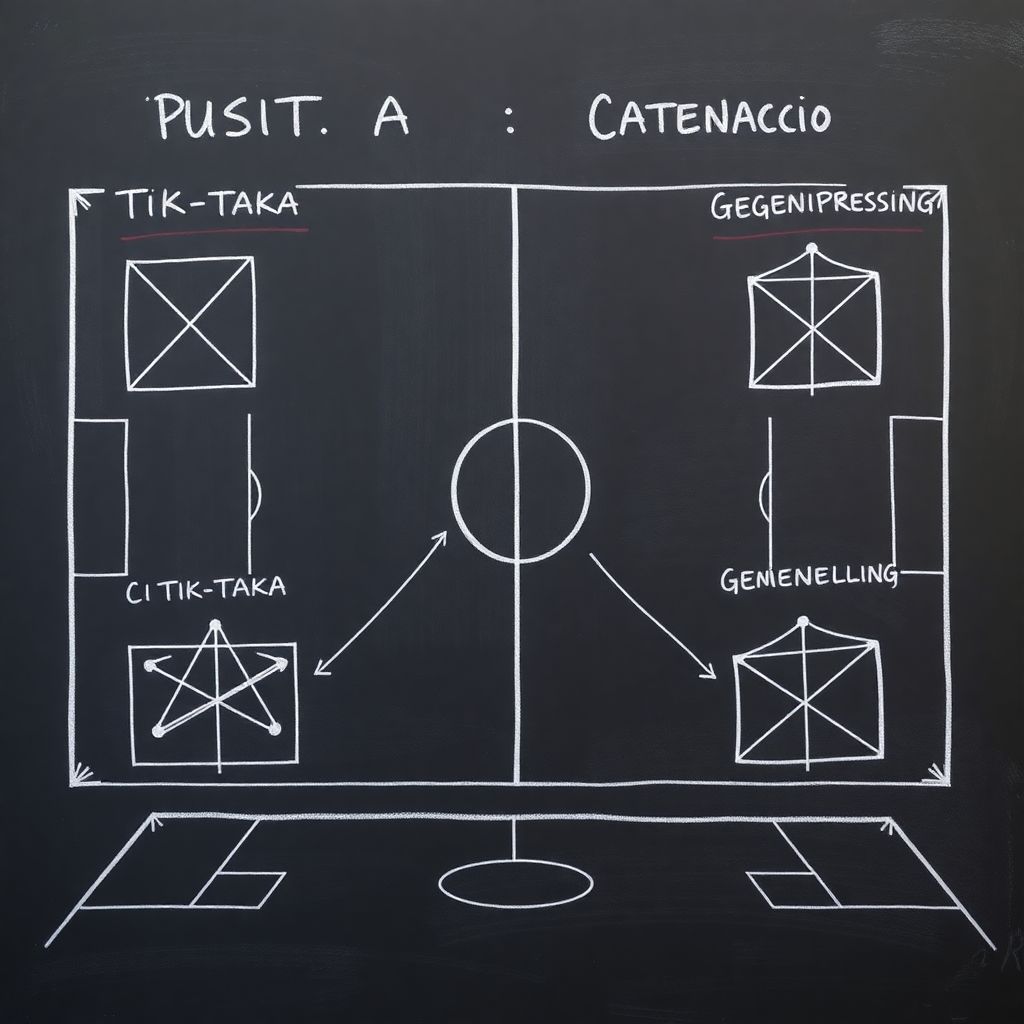
Tiki-taka, catenaccio and gegenpressing are three full-life philosophies: control, resistance and constant attack on chaos. The best choice depends on your squad’s technical level, fitness, emotional profile and club culture. In Spanish grassroots or amateur contexts, blending elements usually beats copying elite models, especially when budgets and training time are limited.
Essence at a Glance: Tactical Philosophies as Life Choices
- Tiki-taka: patience, trust in the ball and short passing as a way to control the match and emotions.
- Catenaccio: discipline, suffering together and valuing clean sheets as much as goals.
- Gegenpressing: courage, aggression and collective intensity as a default response to any setback.
- For most intermediate teams, partial adoption (e.g. tiki-taka in build-up, gegenpressing when losing the ball) is more realistic than pure dogma.
- Your players’ technical quality, fitness level and psychological comfort with risk should guide the tactical «life choice».
Roots and Worldviews: How Each System Frames Football and Life
Before thinking of formations, decide which view of the game and of life you want your team to live every weekend. Use these criteria to choose between tiki-taka, catenaccio and gegenpressing or a hybrid version:
- Relationship with risk: tiki-taka accepts risk in your own half to gain control later; catenaccio minimises risk everywhere; gegenpressing accepts chaos to attack quickly.
- View of the ball: tiki-taka treats the ball as protection; catenaccio as a rare weapon used sparingly; gegenpressing as a trigger to hunt immediately after losing it.
- Attitude to suffering: catenaccio embraces long periods without the ball; tiki-taka suffers when it cannot circulate; gegenpressing suffers when it cannot press.
- Time horizon: tiki-taka is long-term and process-based; catenaccio is moment-based (next defensive action); gegenpressing is ultra-short-term (first seconds after loss).
- Player empowerment: tiki-taka promotes creative combinations within a structure; catenaccio restricts freedom to guarantee compactness; gegenpressing empowers effort and bravery.
- Training culture: tiki-taka needs many touches and rondos; catenaccio needs repetition of blocks and shifts; gegenpressing needs repeated pressing and transition games.
- Compatibility with Spanish amateur football: many squads in es_ES have good technique but inconsistent fitness; this often suits tiki-taka with conservative rest defence or selective gegenpressing.
- Club identity: think whether your club wants to be remembered for elegance (tiki-taka), defensive steel (catenaccio) or relentless energy (gegenpressing).
- Education tools: choose libros sobre tácticas de fútbol tiki taka catenaccio gegenpressing and video resources that match the worldview you want to transmit to your players.
Core Principles Compared: Possession, Defence and Immediate Recovery
The table below contrasts the three main philosophies from the point of view of an intermediate coach in Spain, balancing ideals with budget, training time and player profiles.
| Variant | Ideal profile | Key advantages | Main drawbacks | When to choose |
|---|---|---|---|---|
| Tiki-taka | Technically solid team, patient players, club that values style and possession. | Controls rhythm, reduces random transitions, develops intelligent decision-making, fits skilful but not very physical players. | Vulnerable to fast counters if rest defence is poor; needs many training hours; fans may be impatient when circulation is slow. | Use when you have ball-loving players and can train at least twice per week; especially in youth teams and on good quality pitches. |
| Catenaccio | Disciplined, humble squad, strong central defenders and a good goalkeeper. | Simple to organise; protects weaker teams; maximises value of set-pieces and individual quality in transition. | Can limit development of creative players; physically and mentally tiring without the ball; hard to change result if you concede first. | Use when you are underdog, when squad is physically strong but not very technical, or when the pitch is small and poor. |
| Gegenpressing | Very fit, aggressive players with high work-rate and collective mentality. | Turns losses of possession into chances; keeps opponents under permanent stress; creates strong team spirit. | High injury risk if fitness base is low; demanding to coach; intensity may drop in hot climates or with small squads. | Use when you have young, energetic squads, deep benches and can invest in fitness; ideal in competitive regional leagues. |
| Hybrid (Tiki-taka + Gegenpressing) | Technically good but also brave squad, with coach ready to study modern trends. | Possession plus immediate recovery; suits many Spanish teams; flexible against different rivals. | Complex for beginners; requires clear rules for when to press and when to drop; mistakes in spacing are punished. | Use when you can follow a curso online de táctica de fútbol tiki taka y presión alta and slowly implement ideas session by session. |
If you want a deeper, structured framework, consider an análisis táctico profesional tiki taka vs catenaccio as your personal study project: break down 3-5 matches of each style and link every principle you see to a concrete training drill.
Mechanics in Play: Typical Formations, Roles and Phase Transitions
Translate philosophies into simple «if-then» rules so players know what to do in real match situations, including budget and premium options.
- If your centre-backs are calm on the ball and your pivot understands orientation, then:
- Budget variant: use a 4-3-3 or 4-2-3-1 tiki-taka base with short build-up but allow occasional long switch to full-backs.
- Premium variant: add detailed positional play, third-man runs and strict zones, ideally after studying clinics and seminarios de táctica de fútbol moderna gegenpressing and possession games.
- If your team panics under high press, then:
- Budget catenaccio: switch to 5-3-2 or 4-4-2 low block, train clearances to wide areas and fast counter with two players only.
- Premium adaptation: integrate a flexible mid-block that steps up on triggers (bad touch, back-pass) and rehearsed counters with 3-4 players.
- If your squad is young, very fit but technically irregular, then:
- Budget gegenpressing: simple rule «lose the ball, sprint towards it for 5 seconds». Use 4-3-3 or 4-2-3-1 with narrow wingers.
- Premium gegenpressing: design pressing traps (forcing play wide or inside), synchronised jumps from striker and 10, and rest defence with at least three players.
- If you have mixed profiles (some technical, some physical), then:
- Budget hybrid: tiki-taka in your own half, but if you lose it, nearest 3 players press, rest drop to compact lines.
- Premium hybrid: build structured pressing from tiki-taka shapes, with pre-agreed triggers and rotations, possibly supported by an entrenador táctico especializado en tiki taka y gegenpressing for periodic consultancy.
- If training time is limited (1-2 sessions per week), then:
- Emphasise simple automated behaviours: line depth, distances and one or two clear pressing cues.
- Use small-sided games that simultaneously train possession and pressing to reduce need for extra fitness work.
- If your budget is extremely low, then:
- Base your work on free content and libros sobre tácticas de fútbol tiki taka catenaccio gegenpressing from local libraries.
- Film matches with a phone and run your own análisis táctico profesional tiki taka vs catenaccio or vs gegenpressing to adapt ideas gradually.
Tactical Outcomes vs Human Outcomes: Team Identity, Discipline and Joy
Use this quick checklist to choose and communicate your «life philosophy disguised as tactics».
- Define your non-negotiable: joy with the ball, security without the ball or energy in transition. Match it with tiki-taka, catenaccio or gegenpressing respectively.
- Assess your current reality: training days per week, pitch quality, squad size, fitness base, technical level and age.
- Choose one primary macro-principle (keep the ball, protect the box, press immediately) and one secondary (e.g. tiki-taka primary, gegenpressing secondary).
- Translate principles into 3-5 simple rules for each phase (build-up, finishing, defensive block, pressing after loss) and repeat them every session.
- Design or find 3 low-cost drills per principle; many curso online de táctica de fútbol tiki taka y presión alta packages already group exercises like this.
- Communicate clearly to players and parents that success is not only scoreboards but also identity: how we suffer, how we enjoy, how we react to mistakes.
- Review every 6-8 matches: adjust balance between tiki-taka, catenaccio and gegenpressing elements instead of jumping to a totally new philosophy.
Strengths, Weaknesses and Predictable Counters
Typical mistakes when choosing and implementing these tactical «life paths»:
- Copying elite teams’ tiki-taka or gegenpressing without adapting to amateur training time, pitch quality or player motivation.
- Confusing catenaccio with simple «parking the bus» and ignoring coordinated pressing cues and counter-attacking patterns.
- Asking for high-intensity gegenpressing with unfit squads and no progressive physical preparation, leading to injuries and frustration.
- Overcomplicating positional rules for tiki-taka with young or low-experience players who still struggle with basic control and passing.
- Ignoring psychological fit: some players love suffering in a low block, others shut down when defending for long periods.
- Failing to invest in staff education: refusing a short curso online de táctica de fútbol tiki taka y presión alta or avoiding clínicas y seminarios de táctica de fútbol moderna gegenpressing that could save months of trial and error.
- Not preparing counters: every philosophy has vulnerable zones (space behind full-backs in tiki-taka, flanks against narrow catenaccio, long balls behind aggressive lines in gegenpressing).
- Switching systems every week after a bad result, preventing the team from consolidating automatisms and identity.
- Using only static drills instead of match-like games; this disconnects training from the emotional reality of competition.
Adopting These Philosophies on a Budget: Practical Drills and Priorities
Tiki-taka is usually best for technically oriented Spanish squads with limited physical resources, catenaccio for clear underdogs or physically strong but less skilful teams, and gegenpressing for young, energetic groups; on a budget, mix simple possession games, compact-block work and 5-second pressing rules rather than chasing a pure model.
Common Practitioner Questions and Short, Practical Answers
How do I start implementing tiki-taka without losing every match to counters?
Begin with simple rest-defence rules: when the ball is on one side, opposite full-back stays, pivot holds central space and centre-backs stay connected. Use small-sided possession games with two «rest defenders» always in position to train balance.
Can catenaccio help player development in youth football?
Yes, if you use it to teach compactness, communication and defensive timing, not just deep defending. Combine it with ball-oriented exercises and some build-up work so players still improve technically and can later expand into more proactive styles.
Is gegenpressing realistic for amateur teams with one or two weekly sessions?
It is realistic in a simplified version: teach a 5-second sprint rule after loss, keep lines short and train pressing in game-based drills. Avoid complex traps until the basic fitness and coordination of the group are solid.
What formations are most flexible if I want to mix tiki-taka and gegenpressing?
4-3-3 and 4-2-3-1 are the most adaptable because they allow triangles for possession and clear pressing roles for wingers and attacking midfielder. Use them as «shells» to move between a more patient build-up and aggressive pressing after loss.
How can I educate myself without hiring an external tactical coach?
Combine libros sobre tácticas de fútbol tiki taka catenaccio gegenpressing, free match analyses online and your own recordings. If possible, add at least one curso online de táctica de fútbol tiki taka y presión alta or short clínicas y seminarios de táctica de fútbol moderna gegenpressing to see how professionals structure their teaching.
What is the simplest measurable goal for each philosophy at amateur level?
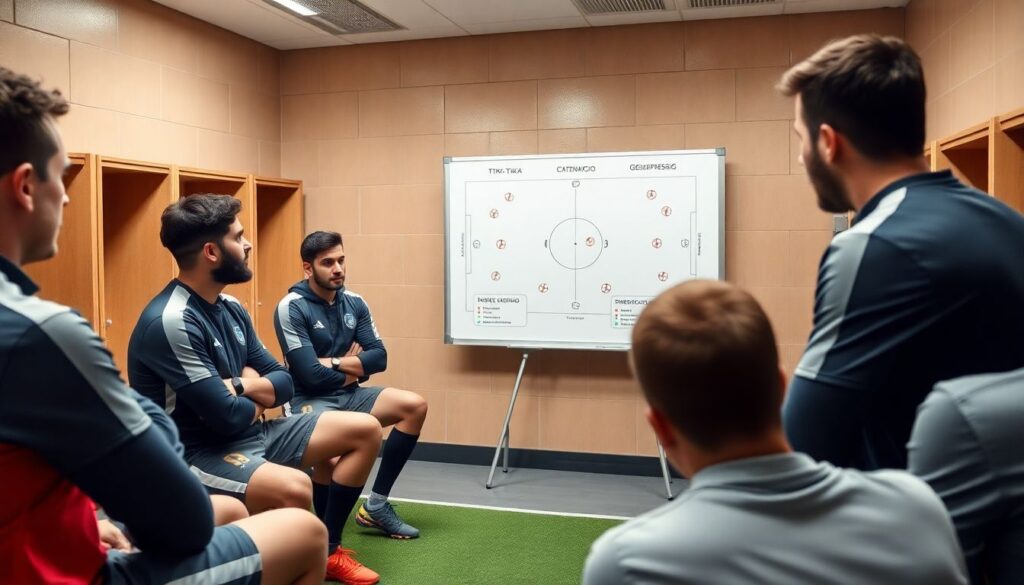
For tiki-taka, track number of controlled 3+ pass sequences per match; for catenaccio, shots conceded from inside your box; for gegenpressing, ball recoveries within 5 seconds after loss. Choose one indicator and review it with your team monthly.
How do I convince parents and club directors to support a long-term tactical project?

Explain clearly how tiki-taka, catenaccio or gegenpressing will help players as people: decision-making, resilience or work ethic. Share your plan, expected learning stages and simple metrics, and show small video clips each month so they see visible progress.