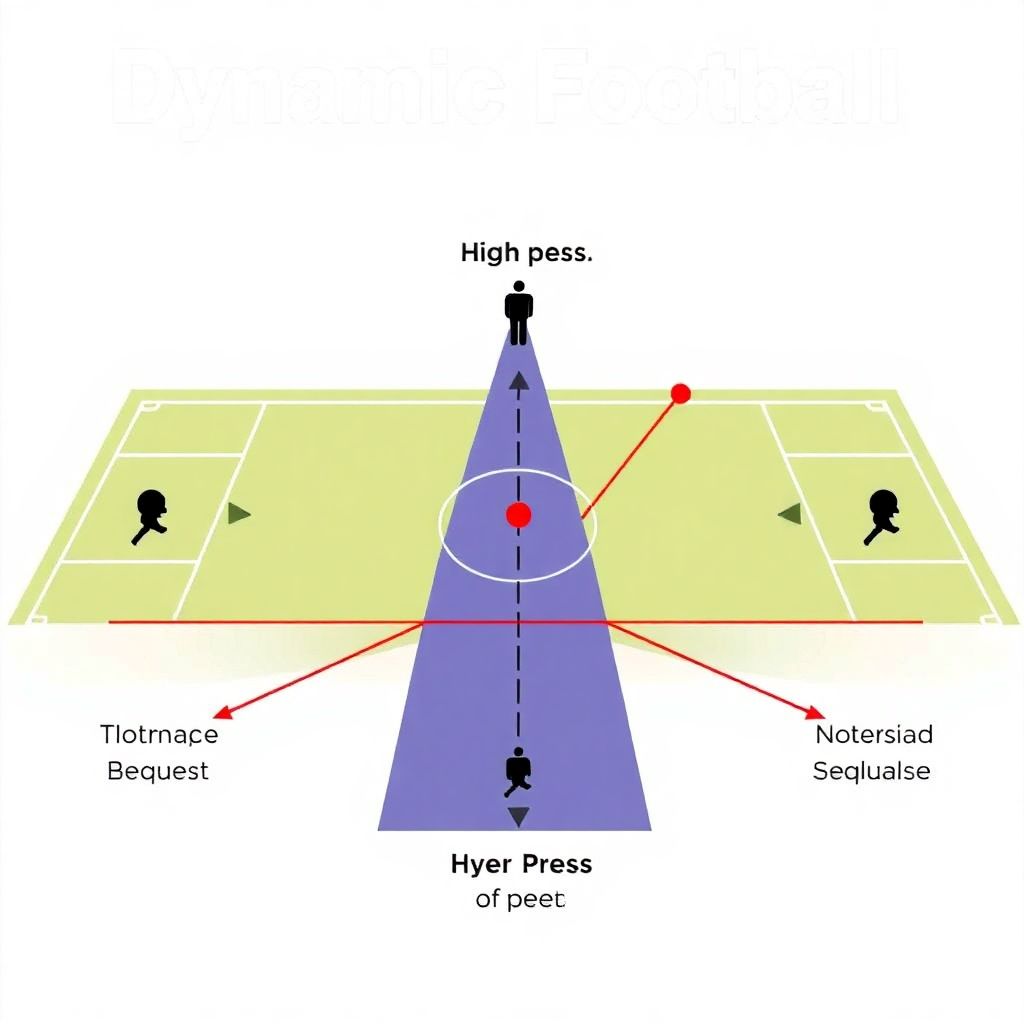
High press, low block and counterattack are three ways of organising time and space in football: accelerate time around the ball, slow it down in your half, or explode forward in transition. Understanding when each shape compresses or expands metres and seconds is the core of intelligent tactical decision‑making.
Core Concepts: Time and Space in Pressing, Blocking and Counters
- High press speeds up time for the opponent by shrinking their usable space, often within 25-30 metres of their goal.
- Low block slows the game by denying depth and central lanes, forcing harmless possession far from your box.
- Counterattack converts defensive recovery into forward acceleration, turning regained seconds and metres into chances.
- Every tactical choice redraws the geometry of passing lines, cover shadows and pressing triggers.
- Training must link perception (who, where, when) with action (press, hold, run) in specific field zones.
- Video, data and even simple software de análisis táctico fútbol para estudiar tiempo y espacio en el juego can sharpen these judgments.
High Press: Temporal Urgency and Spatial Compression
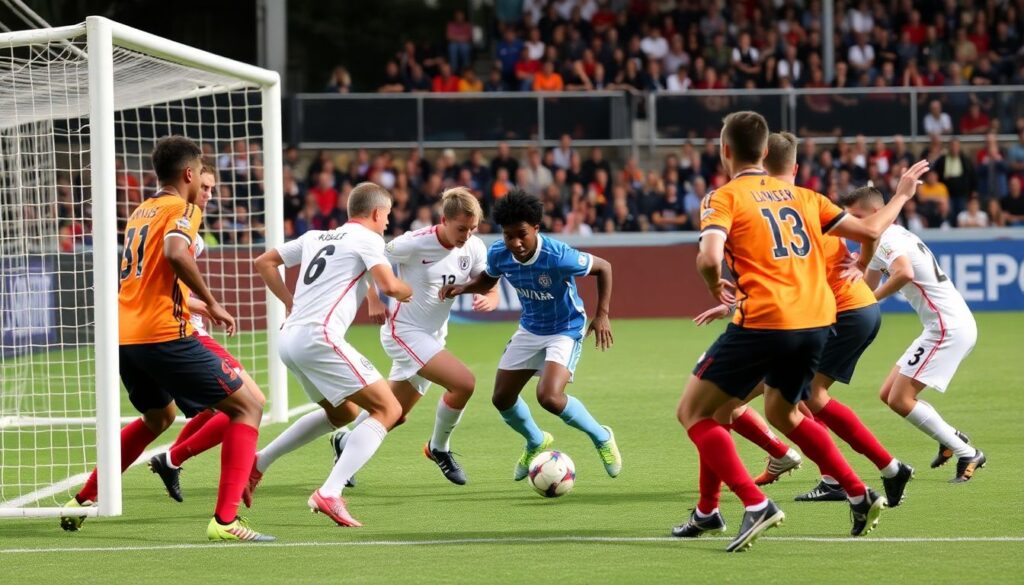
High press is a collective attempt to win the ball close to the opponent’s goal by compressing space and time around their first passes. The team defends in the attacking or middle third, usually within a compact block of about 25-30 metres vertically.
Temporally, the idea is to reduce the opponent’s decision window from several seconds to a fleeting instant. When the centre-back receives, he should feel pressure in under one second, with passing options cut off by coordinated marking. Spatially, forwards and midfielders climb high, squeezing the pitch so that long balls become hurried and imprecise.
Philosophically, high pressing treats time as something to be stolen. Every forward run is an attempt to make the opponent play earlier than they want, in zones they did not choose. Space becomes expensive: the opponent must pay for every free metre with perfect technique and quick orientation.
Mini-scenario: high press after a backward pass
Your 9 curves the run to screen the pivot; the opponent’s right centre-back receives facing his own goal at 20 metres from the box. In the next two seconds: the 9 presses the ball, the winger jumps to full-back, the 10 closes the lane inside. One forced long ball, your back line ready to win the duel and attack again.
Resources such as libros de táctica de fútbol presión alta y contraataque and any good manual de entrenamiento presión alta y contraataque para entrenadores de fútbol often stress this choreography of time and distance: when the trigger appears, six or seven players must react almost as one.
Low Block: Creating Time Through Space Denial
Low block is defending close to your own penalty area with many players behind the ball, prioritising compactness over pressing height. Instead of stealing time actively, you create time by denying depth and central space, forcing the opponent to circulate the ball harmlessly.
Main mechanisms that make a low block work:
- Vertical compactness: Back four and midfield line stay within roughly 10-15 metres, so no easy passes «between the lines». The opponent can have the ball, but not between your lines or behind them.
- Central lane closure: 6 and 8 protect the zone in front of the box (the «red zone»). Shots from 20-25 metres are accepted; split passes into the box are not.
- Wide invitations: You deliberately leave space for switches to the wing, where your full-back and winger can double up and force crosses from unfavourable angles, often 25-30 metres from goal.
- Delayed pressure: You do not sprint to press every reception. The line waits until the opponent’s touch is poor or his body is closed, then steps together to recover the ball or at least push them backwards.
- Resting with the ball in mind: Even while defending deep, your fastest players position themselves where a clearance can become the first pass of a counter, not just a random long ball.
In a good curso online de análisis táctico en fútbol bloque bajo y transiciones you usually study how this denial of depth adds seconds to your own team’s decision-making: you are not chasing the ball; you are shaping where it is allowed to go.
Counterattack: The Temporality of Transition and Spatial Opportunism
Counterattack is the art of turning regained possession into immediate, vertical progress before the opponent reorganises. It is pure temporality: you attack not because you have the perfect structure, but because the opponent’s structure is momentarily broken.
Typical counterattacking scenarios:
- Recovery after a risky through ball: Your centre-back intercepts a pass on the edge of the box. He has about two seconds before pressure arrives. A vertical 20-25 metre pass into the 10 between lines opens space for a 30-40 metre run from the winger.
- Pressing trap near the touchline: In a high press, you steer the opponent to one side. Three players surround their full-back, win the ball, and immediately play a diagonal pass into the half-space on the opposite side, attacking a weak far-side defender.
- Clearance turned into lay-off: From a low block, the 9 intentionally positions on the shoulder of the holding midfielder. A long clearance of 40-50 metres is not just escape; it is a target ball. The 9 cushions it back to a late runner, and the team attacks with three players.
- Stolen second ball on set play: After defending a corner, the opponent leaves many players ahead of the ball. Your 6 wins the second ball about 25 metres from your goal and instantly plays into the channel where your winger is sprinting behind a disorganised full-back.
- Transition after blocked shot: The opponent shoots from 18 metres, your keeper catches and releases within three seconds with a throw into open space on the flank, exploiting 30-40 free metres before defenders can reset.
Philosophically, counterattack is the celebration of contingency: you do not control when the ball is lost or won, but you prepare your structure so that any regain has a clear, pre-planned direction.
Mapping Interactions: How Press, Block and Countershape Field Geometry
High press, low block and counterattack are not isolated strategies; they are phases within the same spatial game. Each choice redraws the map of where the ball is likely to travel and how long each team has to react.
When you press high, you accept a high defensive line of maybe 40-45 metres from your goal, leaving large spaces behind that must be controlled by coordinated pressure and goalkeeper positioning. When you sit in a low block, you compress the last 25-30 metres but open huge safe zones for the opponent in their own half. Counterattacks ride the shifting borders between these geometries.
Benefits of integrating the three approaches
- Ability to change rhythm: speed up (press), slow down (block), or explode (counter) based on match state.
- Better control of where the game is played: high up in pressing phases, deep but narrow in the block, stretched on the break.
- More complete player education: attackers learn to defend, defenders learn to attack in space.
- Strategic flexibility against different opponents and game plans.
Limitations and trade-offs to manage
- High press demands huge physical output and perfect synchronisation; one late player can open a 20-30 metre gap.
- Low block can invite excessive passivity and psychological fatigue, with long periods without the ball.
- Constant counterattacking can stretch your shape and leave large spaces between your lines if the move fails.
- Switching identity too often in one match can confuse players if principles are not clearly defined in training.
The mejores academias de fútbol para aprender táctica de presión alta y bloque bajo often insist that «system» is less about a static 4-4-2 or 4-3-3, and more about how your team stretches and compresses the pitch across these three modes.
Quantifying Tactics: Metrics for Time, Distance and Risk in Play
Even without complex data, coaches can think in simple metrics: how many seconds until pressure arrives, how many metres between lines, how many opponents behind the ball when you counter. Misunderstandings often come from ignoring these invisible numbers.
Common errors and myths:
- «High press is just running forward»: Sprinting without coordinated distances (for example, 8-12 metres between forwards and midfield) creates holes that one vertical pass can break.
- «Low block means parking the bus»: A good block is alive: the line shifts 5-10 metres up or down together, and the team jumps out on certain triggers, not just waits passively in the box.
- «Counterattack is chaos»: Successful counters are rehearsed. The first two passes and target zones (wide channel, half-space, or direct to 9) are defined in training, not improvised every time.
- Ignoring recovery time: Demanding constant high pressing for 90 minutes without planning when the team can «rest» in a mid or low block leads to late pressing and huge spaces to defend.
- Over-focusing on possession percentage: A team can have less of the ball but more control of where the ball is. Spatial control is a better guide than pure possession in many matches.
Here is where simple software de análisis táctico fútbol para estudiar tiempo y espacio en el juego is useful: you can tag frames to see your line height, average distance between players, and timing of presses or counters instead of relying only on intuition.
Coaching Practice: Drills to Tune Perception of Time and Space
Coaching these ideas is less about long lectures and more about shaping perceptions of time and distance. Players must feel what three seconds of pressure or 15 metres of compactness actually mean in real speed.
Example drill: 6v4 high-press transition game
Organisation: In a 40x30m zone, team A has 6 players building up from a mini-goal; team B has 4 pressing players. Behind the pressing team, 20 metres away, there is another mini-goal.
- Team A starts play from their mini-goal; team B presses high.
- If team B wins the ball, they have four seconds to score in the far mini-goal with a maximum of three passes.
- If team A breaks the press and dribbles out of the 40x30m zone, they score a point.
- After several repetitions, switch roles and adjust touches or time limits.
This one drill connects all three concepts: high press (immediate pressure), low block principles (build-up team trying to stay compact under press), and counterattack (once the ball is won, players must attack space quickly within a strict time window).
For coaches designing sessions, a structured manual de entrenamiento presión alta y contraataque para entrenadores de fútbol or a good curso online de análisis táctico en fútbol bloque bajo y transiciones can provide additional progressions, but the core idea remains: build games that force players to link time, space and decision.
End-of-session checklist for applied time-space tactics
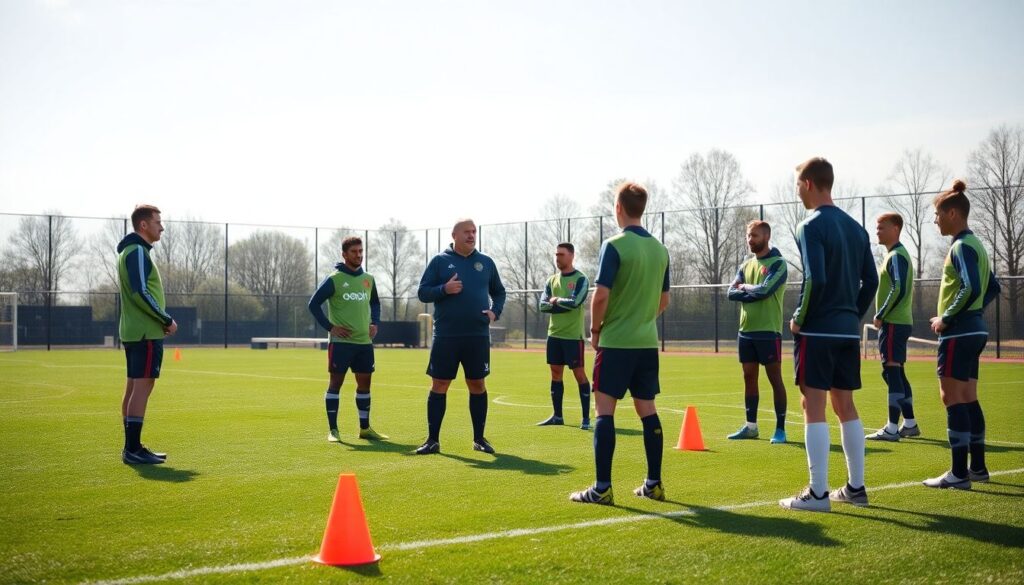
- Can your players explain, in simple words, what changes in their roles between high press, low block and counterattack?
- Do your training games include explicit time limits (seconds) and spatial constraints (zones, metres) connected to these tactics?
- Is there at least one drill each week that starts from a defensive regain and finishes with a structured counterattack?
- Have you defined clear pressing triggers (back pass, bad touch, sideways pass) and rehearsed them until automatic?
- Do video or data reviews focus not only on goals but also on line height, team compactness and distances between units?
- Are you progressively increasing complexity, moving from simple rondos to full-pitch scenarios that mirror match transitions?
Clarifications on Common Tactical Misconceptions
Is high pressing only suitable for physically dominant teams?
No. Physical capacity helps, but the key is synchronisation and compactness. A well-organised intermediate team that presses in coordinated 5-6 second bursts can be more effective than a fitter but disorganised side constantly chasing the ball.
Can a low block be an attacking strategy?
Yes. A low block can be a platform for fast counters if you pre-position outlets and rehearse first passes forward. The aim is not just to survive, but to lure opponents into spaces where losing the ball is most dangerous for them.
How many players should join a counterattack?
It depends on field position and score, but a useful rule is to ensure at least one extra line of cover behind the ball. Over-committing five or six players often leaves too much space if the move breaks down.
Does pressing high always mean defending man-to-man?
No. Many teams press zonally, passing opponents between players while protecting key spaces. The essence of high pressing is height and timing, not pure man-marking across the whole pitch.
Is possession football incompatible with counterattacking?
Not at all. Many possession-oriented teams are deadly on counters because their positional structure is already in place when they lose the ball, allowing immediate regains and vertical runs into space.
Should youth teams focus first on systems or principles?
Principles. At younger ages, it is more important that players understand pressing triggers, compactness and counterattacking runs than memorise formations. Systems can change; spatial and temporal principles remain.
Are set pieces separate from these tactical ideas?
No. Defensive and attacking set pieces often decide where your block starts and where counters begin. Treat corner and free-kick structures as part of your global time-space strategy.