
Football reflects contemporary moral dilemmas because every match condenses conflicts about fairness, money, identity, technology, inequality and freedom of expression. In Spain and beyond, what happens around a ball reproduces debates about corruption, nationalism, commodification and digital surveillance. Watching, coaching, betting or teaching football becomes a practical way to observe ethics in motion.
Moral snapshot: how football crystallizes contemporary ethical tensions
- Fair play ideals clash with systematic rule-bending and tactical fouls aimed purely at winning.
- Commercialization turns players into assets, raising questions about dignity, consent and long‑term wellbeing.
- Stadiums amplify nationalism and identity politics, sometimes reinforcing exclusion and hate.
- Technologies like VAR improve accuracy but increase surveillance and shift responsibility from people to systems.
- Elite football draws resources away from grassroots, deepening social and gender inequalities in access to play.
- Protests and symbolic gestures on the pitch test the limits of neutrality and free speech in sport.
Fair play and rule-bending: when winning eclipses ethics

Fair play in football is the expectation that teams respect both the written rules and the spirit of the game. Rule-bending appears when players, coaches or clubs systematically exploit grey areas, accept small cheats or use gamesmanship as part of normal strategy. The ethical tension emerges when results matter more than integrity.
Modern football normalises tactical fouls to stop counterattacks, time‑wasting to protect a lead, and strategic dives to win penalties. These behaviours rarely look like spectacular scandals, but they erode trust match after match. In La Liga, supporters often defend a player's simulation when it benefits their club and condemn the same act by a rival, showing how tribal loyalty distorts moral judgement.
Consider a youth coach in Madrid whose team fights for promotion. Opponents consistently waste time when they are ahead. Parents demand that the coach do the same. The coach faces a choice: copy the gamesmanship and "adapt" to reality, or model a stricter version of fair play that may cost points but educates players differently. That micro-decision mirrors broader social dilemmas about cutting corners in business, politics or exams.
Typical mini-scenario: you attend a match with entradas para partidos de fútbol de primera división. A last‑minute penalty from a soft contact decides the game after your striker exaggerates the fall. Afterwards, use that moment to discuss with friends or students whether the victory still feels deserved, and what you expect from professionals.
- Ask in each controversial play: "Would I judge this the same way if it was the rival team?"
- As a coach or captain, define in advance which behaviours your team will refuse to use, even if they are legal.
- Use post‑match conversations to distinguish between being clever and being dishonest.
Commercialization and player commodification: money versus dignity
Commercialization is the process by which football becomes an entertainment industry driven by media rights, sponsorships and global branding. Player commodification goes further: athletes are treated as tradeable financial assets whose value must be maximised, often above their human needs and attachments.
The mechanics that connect money and dignity typically include:
- Transfer market as trading floor. Clubs buy and sell players as portfolio items, sometimes moving them repeatedly between teams and leagues with little regard for family or community ties.
- Contract structures. Long, complex deals with release clauses, image rights and bonus triggers can create pressure to play through injury, maintain a specific public image or prioritise marketing events over rest.
- Data-driven performance management. Detailed statistics, GPS tracking and algorithmic scouting classify players as numbers on dashboards, facilitating comparisons but also depersonalising them.
- Global tours and branding. Pre‑season trips and commercial friendlies are scheduled mainly for sponsors and new markets, sometimes against the interests of local fans and players' physical limits.
- Fan consumption habits. Fans support or resist commodification through what they buy: shirts, subscriptions, VIP experiences or, increasingly, apuestas de fútbol en vivo liga española that turn each action into a micro‑investment.
- Media narratives. Headlines about a player's price tag or wages frame public perception, reducing complex people to simple "overpriced" or "cheap" labels.
Example: a rising talent from a small Spanish club is signed by a top European team, then loaned twice to foreign leagues to increase market value. He struggles with anxiety and isolation, but the conversation around him focuses almost entirely on his resale price. This reflects labour dilemmas in many sectors where human stories disappear behind KPIs.
- When discussing transfers, deliberately mention the person behind the fee: family, language, adaptation.
- As a fan, decide what products or betting habits indirectly reward the most exploitative business practices.
- In coaching or education, balance performance metrics with conversations about mental health and long‑term life plans.
Nationalism, identity and stadium politics: sport as civic mirror
Football stadiums are powerful arenas where national, regional and local identities are performed in public. Flags, anthems and chants reinforce belonging, but they also mark who is considered an outsider. The same energy that unites can easily be channelled into exclusion, racism or xenophobia.
In Spain, club rivalries and regional tensions frequently intersect. Matches between teams from different autonomous communities can become stages for wider constitutional debates. A banner, a whistle during a national anthem or a controversial decision by a referee from another region can quickly acquire political meaning. Fans who only wanted a game are suddenly pulled into identity conflicts.
Typical scenarios include:
- National team tournaments. International competitions act as moments of "safe nationalism" where flags and pride feel legitimate, but can also generate pressure to conform or hostility to those who do not celebrate in the same way.
- Regional symbols in club games. Displays of local flags or songs can affirm minority cultures or, if weaponised, deepen divisions toward other Spaniards or migrants.
- Stadium as protest space. Supporters use choreographies and banners to criticise governments, federations or corporate owners, testing the boundaries of acceptable speech.
- Everyday micro‑exclusions. Racist or xenophobic chants, even by a small group, create a climate where some fans and players feel permanently unsafe or "tolerated" but not fully accepted.
- Media framing. Commentary and headlines can either reduce complex identity issues to clichés or open space for nuanced discussion.
Mini-scenario: you watch a match featured in documentales de fútbol sobre ética y corrupción that explores how a club became a symbol of resistance under an authoritarian regime. Use it in class or a fan discussion group to compare with how flags and songs are used in today's stadiums, and where you draw the line between healthy pride and toxic nationalism.
- Before games with political tension, clarify with friends or students what respectful support looks like.
- When you hear discriminatory chants, decide in advance whether you will report, confront or at least withdraw your participation.
- Use football stories to teach that identities are layered: club, city, region, country, and that none has absolute priority.
Technology, surveillance and the integrity of decisions
Technologies such as goal‑line systems, VAR and advanced statistics promise more accurate decisions and a fairer competition. At the same time, they expand surveillance over players, referees and even fans, raising questions about privacy, autonomy and who ultimately controls the game.
Benefits often highlighted by leagues and federations include:
- Improved accuracy. VAR reduces clear and obvious errors in goals, penalties and red cards, protecting the integrity of results.
- Transparency. Replays and offside lines make it easier for audiences to understand why a decision was taken.
- Protection of referees. Technology can reduce personal pressure on officials by sharing responsibility with systems.
- Performance optimisation. GPS, wearables and video tools help coaches reduce injuries and improve training efficiency.
Limitations and ethical costs are equally important:
- Fragmented experience. Long VAR checks interrupt the emotional flow of the match, changing how fans celebrate goals.
- Overreliance on machines. Referees may become hesitant, expecting technology to fix everything, while fans forget that interpretation remains human.
- Data ownership. Massive performance and health data raise questions: who owns it, how long is it stored, can it affect contracts or insurance?
- Fan monitoring. High‑resolution cameras and facial recognition, sometimes introduced for security, can be used for commercial profiling or excessive control.
Example scenario: a controversial offside keeps your team from qualifying for Europe. You rewatch the VAR images frame by frame. This disappointment is an opportunity to examine how much certainty you demand in football and in public life, and at what cost in terms of surveillance or delayed decisions you are prepared to accept.
- Ask whether each new technology reinforces human responsibility or hides it behind algorithms.
- Support calls for clear, public protocols on data use for players and spectators.
- Use debates about VAR decisions to teach the difference between error, bias and uncertainty.
Inequality, access and the erosion of grassroots football
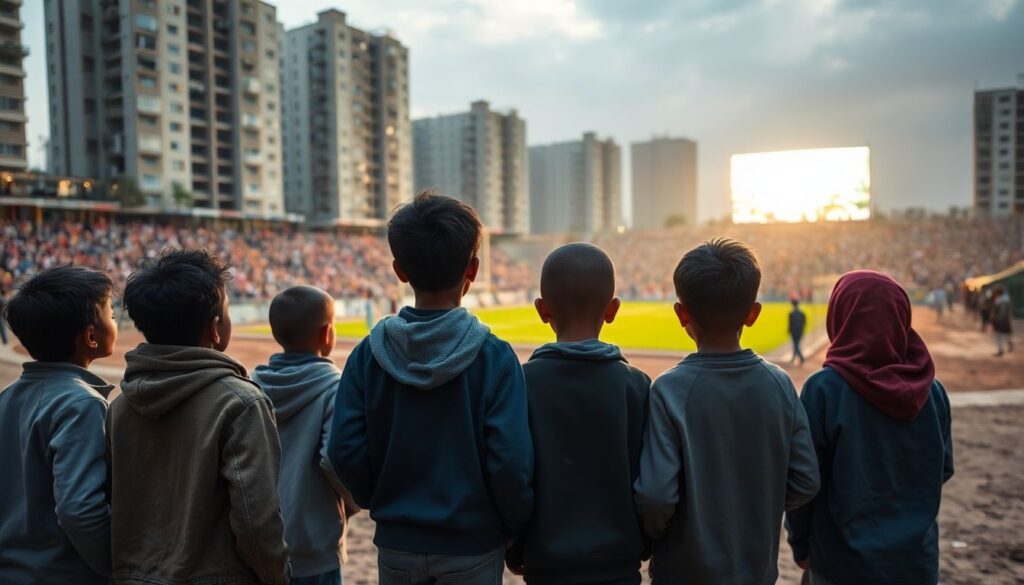
While elite football in Spain and Europe generates massive revenues, access to simple, local football is increasingly uneven. Costs of facilities, equipment and travel make participation harder for working‑class families, migrants and girls, even as televised matches are more available than ever.
Several persistent mistakes and myths shape this landscape:
- Myth: elite success automatically lifts grassroots. In reality, high broadcast incomes do not always translate into sustainable local pitches, especially in rural areas.
- Mistake: talent as purely individual merit. Scouts may overlook how economic stability, supportive schools and safe neighbourhoods enable "merit" to emerge.
- Myth: girls' participation will grow "naturally". Without targeted investment, mixed teams, and safe changing rooms, many girls still abandon the sport early.
- Mistake: over‑professionalising childhood. Some academies treat children as mini‑professionals, charging high fees and promising unrealistic careers while neglecting joy and education.
- Myth: community fields are only "recreation". They are in fact key spaces for integration of migrants and conflict prevention among youth.
Consider an educator in Barcelona designing a unit on sport and society. Combining local case studies with cursos online de sociología del deporte y fútbol, they discover that nearby neighbourhoods lack safe pitches while major clubs sign global sponsorships. Students visit a grassroots club to see how volunteers struggle to fund kits and transport, making inequality visible and concrete.
Another everyday scenario: a parent choosing between paying for an expensive academy or a cheaper community club. The decision is not only about potential professional futures, but about what kind of football culture they want to support: inclusive and local, or exclusive and market‑driven.
- When analysing "talent", always ask what invisible support systems made it possible.
- Advocate in schools and municipalities for equal access to pitches for girls and boys, day and night.
- Support at least one local grassroots initiative with your time, fees or visibility, not just your elite club.
Protest, speech and the contested neutrality of the pitch
Football institutions often claim that the pitch should be "neutral": free of politics, religion and social conflicts. In practice, players, coaches and fans constantly bring their convictions to the stadium, using celebrations, armbands or gestures to demand attention for injustices. The ethical question is not whether politics enter football, but how and under what rules.
Mini-case: imagine a top‑flight Spanish player whose family escaped a war. Before a televised match, he lifts his shirt to show a message calling for peace and support for refugees. The referee follows competition rules and books him for an unauthorised slogan. Social media debates explode: some defend the rule for consistency, others argue that moral duty outranks sporting regulations.
This single incident crystallises broader dilemmas: free speech versus organisational order, individual conscience versus collective contracts, symbolic gestures versus concrete action. Clubs may support certain causes that align with their sponsors and punish others that are more controversial, revealing asymmetries of power.
Use scenario: after watching such an episode, a teacher recommends students some libros sobre filosofía del fútbol y sociedad and asks them to map the stakeholders: player, teammates, club owners, league, sponsors, fans. Each group must propose a code of conduct for future protests on the pitch and in celebrations, making trade‑offs explicit.
- Distinguish between symbolic acts that open dialogue and those that deliberately dehumanise or incite violence.
- Push federations and clubs to define clear, content‑neutral rules for political messages, applied consistently.
- When you support a gesture online, also ask what concrete off‑pitch actions would make it less symbolic and more transformative.
Quick self-audit: how you engage ethically with football
- When you watch or discuss matches, do you notice and name ethical tensions, or only talk about results and statistics?
- Do your consumption habits (tickets, TV, betting, merchandise) unintentionally reinforce practices you actually criticise?
- Have you ever intervened, even minimally, against racist, sexist or homophobic behaviour in a football setting?
- Do you support at least one initiative that improves access to football for children or marginalised groups?
- When using football in education or work, do you connect specific incidents to wider social dilemmas, not just "values" in general?
Direct, practical answers to recurring ethical quandaries
How can I use football to teach ethics without turning every match into a moral lecture?
Choose one or two incidents per game and explore them in depth instead of commenting on everything. Let students or friends describe what they saw, ask who benefited or was harmed, and link it to an everyday context like school or work. Keep most of the match simply enjoyable.
Is it hypocritical to enjoy elite football while criticising its inequalities and excesses?
It is possible to enjoy the game and still recognise its problems, as long as you act on that awareness where you can. Balance elite consumption with support for grassroots clubs, women's football or community projects, and be critical of business models you find unacceptable.
What should I pay attention to when I go to a big stadium for the first time?
Notice not only the spectacle, but also security practices, crowd chants, sponsor presence and how away fans are treated. After the match, reflect on which elements felt inclusive and which produced fear or exclusion, especially for children, migrants or rival supporters.
Are live football bets always unethical, or can they be just entertainment?
They are not automatically unethical, but they carry real risks of addiction and debt, especially with apuestas de fútbol en vivo liga española that encourage constant micro‑decisions. Set strict limits, never bet money you cannot afford to lose, and avoid normalising betting for minors around you.
How can a small club address racism or sexism among its fans?
Start by acknowledging incidents openly and setting clear codes of conduct. Combine visible sanctions with educational actions: workshops, joint activities with diverse groups, and public commitments from players and coaches. Consistent, small steps matter more than one big campaign.
What resources are useful to go deeper into football, society and ethics?
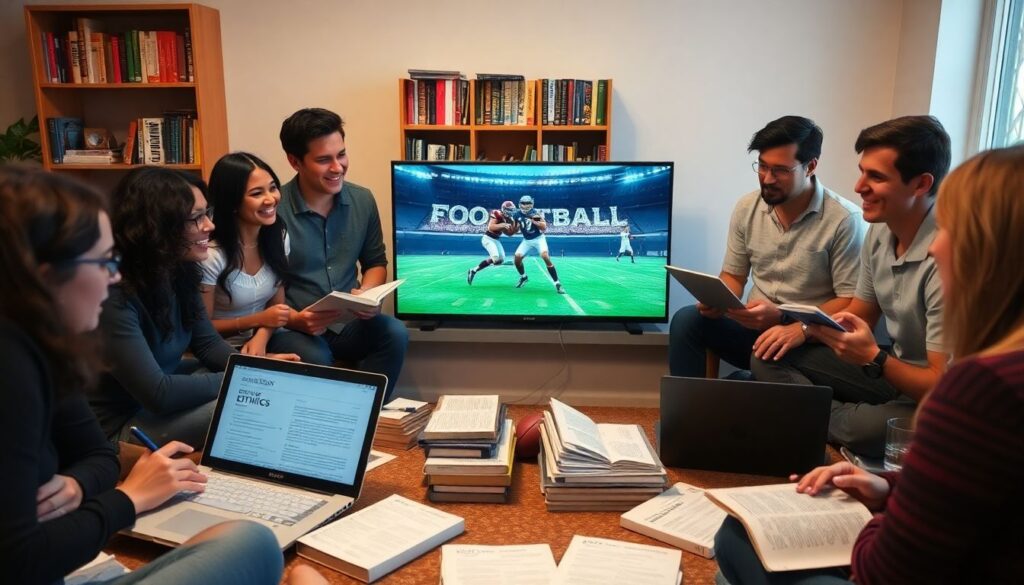
Combine different formats: critical books, serious journalism, and documentales de fútbol sobre ética y corrupción that show real cases. For structured learning, look for reputable cursos online de sociología del deporte y fútbol, and use them to frame discussions in fan groups, classrooms or coaching courses.
How can I talk about corruption in football without making fans cynical?
Present corruption cases as opportunities to demand better governance, not as proof that everything is hopeless. Highlight examples where transparency, fan pressure or legal action produced change, and show how ordinary supporters can influence clubs, federations and local authorities.