
Por qué las tácticas también son lenguaje
When we talk about game meaning, people usually jump straight to dialogue, lore or cutscenes. But in design practice, tactics work more like grammar: the set of allowed actions and constraints that quietly say what the game thinks about the world. A stealth system that always rewards waiting in shadows “argues” that caution beats aggression. An economy where grinding is mandatory “claims” that time equals value. Designers working on competitive games often joke that “players don’t read rules, they read win‑rates” — and that’s exactly how systemic meaning is produced in the wild.
Un breve contexto histórico: del ajedrez a los roguelikes
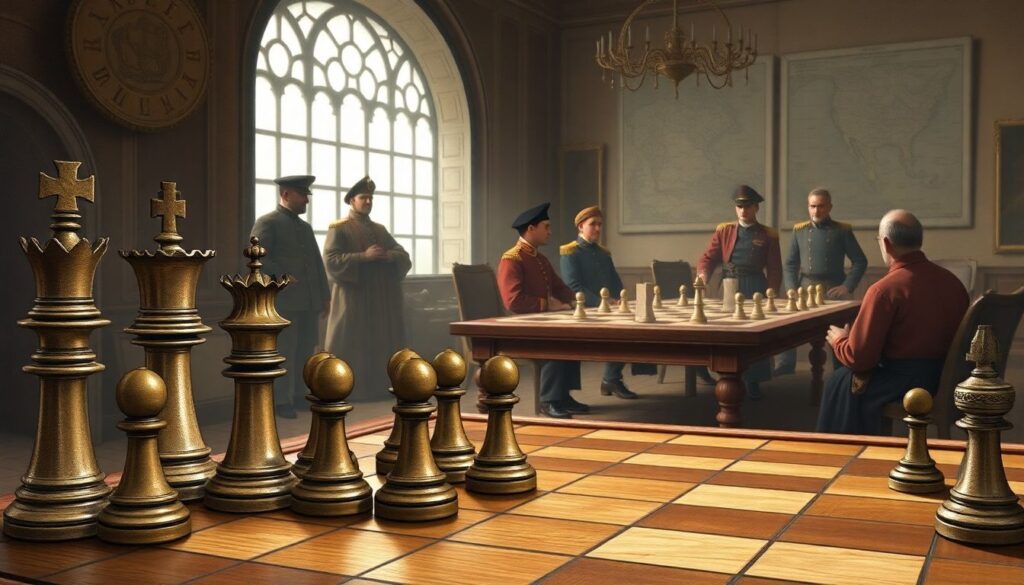
Philosophical expression through systems isn’t new. Medieval interpretations of chess ya lo trataban como modelo del orden social: cada pieza encarnaba un estamento. In the 20th century, war games like Kriegsspiel (Prusia, siglo XIX) were used to test doctrines; their rules encoded assumptions about logistics, morale and hierarchy. Fast‑forward to the 1980s: early roguelikes such as Rogue y NetHack transform metaphysical ideas into mechanics — randomness as fate, permadeath as finitud humana. By 2026, we see this lineage explicit in many of the mejores videojuegos de reflexión y filosofía, from indie tactics titles to big‑budget strategy games.
De “story” a “system”: el giro de los años 2000
In the 2000s, game studies shifted from seeing games as “interactive movies” to systems that argue through rules. Influential libros sobre filosofía de los videojuegos y game design (por ejemplo, “Rules of Play”, 2003) formalised ideas like procedural rhetoric: the notion that mechanics persuade. Around the same time, designers of tactics and strategy titles started to consciously treat unit stats, action points and fog of war as expressive tools, not just balance knobs. By the 2010s, major studios had telemetry from millions of players, turning philosophical hunches about risk, cooperation or punishment into measurable, tweakable design parameters.
Tácticas como sintaxis: cómo las reglas forman frases
Think of a tactics game turn as a sentence. Action points are its word limit, while movement, cover and abilities are the vocabulary. XCOM (2012) is a classic case: the “two actions per turn” rule plus high hit‑chance variance communicates a worldview of uncertainty and constrained agency. You are always one unlucky roll away from disaster, which many players interpret as commentary on modern warfare’s chaos. By contrast, Into the Breach (2018) reveals enemy moves in advance, shifting the metaphysical claim: the future is knowable but brutally cramped, and your ethics emerge from choosing who you can’t save.
Bloque técnico: modelando ideas en sistemas tácticos
Technical detail: In commercial tactics engines, philosophical intent often flows through three numeric layers. First, state space size: number of legal board states, which can hit 10¹²–10¹⁸ even in “small” maps; this determines how legible consequences feel. Second, branching factor: average choices per turn, typically tuned between 5 y 20 in tactics games to balance mastery and paralysis. Third, payoff curves: how damage, resources or narrative flags scale over time. Exponential payoff curves push power fantasies; sub‑linear curves encode skepticism about progress. Designers use Monte Carlo simulations and heatmaps to see what “values” players are silently nudged toward.
Decisiones morales encarnadas: no sólo diálogos
While juegos narrativos con decisiones morales suelen enfatizar diálogos y bifurcaciones, tactics systems embed ethics right into spatial and temporal constraints. In Spec Ops: The Line, the infamous white phosphorus scene is framed tactically: available options, line of sight and perceived objectives funnel the player into complicity. In Frostpunk (2018), resource distribution on a circular city grid translates political philosophy into placement puzzles: child labour, emergency shifts and propaganda aren’t presented as binary text choices but as survival modifiers on heat and coal output. The tactics layer makes utilitarian trade‑offs physically tangible on the map.
Ejemplos concretos: tres filosofías, tres sistemas
First, Darkest Dungeon (2016) encodes a tragic, almost Lovecraftian view of heroism. The stress mechanic ensures that every optimal tactical line — critical hits, light management, party order — still accumulates trauma. The system “says” that victory corrupts. Second, Into the Breach frames sacrifice as structural: its time‑travel meta‑system records timelines where whole populations died so that another run might succeed. Third, multiplayer tactics like Valorant use economy and round structure to express trust in information, precision and discipline; the competitive meta becomes a moving argument about rational cooperation under pressure.
Bloque técnico: telemetría, ética y balance
Technical detail: By 2026, large live‑service games collect billions of events per month. A typical tactics shooter tracks kill/death ratios, ability usage, map heat, and even camera aim trajectories at 20–60 Hz. This data feeds reinforcement‑learning‑assisted balance tools that suggest nerfs or buffs. Philosophically, this raises a subtle issue: if the system’s “worldview” is partly optimised by algorithms to maximise engagement, then its ethical stance may drift toward retention metrics. Some studios now run “values audits”, where designers and philosophers inspect the top 1% most winning tactics to check whether they encode undesirable norms like griefing or exploitation.
De aula a producción: enseñar metáforas sistémicas
In the last decade, cursos de diseño de videojuegos narrativos y metáforas have started treating tactics design as a form of applied philosophy. Students prototype small grid‑based games where every rule must correspond to a stated worldview: e.g., “knowledge decays quickly” implemented as fog of war that re‑covers tiles after two turns, or “alliances are fragile” encoded as probability thresholds for betrayal when units stand adjacent. Postmortems from studios like Subset Games or Red Hook are now assigned readings, because they show — with numbers, not slogans — how slight changes in cooldowns or stress values rewrite the game’s metaphysical argument.
Más allá del texto: el futuro de los videojuegos con mensajes filosóficos

Looking toward the late 2020s, videojuegos con mensajes filosóficos are increasingly driven by procedural systems, not just branching scripts. Advances in AI‑assisted content generation allow tactics engines to adapt maps, enemy behaviours and victory conditions to a player’s inferred ethical preferences. This raises new design problems: how do you keep a coherent philosophical stance if the system personalises its own rules? Experimental projects in academia and indie scenes are exploring “resistant systems” that refuse certain player choices, or that explicitly debate you via mechanics, turning every match into a small, argumentative essay written in moves.