
Historical background: football’s moral hangover

For most of the 20th century, fans liked to believe football was a fairly pure meritocracy: local kids, muddy pitches, modest wages. That memory is already selective. Bribery scandals, political interference and opaque transfers have been around for decades. What changed in the last 30 years is the sheer scale: TV rights exploded, petrodollars arrived, global betting markets followed and suddenly the game became a financial asset class. Clubs turned into entertainment brands, sovereign wealth funds started buying entire leagues, and data‑driven gambling platforms were tracking every corner kick. The ethical question stopped being marginal and began to touch almost every pass, sponsorship and broadcast deal.
That’s why asking whether an “ethical football” is still possible isn’t just nostalgia. It’s a way to interrogate who really runs the game now and on whose terms.
Basic principles: what would “ethical football” even mean?
Before comparing solutions, it helps to define the goal. An ethical version of the sport would protect sporting integrity, treat people decently and limit harmful externalities. That means competitions not distorted by match‑fixing or financial doping, players and workers with real labour rights, and transparent ownership structures that don’t treat clubs as disposable assets or PR tools. It also means acknowledging that betting is not going away; instead, it must be constrained so that both fans and athletes are protected from addiction, manipulation and conflicts of interest. In other words, we’re not looking for a utopia without money, but for rules that keep money in its place.
From there, different camps emerge: some trust strict state regulation, others prefer market‑based solutions like ethical investment, and many fans push for grassroots, supporter‑owned models.
Approach 1: heavy regulation of money and betting
The first strategy says: if football has become a big business, then treat it like any other risky industry. This means tight financial fair‑play rules, ownership screening, caps on related‑party sponsorship and robust oversight of betting operators. Under this approach, governments demand that operators offer apuestas de fútbol online legales y seguras, with mandatory identity checks, loss limits, and clear separation between sports governance and gambling interests. The same mindset extends to TV rights and sponsorship: full disclosure of owners, funding sources and tax structures. The idea is that only a dense web of regulation can offset the asymmetry between hyper‑wealthy investors and relatively powerless local communities.
The upside is clarity: if something is banned, it’s banned for everyone. The downside is that rules are only as strong as the political will to enforce them, and global investors can always shop around for the weakest jurisdiction.
Approach 2: ethical capital instead of “any money is good money”
A second camp accepts that capital is here to stay but wants to discipline its origins and its goals. Rather than banning external money, this approach prioritises frameworks to invertir en clubes de fútbol con capital ético: funds with transparent governance, environmental and social criteria, and independent oversight. Here, supporters and pension funds might co‑invest in clubs, demanding limits on leverage, living‑wage policies and community projects as conditions for capital injections. Compared with pure regulation, it uses the logic of the market against itself: if ethical investment becomes a badge of legitimacy, “sportswashing” projects face reputational and financial pressure.
But this strategy also has limits. Ethical funds still seek returns, so tensions arise when sporting ambition collides with financial prudence, and smaller markets may struggle to attract this kind of capital at all.
Approach 3: fan power and partial de‑commercialisation
The most radical response says the only way to clean the game is to reduce its dependence on global finance altogether. Here the model is supporter ownership, strong fan representation on club boards, and local sponsorship rather than global mega‑deals. Instead of chasing the mejores casas de apuestas deportivas de fútbol as shirt sponsors, clubs might privilege local businesses or impose internal limits on which industries they advertise. This approach often goes hand in hand with wage ratios between players and staff, ticket‑price controls and strong youth academies focused on education as well as performance. Ethically, it is appealing: decision‑making moves closer to the community that actually fills the stadium.
The trade‑off is competitiveness. In a Champions League ecosystem dominated by billion‑euro squads, fan‑owned or semi‑amateur models can struggle to keep up without compromising their principles or selling stakes to outside investors.
Betting: from moral panic to harm reduction
When it comes to gambling, debates often polarise between total rejection and laissez‑faire, but real‑world solutions sit in the middle. One pragmatic line focuses on how to apostar en fútbol responsablemente: clear information on odds, visible warnings, self‑exclusion tools and social norms that frame betting as entertainment, not income. On the supply side, regulators insist that operators be audited, tax‑compliant and technically robust, favouring plataformas de apuestas deportivas con licencias en España and similar regulated markets over offshore sites. Smaller but significant reforms include banning in‑play betting on ultra‑granular events that are easy to manipulate, restricting ads during youth broadcasts and obliging clubs to run education campaigns for players and fans alike.
This approach treats betting a bit like alcohol: risky, but manageable if framed within strong norms, good information and enforceable limits. It doesn’t remove money from the game, but it tries to civilise its behaviour.
Real‑world examples and mixed models
No country or league uses just one of these strategies; they blend them. Germany’s 50+1 rule is a classic case of structural fan power that coexists with sponsorship from major corporations and sometimes from betting companies. Some Scandinavian leagues lean heavily on transparency and community oversight, with fan representatives monitoring ownership and youth development, while still allowing tightly regulated betting partners that claim to provide apuestas de fútbol online legales y seguras. In England, supporters’ trusts have saved several clubs from collapse by buying shares or seats on the board, even as the Premier League remains a magnet for petrodollars and private equity. Spain has combined stronger oversight of betting advertising with licensing regimes that try to favour responsible operators over aggressive, opaque ones.
The emerging pattern is not a clean laboratory model, but a patchwork in which ethical constraints must constantly be updated as new money and technologies appear.
Common misconceptions that block progress
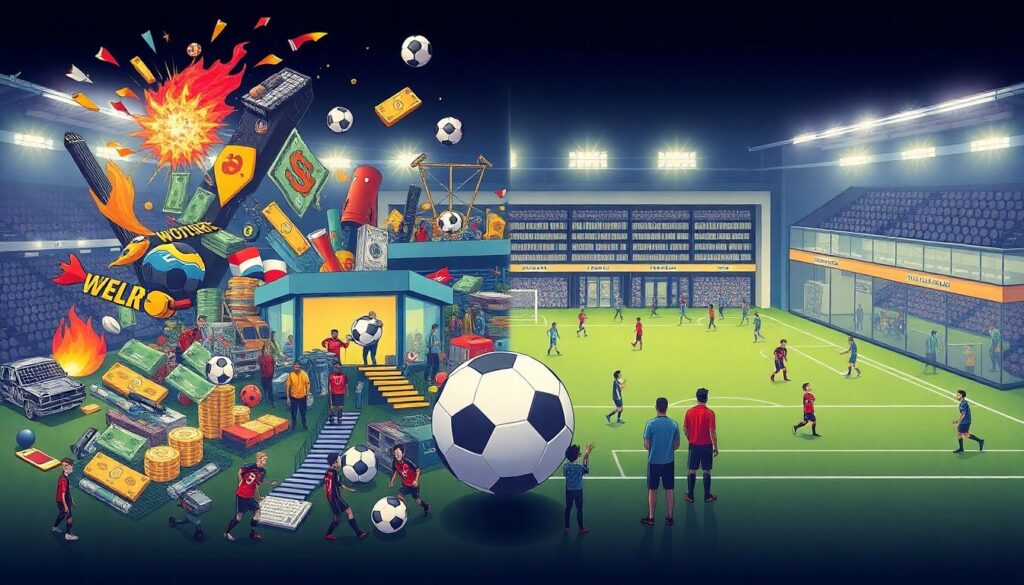
One frequent misunderstanding is the idea that ethics and competitiveness are mutually exclusive, as if any constraint on investment automatically condemned a club to mediocrity. In reality, long‑term sporting success often depends on stability, youth development and good governance rather than on endless capital injections. Another myth is that “responsible betting” is just a marketing slogan; in well‑regulated markets, requirements on customer protection, data security and anti‑fraud systems are quite demanding, particularly for plataformas de apuestas deportivas con licencias en España and similar jurisdictions. There is also the belief that “fan ownership solves everything”, ignoring that even supporter‑run clubs can slide into cronyism or short‑termism if they lack professional management and external scrutiny.
Equally misleading is the fatalistic claim that petrodollars make any ethical regulation pointless. While no national association can neutralise global wealth alone, coordinated rules on transparency, related‑party deals and human‑rights benchmarks for owners can raise the cost of sportswashing and shift norms over time.
So, is ethical football still possible?
Ethical football will never mean a world without money or mistakes. What is possible, and already visible in pockets, is a landscape where capital is more accountable, communities have a louder voice, and the most harmful practices of gambling and speculative ownership are curbed. Some progress will come from hard law, some from market pressure for cleaner investment, and some from fan activism that refuses to normalise every new sponsorship or takeover. In that hybrid space, ethical standards stop being a nostalgic fantasy and become a moving target that clubs, leagues, investors and bettors must constantly negotiate.
The key comparison, then, is not between “pure” and “corrupted” football, but between different mixes of regulation, ethical capital and fan power. The question is less “is it possible?” than “how much compromise are we willing to accept, and who gets to decide where we draw the line?”.