
Super Leagues, Financial Fair Play and Inequality: Is Football Becoming a Game for the Few?
We’ve been hearing it in bars, podcasts and press conferences for years: “Modern football is broken.”
Sometimes it sounds exaggerated. But when you start putting numbers, regulations and court cases on the table, the picture gets uncomfortable fast.
This isn’t just about whether the European Super League is “good” or “evil”. It’s about a deeper question: are we moving towards a closed ecosystem where a handful of clubs control almost all the money, the stars and the trophies — and everyone else is just a backdrop?
How We Got Here: From Local Game to Global Industry
Football didn’t become a multi‑billion‑euro industry overnight.
In the 1980s, even big European clubs still depended heavily on stadium tickets and local sponsors. Satellite TV was in its infancy, merchandising meant a few scarves, and nobody in Turin or Manchester cared deeply about fans in Jakarta or Mexico City.
Then three things changed the map:
1. TV money exploded
The late 80s and 90s brought pay‑TV and transnational broadcasting. The value of derechos de televisión fútbol europeo grew at a pace that no ticket office could match. The more TVs you reached, the more you earned.
2. The Bosman ruling (1995)
The EU Court of Justice allowed players to move freely at the end of their contracts within the EU and banned foreign‑player quotas for EU nationals. That turbo‑charged wages, agents’ fees and cross‑border transfers. Talent began flowing systematically to the richest clubs and leagues.
3. Rebranding of competitions
The European Cup became the Champions League; group stages, anthem, logo, prime‑time slots. More matches, more rights, more sponsors. UEFA realized that “show business” could be as important as “sport”.
From there, inequality became a structural feature. Clubs playing regularly in the Champions League got recurring European income, while others stayed trapped in domestic ceilings.
Why Big Clubs Pushed for a Super League
By the 2010s, a paradox appeared: the very clubs that benefited most from the Champions League were also its loudest critics.
Real Madrid, Barcelona, Juventus and others argued:
– The distribution of TV money was not “fair” enough in their favor.
– They generated most of the audience but had to “share their cake” with smaller clubs.
– Uncertainty (not qualifying every year) made long‑term investment risky.
Out of that logic came the Superliga idea: a competition with more guaranteed matches between giants, predictable revenue and, at least in the original 2021 project, a kind of semi‑closed membership.
The 2021 announcement collapsed after a 48‑hour backlash from fans, governments and UEFA, but the episode left two key lessons:
– Big clubs were willing to confront UEFA openly.
– The concept of a super league was not going to disappear; it would pivot to legal and institutional battles.
The later rulings of the Court of Justice of the EU in 2023, criticizing how UEFA and FIFA controlled competition approvals, reopened the door. By 2024, the debate wasn’t “if” but “how and under what conditions” alternative competitions could exist.
Financial Fair Play: Referee or Access Barrier?
When UEFA launched Financial Fair Play (FFP) around 2011, the official narrative was simple: stop clubs from spending much more than they earn and accumulating unsustainable debts.
In practice, FFP did three things:
– It reduced the most extreme financial chaos (cases of clubs spending wildly and collapsing).
– It protected the interests of existing creditors and stakeholders.
– And, indirectly, it made it harder for new rich owners to “buy success” quickly.
Technical focus: How (classic) FFP actually works
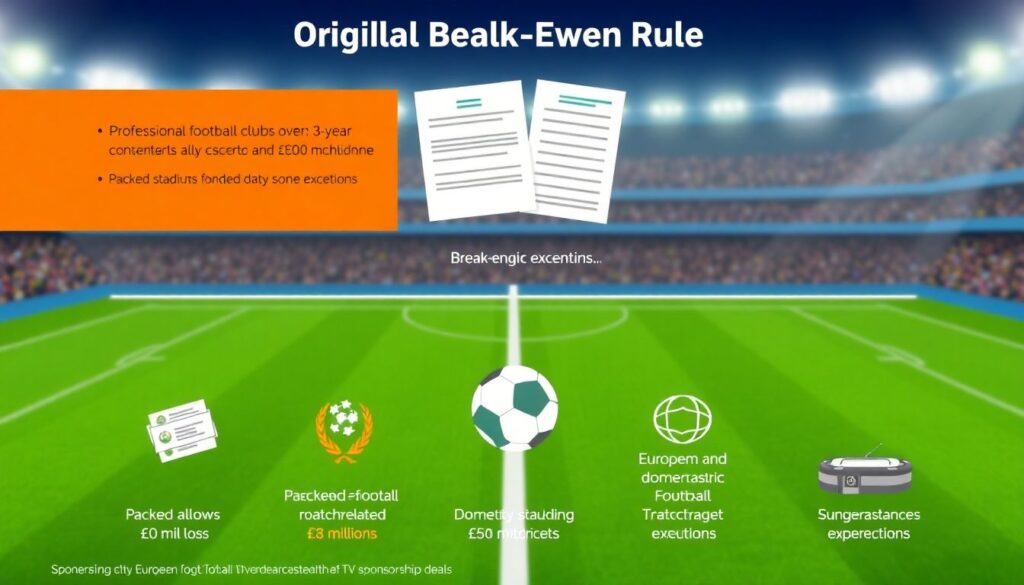
Under the original break‑even rule:
– Clubs had to show that football‑related losses over a monitoring period (typically 3 years) did not exceed a certain threshold (for example, €30 million), with some exceptions.
– Revenues included: matchday, derechos de televisión fútbol europeo and domestic, sponsorships, commercial deals, UEFA prize money, and player sales.
– Certain “good” costs (youth development, women’s football, infrastructure) were excluded from the calculation.
– Sanctions ranged from fines and squad limitations to exclusion from UEFA competitions.
On paper, that sounds reasonable.
In reality, it tends to freeze the existing hierarchy:
– A club already in the Champions League can count that stable income to justify higher spending.
– A mid‑table club without European income can’t suddenly inject huge funds — even if a billionaire owner is ready to invest — without clashing with FFP.
That’s why so many owners, lawyers and investors started knocking on the door of an abogado especialista fair play financiero uefa: navigating what is allowed, what can be reclassified as “commercial income”, and where the grey areas lie became almost as important as scouting players.
From FFP to “Financial Sustainability”: Did the System Change?
UEFA has been moving from classic FFP towards broader “financial sustainability” rules, with three big axes:
1. No overdue debts (towards clubs, tax authorities, players).
2. Caps on squad spending as a percentage of revenue (for example, gradually moving from 90% down to 70%).
3. More granular monitoring of budgets and long‑term planning.
Technical focus: The new spending cap logic
Instead of just saying “don’t lose more than X”, the new rules say roughly:
– Wages + amortization of transfers + agent fees
must not exceed a given % of total revenue.
– Revenue includes all the classic streams: matchday, domestic and international TV, UEFA competitions, sponsorships, plus commercial activities.
– Financial injections from owners can help in limited ways, but if they inflate sponsorships artificially, UEFA may reclassify those deals as related‑party transactions and adjust their value.
This has created a market for consultoría fair play financiero clubes de fútbol, where clubs hire specialized firms to:
– Structure contracts and amortization to fit within the cap.
– Design sponsorship and licensing schemes that maximise revenue while passing related‑party tests.
– Plan multi‑year transfer strategies aligned with regulatory windows.
Again, the common thread: clubs with larger and more diversified revenue bases are naturally advantaged.
TV Rights: The Real Engine of Inequality
Forget individual transfer fees for a second.
The long‑term driver of structural inequality in European football has been the distribution of TV and media income.
When a club in England’s Premier League earns over €100–150 million per season just from domestic TV rights, while a club in a mid‑tier league earns €10–20 million, they’re effectively playing different games.
Add on top:
– UEFA competitions: reaching the Champions League group stage brings in tens of millions in fixed fees, plus performance bonuses and the “market pool”.
– Global streaming deals and marketing: big brands are attractive to multinational sponsors and global broadcasters.
So when people look at the price of superliga europea entradas and complain that “football has become too expensive for ordinary fans”, they’re not just talking about tickets. They’re reacting to an entire economic model that’s increasingly built around global TV and digital audiences rather than local stadium communities.
Super Leagues as a Symptom of a Deeper Problem
The push for a European Super League is a consequence, not a cause, of financial polarization.
Big clubs see themselves as global entertainment companies competing with NBA, NFL and streaming platforms. From that angle:
– A midweek match between two continental giants looks like premium content.
– A domestic game against a relegation candidate looks like “inventory” necessary for tradition and local rivalries, but less essential for global revenue.
A closed or semi‑closed super league offers:
– Guaranteed participation (thus guaranteed income).
– Greater leverage in negotiating derechos de televisión fútbol europeo on a collective, global scale.
– More predictable cash flows for long‑term loans and investments.
But from the standpoint of sporting merit, a closed league undermines the basic promise of European football since its beginnings: you play your way up, not buy your way in.
Historical Flashpoints: Moments That Tilted the Field
It’s useful to pick a few turning points where rules or decisions widened — or at least crystallized — the gap between clubs.
1. The birth of the Champions League era (1992)
The move from straight knock‑out to group stages was a game‑changer.
– More matches between top clubs.
– More guaranteed games for large markets.
– Higher value for TV partners.
Over time, qualification criteria and seeding also started favoring historical performance, which reinforced the presence of usual suspects in later rounds.
2. The G‑14 and the “big clubs lobby”
In the late 90s and early 2000s, top clubs formed associations (like the G‑14) to negotiate more power in UEFA decision‑making:
– Pressure for bigger financial distributions to participants.
– Influence over match calendar and competition formats.
– Compensation for player injuries on international duty.
They didn’t get everything they wanted, but they did secure a larger slice of European revenue and a bigger say in the shape of competitions.
3. Financial doping and state‑backed clubs
The arrival of state‑linked or state‑supported investors — sovereign wealth funds or entities closely tied to governments — altered the market:
– Massive capital injections, stadium projects, global marketing campaigns.
– Aggressive transfer strategies that pushed the overall cost of talent upwards.
– Legal disputes over whether financial contributions were “fair value” or disguised owner support.
This clashed head‑on with FFP and accelerated the need for more precise rules and more rigorous enforcement.
The New Investor Logic: Buying Clubs, Buying Ecosystems
In the 2020s, inversión en clubes de fútbol europeos has matured into a sophisticated asset class:
– Multi‑club ownership: one group owning clubs in several countries, using them as talent pipelines, branding bridges and financial hedges.
– Private equity funds buying stakes in leagues, media rights or club holding companies.
– Institutional investors analyzing football cash flows like they would airports or toll roads.
For these actors, regulatory clarity is essential. They want to know:
– How stable are the revenue streams from TV and European competitions?
– How rigid or flexible are FFP/sustainability rules?
– What is the risk that a new super league format could cannibalize existing competitions or, conversely, open a more profitable market?
That’s why high‑end deals now very often involve both a sports‑business consultant and an abogado especialista fair play financiero uefa working together. It’s not enough for a club to be popular; it has to be structurally compatible with current and future rules.
Fans, Tickets and the Social Contract
Amid all this, where do fans stand?
Prices for top‑level games have risen significantly in many markets, especially for “premium” matches: derbies, knockout ties, key Champions League nights, or hypothetical super league clashes.
The irony is stark:
– Local fans face rising prices, complex membership systems and loyalty points races for the best seats.
– Meanwhile, global fans are courted with tailored content, international tours, and streaming packages.
The debate about superliga europea entradas is in fact a debate about who football is really being designed for:
the 50,000 in the stadium or the millions online.
So… Are We Heading Towards Football for the Few?
The uncomfortable answer is: in many ways, we already are.
But it’s not an irreversible destiny; it’s a political and regulatory choice.
Three key forces shaping the future
1. Regulation and courts
European institutions, competition authorities and courts will decide how far UEFA and FIFA can go in controlling new competitions, and how far private leagues can go in closing the system.
2. Domestic leagues’ responses
National leagues can redesign their own format and money distribution (solidarity payments, revenue sharing, salary caps) to limit internal inequality. Few have done so aggressively.
3. Fan and political pressure
The 2021 backlash showed that, when mobilized, fans and governments can still derail projects. But sustaining that pressure in the long run, and turning it into regulation, is much harder.
What Could Change the Trajectory?
Let’s close with a realistic — not utopian — look at what could actually bend the curve away from “football for the few”.
1. Smarter, not just stricter, financial rules
A new generation of rules could:
1. Tie spending caps not only to individual club revenue, but also to league‑wide averages, preventing runaway gaps.
2. Incentivize genuine revenue creation (infrastructure, academies, women’s football) more strongly than short‑term transfer gambles.
3. Penalize “cosmetic engineering” (inflated related‑party sponsorships) more swiftly and predictably.
2. More progressive distribution of TV and prize money
Redistribution doesn’t need to be purely ideological; it can be justified in business terms:
1. More competitive leagues are more interesting to neutral viewers.
2. Genuine uncertainty of outcome increases the value of derechos de televisión fútbol europeo in the long run.
3. A healthier pyramid of clubs ensures a deeper talent pool and more meaningful matches.
3. Binding protections for sporting merit
Regulators could:
1. Cap the number of guaranteed spots in any future super league‑type competition.
2. Link access firmly to domestic performance — no permanent memberships.
3. Preserve promotion and relegation as core, non‑negotiable pillars across the pyramid.
Conclusion: The Battle Over Football’s DNA
When we talk about Super Leagues, Financial Fair Play and inequality, we’re really debating football’s DNA:
– Is it primarily a global entertainment product optimized for investors, broadcasters and sponsors?
– Or is it still, at its core, a sporting competition rooted in merit, local identity and the fragile dream that “with a good generation, even a small club can reach Europe”?
The answer won’t come from one spectacular match or one scandalous transfer.
It will come from regulations, court judgments, TV deals, and countless small decisions in boardrooms and ministries.
The big risk is not that we wake up one day and “suddenly” have a closed super league.
The real danger is quieter: that, step by step, financial logic tightens its grip until the gap between giants and the rest becomes so wide that upsets are reduced to marketing anecdotes — nice stories for documentaries, but no longer real possibilities.
If that happens, football won’t die.
It will still exist, full of goals, stars and dazzling broadcasts.
But it will be a different game — one where many of us may start to feel more like customers of a content platform than supporters of a shared, open competition.