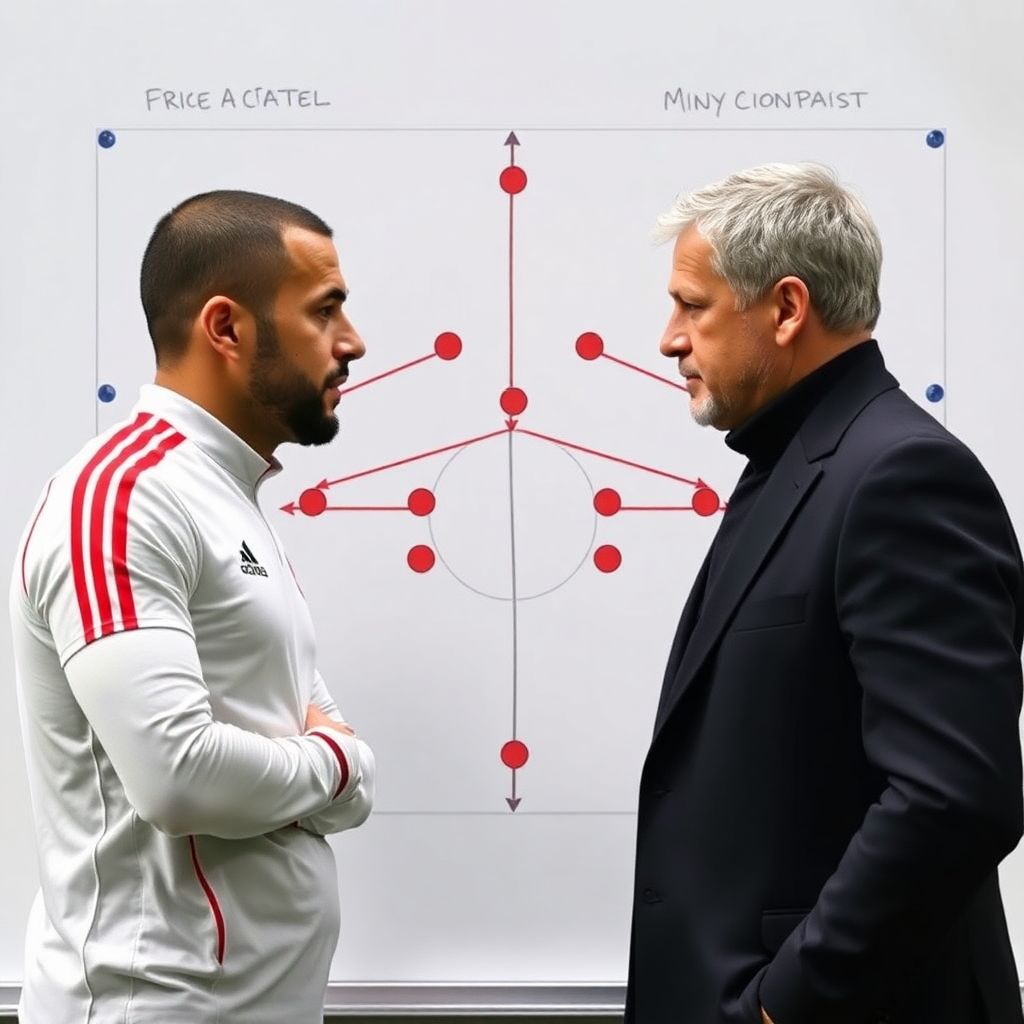
Choose Guardiola’s model if you want to control the ball, structure and tempo through positional play and high pressing. Choose Mourinho’s if you prioritise game-state management, defensive compactness and exploiting mistakes. For most semi-professional and academy contexts in Spain, a hybrid model with Guardiola principles in possession and Mourinho discipline without the ball is usually optimal.
Core strategic contrasts between Guardiola and Mourinho
- Guardiola controls games mainly through the ball; Mourinho controls them mainly through space, time and emotions.
- Guardiola’s risk is defensive vulnerability in transitions; Mourinho’s is offensive predictability if counters are stopped.
- Guardiola demands technically and tactically elite players; Mourinho can maximise more limited squads through structure.
- Guardiola’s model needs long-term alignment at club level; Mourinho’s can deliver faster short-term results.
- For LaLiga es_ES academies, Guardiola-style principles suit development; Mourinho-style compactness suits competitive survival.
- Analysts measure Guardiola by chance creation and field tilt; Mourinho by chances conceded and control of key zones.
- Psychologically, Guardiola convinces via game ideas; Mourinho via siege mentality, narrative and us-against-the-world frames.
Philosophical foundations: possession control vs. result-oriented control
To choose between Guardiola and Mourinho as philosophical references, compare them across clear criteria instead of emotion or club loyalty.
- Definition of control
- Guardiola: control = having the ball in prepared zones, dictating tempo, minimising transitions.
- Mourinho: control = forcing predictable situations, limiting opponent strengths, mastering game-state.
- Risk tolerance
- Guardiola accepts high defensive risk to attack with many players and constant circulation.
- Mourinho accepts low attacking numbers to guarantee rest-defence and compactness.
- Time horizon
- Guardiola’s ideas require time for automatisms, something often discussed in any curso online filosofía de juego de Guardiola y Mourinho.
- Mourinho can implement a solid block quickly, useful for relegation-threatened or cup-focused teams.
- Squad profile and market
- Guardiola needs ball-playing centre-backs, press-resistant interiors, proactive goalkeeper.
- Mourinho can work with strong box defenders, transition wingers and physical reference forwards.
- Club identity and fan expectations
- Historically possession-based clubs (many in LaLiga) fit better with Guardiola-style principles.
- Clubs with underdog identity may align more easily with Mourinho’s aggressive pragmatism.
- Development vs result priorities
- Academy and long-cycle projects: Guardiola philosophy encourages technical and cognitive growth.
- Short-cycle projects: Mourinho maximises points per match in constrained contexts.
- Cultural and media environment
- Guardiola thrives where process and style are valued, something well illustrated in any documental Guardiola vs Mourinho control del juego.
- Mourinho handles hostile media well, using narrative to protect players and shift pressure.
Persona takeaways
- Analyst: Build dashboards that classify control as possession-based vs space-based and tag matches accordingly.
- Head coach: Define non-negotiables (ball or space first) and align all training tasks to them.
- Informed fan: When debating, reference control definitions instead of only trophies or style preferences.
Pressing, space manipulation and tempo in Guardiola’s teams
Guardiola’s pressing is not one fixed model; it adapts to squad and league, always aiming to recover fast and attack from advanced zones. Below are practical variants of pressing and tempo structures you can borrow, with contrasts that often appear in any charla táctica Guardiola Mourinho para entrenadores.
| Variant | Best for | Pros | Cons | When to choose |
|---|---|---|---|---|
| High-possession high press (Barça 2010-2011 style) | Technically dominant teams in leagues where rivals build short | Constant territorial dominance, quick ball recoveries, suffocates opponent build-up | Massive physical and cognitive demands; vulnerable to long balls and fast strikers | Home games as favourite, especially with short pitches and brave centre-backs |
| Flexible pressing with wide overloads (Bayern phase) | Teams with strong wingers and half-space runners | Creates many attacks from wide recoveries, manipulates rival full-backs | Can open central lanes if timing is poor; requires excellent communication | When rivals insist on wide progression or use attacking full-backs |
| Rest-defence focused press (City 2017-2019) | Sides that face many counters and play high defensive lines | Stabilises transitions, keeps three or four behind the ball at all times | Occasional loss of central presence; demands press-resistant defenders | Against transition-heavy opponents or in knockout ties with away-goal logic (or similar incentives) |
| Situational mid-block with pressing traps | Teams without capacity to press high for 90 minutes | Saves energy, guides rivals into pre-defined zones, easier to coach in lower levels | Less field tilt; can look passive if traps are not clear | Busy fixture periods, or squads with limited depth and fitness |
| Hybrid Guardiola press with Mourinho-style game management | Clubs seeking control with ball but willing to defend deeper late on | Combines structured build-up with pragmatic closing of games | Identity may become unclear if principles are not well defined | When league survival and development are equally important, common in mid-table LaLiga contexts |
Comparative practical notes
- Mourinho’s pressing is usually a trigger to launch counters from a medium or low block, not a constant tool for field tilt.
- Guardiola invests training volume in pressing coordination; Mourinho in block cohesion and counter patterns.
Persona takeaways
- Analyst: Track PPDA, starting location of possessions and field tilt for each variant; this mirrors many ideas from any libro Guardiola vs Mourinho análisis táctico.
- Head coach: Choose one main variant and two situational ones (for leading vs trailing) and train them weekly.
- Informed fan: When watching, focus on first five seconds after loss to identify which pressing idea is applied.
Defensive structure, compactness and transition play in Mourinho’s sides
Mourinho builds defensive structures to control space, not possession. His teams are compact, horizontally and vertically, always with transition in mind. For Spanish coaches, these principles are highly transferable, especially in underdog scenarios.
- If your team suffers against crosses and set pieces, then consider Mourinho’s deep but narrow block with strong aerial defenders and specialist marking on key targets.
- If rivals are superior in open play but weak in rest-defence, then adopt a mid-to-low block, lure them forward and prepare 2-3 rehearsed counter patterns attacking their full-back zones.
- If your squad lacks pace but is tactically mature, then compact central zones, accept wide crosses, and focus on winning second balls with clear zonal responsibilities.
- If you have very fast wingers and a target striker, then structure a 4-4-1-1 or 4-2-3-1 low block, with pre-agreed release zones to attack once you recover.
- If you often concede after losing the ball high up, then study Mourinho’s rest-defence and counter-pressing triggers, and add more players behind the ball when attacking, even if chance volume drops.
- If your club culture rejects low blocks, then use Mourinho principles selectively: for example, protect the box Mourinho-style in the last 15 minutes when leading.
Persona takeaways
- Analyst: Tag matches by block height and transitions conceded; compare expected goals against between compact and stretched games.
- Head coach: Design at least one Mourinho-inspired game plan specifically for away matches vs top three opponents.
- Informed fan: When someone says Mourinho is purely defensive, look at how transitions are prepared, not just block height.
Player roles, recruitment priorities and development pathways
Choosing between Guardiola and Mourinho styles has direct implications for recruitment and development in any club, from cantera to first team. Use this checklist to align football identity and market strategy.
- Define your primary game model
- If your idea is positional play and dominance, recruit and develop for Guardiola-like structures.
- If your idea is compactness and transitions, prioritise Mourinho-type profiles.
- Set positional profiles by line
- Centre-backs: ball-playing and aggressive in space (Guardiola) vs dominant in box and duels (Mourinho).
- Midfielders: press-resistant interiors vs destroyers and box-to-box runners.
- Clarify academy development targets
- For Guardiola-style academies, emphasise scanning, positional awareness and combination play.
- For Mourinho-influenced academies, emphasise defensive reading, compactness and transition decision-making.
- Recruit for your weak phases
- If you dominate the ball but suffer transitions, sign or promote rest-defence specialists, a typical Guardiola adjustment.
- If you defend well but lack threat, recruit 1v1 and counter-attack specialists, like many Mourinho squads.
- Plan individual pathways
- Technical midfielders should pass through positional play environments, ideal for a clínic de fútbol estilo Guardiola y Mourinho focused on interiors.
- Powerful defenders and wingers should gain experience in low or mid-block teams.
- Align staff education
- Send staff to a curso online filosofía de juego de Guardiola y Mourinho or similar resources to share a common language.
- Use internal workshops to translate theory into club-specific role descriptions.
- Review annually
- Once per season, audit your squad: is it drifting more towards Guardiola or Mourinho, and does that match your declared model?
Persona takeaways
- Analyst: Build role and profile grids that show how each player fits a Guardiola-type or Mourinho-type role.
- Head coach: Demand players that fit your game model, not just big names; resist opportunistic signings that break tactical coherence.
- Informed fan: When judging transfers, ask whether the profile fits the intended style of control.
In-game management: substitutions, tactical shifts and psychological levers
In-game management is where contrasts between Guardiola and Mourinho become very visible. Common mistakes arise when coaches copy surface behaviours without understanding the underlying logic.
- Chasing Guardiola’s constant micro-adjustments without having trained those structures during the week.
- Copying Mourinho’s late defensive substitutions without having a drilled low block and set-piece defence.
- Making changes based on fatigue alone instead of game problems (for example, replacing a winger when the main issue is central overloads).
- Switching system (e.g., from 4-3-3 to 3-5-2) without clear role instructions for each player in possession and out of possession.
- Overloading the team with instructions at half-time, rather than prioritising one Guardiola-style structural point and one Mourinho-style emotional message.
- Ignoring game-state: pressing high when leading late, or dropping too deep too early when level.
- Using public criticism like Mourinho but without his relational capital or media skill, damaging dressing-room trust.
- Refusing to adapt principle hierarchies: pure positional play in extreme wind and rain, or extreme low block with technically superior squads.
- Failing to prepare specific match plans, relying only on your default identity, unlike top coaches who prepare targeted scripts.
Persona takeaways
- Analyst: Log minute, scoreline and tactical context of each substitution; relate outcomes to model-consistent vs panic changes.
- Head coach: Pre-plan at least two substitution scripts (leading vs trailing) and one psychological message for each scenario.
- Informed fan: When analysing changes, ask: did this move support the stated game model or contradict it?
Measuring success: metrics, trophies and sustainable club impact
For dominance projects, youth development and long-term identity, Guardiola-style control through the ball is usually better. For knockout tournaments, underdog clubs or short contracts, Mourinho-style result-oriented control often fits better. The best option for most Spanish clubs is a clear primary reference (Guardiola or Mourinho) with a conscious layer of the other’s best tools.
Practical practitioner queries with concise answers
Which model should a mid-table LaLiga coach prioritise: Guardiola or Mourinho?
Prioritise a hybrid: Guardiola principles in build-up and positional play, Mourinho principles in defensive structure and closing games. Define which phases belong to which coach and train them separately to avoid confusion.
How can an analyst objectively compare Guardiola and Mourinho styles in our club context?
Track metrics for possession, PPDA, field tilt, shot quality for and against, and game-state performance. Then label matches as more Guardiola-like or Mourinho-like and correlate with points and development indicators.
Is Guardiola’s model realistic for amateur or youth teams in Spain?
Yes, if you simplify structures: basic positional play, simple pressing triggers and clear rest-defence. Focus on principles, not complex rotations, and use resources like documental Guardiola vs Mourinho control del juego to explain ideas visually.
When does a pure Mourinho approach make most sense in modern football?
When your squad is clearly inferior technically, fixtures are tight, or you face superior rivals in cups. It is especially helpful if your supporters accept underdog football in exchange for results.
How should I educate my staff on both philosophies without confusing players?
Create a shared glossary of terms, run internal sessions similar to a charla táctica Guardiola Mourinho para entrenadores, and decide which concepts are core and which are situational. Communicate clearly to players which rules apply in each phase of play.
Are there recommended materials to deepen this comparison for Spanish coaches?
Look for a libro Guardiola vs Mourinho análisis táctico, quality curso online filosofía de juego de Guardiola y Mourinho, and a clínic de fútbol estilo Guardiola y Mourinho offered by trusted federations or clubs. Prioritise materials with clear video analysis and session design.