
Closed super leagues can stabilise revenues and global visibility, but they weaken sporting merit, local competition and broad fan trust. Open pyramids protect promotion-relegation and competitive integrity, yet struggle to match investor appetite. For Spanish and European football, hybrid models with conditional access and stricter redistribution are usually the most balanced compromise.
Balancing sporting merit and commercial logic
- Closed or semi-closed super leagues trade promotion-relegation for predictable income and investor-friendly structures.
- Open leagues preserve sporting merit but need smarter revenue-sharing to compete with closed proposals.
- Decisions must weigh local matchday value (for example, superliga europea entradas) against global media demand.
- TV rights, especially derechos de televisión superliga europea, determine most long-term financial outcomes.
- Hybrid models with limited guaranteed spots and performance-based access can align sporting and commercial incentives.
- Fan perception, including opiniones superliga europea clubes grandes, is a hard constraint in politically sensitive markets like Spain.
Historical shift: how open competitions gave way to closed proposals
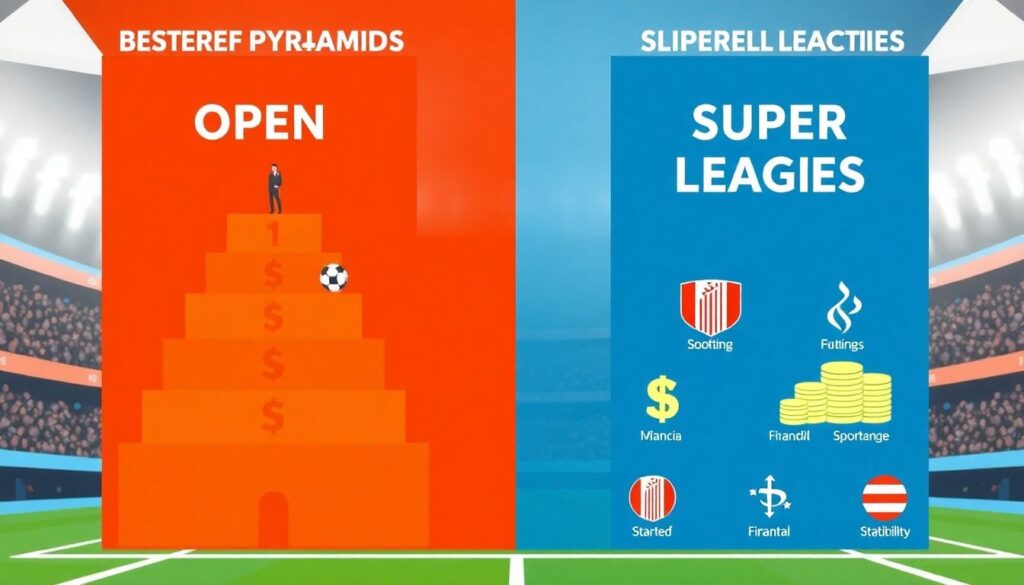
When comparing open pyramids with super leagues and other closed tournaments, use clear evaluation criteria:
- Sporting merit and access: How strongly does the model protect promotion-relegation and qualification via league position?
- Financial stability: How predictable are revenues across cycles, especially for medium-sized clubs?
- Revenue growth potential: Does the format maximise global interest, new markets and premium broadcasting packages to watch ver superliga europea en directo?
- Competitive balance: Does it reduce or magnify the gap between top and smaller clubs, domestically and in Europe?
- Fan legitimacy: How will match-going supporters react, and what is the likely reputational impact in traditional markets like LaLiga?
- Regulatory risk: Is the format compatible with UEFA/FIFA rules, EU competition law and national sports regulations?
- Contractual complexity: How disruptive is it for existing broadcast, sponsorship and stadium agreements?
- Calendar integration: Can the format coexist with domestic leagues and cups without degrading them?
- Long-term ecosystem impact: How does it affect grassroots, smaller professional clubs and the overall impacto económico superliga europea fútbol?
Revenue mechanics: TV rights, sponsorships and investor models
The core comparison is how each competition structure converts sporting content into stable, scalable cash flows. The table below contrasts key options that Spanish and European stakeholders actually debate.
| Variant | Best suited for | Advantages | Drawbacks | When to choose |
|---|---|---|---|---|
| Traditional open pyramid (domestic leagues + UEFA competitions) | National federations, most clubs, regulators prioritising sporting merit | Preserves promotion-relegation; high legitimacy with fans; spreads European money across performance levels; simpler alignment with UEFA/FIFA and national laws. | Revenue volatility for clubs outside the elite; difficult to ring‑fence income; competitive gap between big and small clubs can widen despite solidarity. | When political risk of reform is high and domestic leagues (e.g. LaLiga) remain commercially strong. |
| Semi-closed enhanced Champions League style | Top clubs wanting more recurring games, UEFA seeking control | More guaranteed high‑value fixtures; easier to monetise derechos de televisión superliga europea‑like packages; can still preserve some access for smaller clubs via qualification. | De facto favours historical giants; more congested calendar; perceived erosion of traditional national competitions. | When big clubs threaten breakaway but still accept UEFA leadership and partial merit-based access. |
| Fully closed European Super League | Large investor-backed clubs prioritising global brand and stable cash flows | Maximum predictability of income; highly attractive to private equity and global broadcasters; easier to lock in premium rights to ver superliga europea en directo via long contracts. | Minimal sporting access; strong fan backlash around merit; heavy legal and regulatory exposure; domestic leagues may be downgraded. | Only when clubs accept long-term conflict with UEFA/FIFA and can withstand political, legal and supporter pressure. |
| Hybrid Super League with promotion and relegation tiers | Reformers aiming to blend elite stability with genuine access | Some guaranteed places for big brands while reserving slots for sporting qualifiers; narrative of merit partly preserved; could improve long-term impacto económico superliga europea fútbol for more markets. | Complex governance; resistance from both purists and hardliners; tricky distribution of money between fixed and variable members. | When political stakeholders demand visible pathways for emerging clubs yet accept stronger protection for top brands. |
| Regional super conferences (e.g. Iberian/Mediterranean leagues) | Clusters of mid-to-large clubs in neighbouring countries | Creates new rivalries and TV products; may boost attendances and superliga europea entradas revenue for marquee fixtures; less radical than pan‑European closed league. | Risk of weakening national leagues; complex cross‑border governance; uncertain appeal to global broadcasters compared with a single European Super League. | When domestic markets are saturated and regulators are open to cross‑border experiments under UEFA umbrella. |
Competitive integrity: promotion, relegation and sporting fairness
Structuring competitions requires conditional rules that clarify how much sporting merit is non‑negotiable. The following scenarios illustrate practical choices.
- If your federation’s red line is full promotion-relegation across tiers, then rule out fully closed leagues and work instead on enhanced open formats with stronger revenue floors for smaller clubs.
- If you accept partial protection for top clubs, then favour hybrid models where a core of guaranteed participants coexists with spots awarded via league position or play‑offs.
- If domestic league integrity is the priority, then insist that any super league (closed or hybrid) depends on qualification through final domestic standings and does not fix permanent licenses.
- If your main concern is avoiding «dead» fixtures late in the season, then expand relegation and qualification incentives (extra European places, play‑ins) rather than closing access.
- If smaller clubs fear the loss of European opportunity, then codify minimum access quotas and solidarity payments in any super league agreement, protected by binding contracts.
- If big‑club owners argue that investment requires guaranteed participation, then negotiate time‑limited licences (e.g., multi‑year but renewable) instead of perpetual rights.
Regulation and litigation: governing bodies, antitrust and contracts
- Map existing obligations: list all TV, sponsorship and stadium contracts that could be breached by joining or creating a super league.
- Assess regulatory constraints: analyse UEFA/FIFA statutes, national federation rules and competition law applicability in your jurisdiction.
- Evaluate litigation exposure: estimate the risk and potential cost of being expelled from domestic or UEFA competitions, or sued by partners.
- Stress‑test governance models: decide whether the super league entity would be club‑owned, investor‑led, or a mixed cooperative, and check compatibility with local law.
- Negotiate regulatory carve‑outs: if moving forward, seek formal arrangements with federations to minimise sanctions and clarify calendar integration.
- Phase decisions: structure participation in stages (observer, provisional member, full member) with clearly defined legal exit ramps.
- Document fan and political risk: prepare for potential government intervention, particularly in markets where football is treated as cultural heritage.
Stakeholder impacts: clubs, players, supporters and broadcasters
Across Spain and Europe, recurring mistakes tend to appear when clubs and regulators choose between open and closed structures.
- Ignoring stadium-going fans and focusing only on global TV audiences when forecasting demand for superliga europea entradas.
- Underestimating how strongly supporters value promotion-relegation and how emotionally they react to reduced sporting access.
- Assuming that higher derechos de televisión superliga europea automatically translate into healthier club finances without cost control reforms.
- Overlooking player workload and contractual rights when adding midweek super league fixtures to already crowded calendars.
- Failing to provide transparent redistribution mechanisms for smaller clubs, damaging the long‑term talent pipeline and competitive balance.
- Over‑promising global broadcast deals and «ver superliga europea en directo» audiences without evidence from broadcasters or OTT platforms.
- Taking opiniones superliga europea clubes grandes as the only relevant voice and neglecting medium and small clubs’ sustainability concerns.
- Designing formats that satisfy investors but cannot survive legal or political scrutiny in key EU markets.
- Not planning communication strategies to explain the impacto económico superliga europea fútbol to local communities and public authorities.
Decision pathways: scenarios, triggers and likely transitions
- Start with your non‑negotiables: Is promotion-relegation essential, or is revenue stability the top priority?
- Check regulatory openness: Are national and UEFA bodies signalling flexibility, or clear resistance?
- Test fan sentiment: How would core season‑ticket holders and supporter groups respond to each format?
- Model financial outcomes: Compare realistic TV, sponsorship and matchday scenarios for each structural option.
- Choose a transition strategy: Gradual reform under UEFA, regional pilots, or immediate alignment with a super league project.
For regulators and leagues prioritising integrity and broad ecosystem health, the traditional open pyramid with incremental reform is usually best. For big clubs and investors focused on long‑term media plays, semi‑closed or hybrid super leagues are more attractive. Fully closed models are the most radical and fragile, best avoided unless all political and legal obstacles are clearly manageable.
Practical questions for policymakers and club executives
How should we weigh sporting merit against revenue stability?
Define clear thresholds. For example, decide how many places must always be earned on the pitch, and how much income volatility is acceptable. Then discard any format that breaks those red lines, even if it promises short‑term financial upside.
Can a European Super League coexist with strong domestic competitions?
It can only coexist if domestic qualification remains meaningful and calendars are protected. If super league places are fully guaranteed, domestic leagues will gradually become feeders or exhibitions, weakening long‑term interest and political support.
What is the realistic upside of TV rights in a closed super league?
Closed formats can bundle more frequent top‑brand clashes, which broadcasters value. However, projections must include potential boycotts, legal uncertainties and the risk that some markets reject the product if local clubs or traditions are sidelined.
How do we manage fan opposition to closed or semi-closed formats?

Engage early with supporter groups, explain financial constraints and present genuine alternatives. Protect visible sporting access and solidarity funds in binding rules, not just marketing statements, to build minimum legitimacy.
What governance model best protects clubs from investor overreach?
Structures where clubs retain collective control over key sporting decisions, with investors limited to commercial operations and capped returns, tend to balance capital needs with long‑term community interests.
When is a regional league more realistic than a pan-European super league?
Regional options work better when neighbouring markets share language, time zones and existing rivalries, and when national regulators are more open to gradual, reversible experiments than to a single disruptive European project.
How can smaller clubs benefit from any super league scenario?

They need contractually guaranteed solidarity mechanisms, clear qualification pathways and protection of domestic competitions that generate their main revenues. Without these, the gap to elite clubs will become structurally unbridgeable.