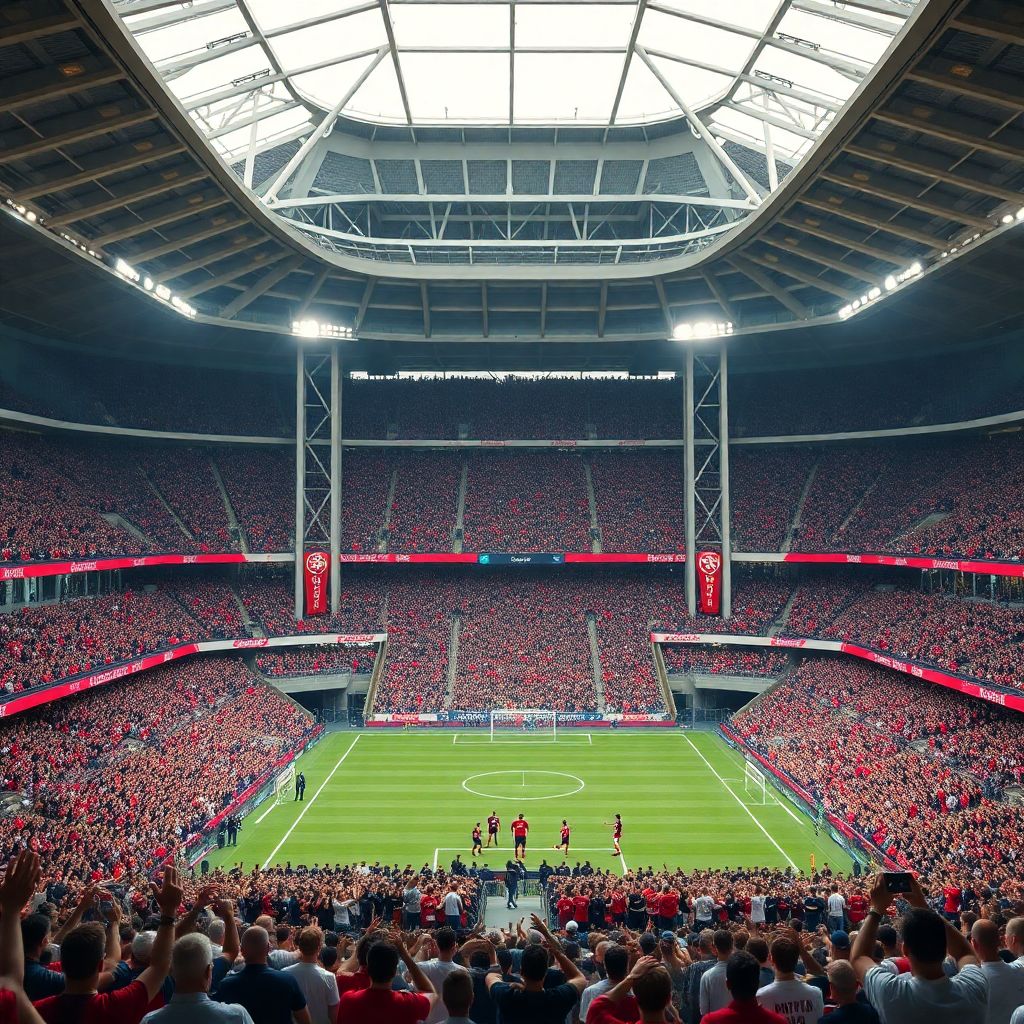
The football stadium functions as a contemporary ritual space where fans rehearse identity, belonging, and power through embodied practices: chants, movements, objects, and emotions. From an anthropological perspective, the hincha’s experience combines sacred time, symbolic architecture, and collective performance, making the matchday a structured rite rather than a simple entertainment event.
Core Ritual Elements of the Stadium
- The stadium suspends everyday time and creates a cyclical, almost sacred calendar for supporters.
- Its architecture organises vision, sound, and movement, shaping how fans participate and identify.
- Chants, rhythms, and gestures synchronise bodies and emotions into a collective subject.
- Objects such as flags, jerseys, and banners materialise memory, loyalty, and hierarchy.
- Boundaries between «us» and «them» are constantly produced, negotiated, and policed.
- Intense emotions operate as a shared «emotional economy» that offers both pleasure and catharsis.
Historical Roots of Spectator Rituals
Stadium rituals have historical roots in religious ceremonies, popular festivals, and early modern spectacles. Anthropologically, they are continuities and adaptations of older forms of collective gathering, now channelled through football as a central cultural narrative in societies like Spain.
Public games in ancient arenas, religious processions, and civic celebrations already combined structured time, spatial order, and symbolic performances. Modern football stadiums inherit this logic: fixed dates, codified sequences (arrival, chants, half-time, exit) and spatial differentiation (stands, pitch, VIP zones) reproduce a ritual grammar under secular, commercial forms.
For the hincha, attending a match in a La Liga stadium integrates family traditions, neighbourhood stories, and media narratives. Over years, these visits sediment as a personal ritual calendar that organises memories (first match, derbies, promotions, relegations). Researchers coming from antropología del deporte cursos online often overlook these long historical continuities and focus only on present-day fan culture.
Mini-scenario (historical perspective): A research team in Madrid compares old photos from the 1980s with current tifos in the same stadium. They identify persistent elements (club colours, rivalries, choreographies) and new ones (commercial banners, social media references), showing how ritual forms adapt while preserving core structures of belonging.
- Clarify the historical links between religious festivals, civic parades, and football matches.
- Track how specific clubs in Spain built ritual calendars around derbies and decisive games.
- Use interviews with older fans to reconstruct changes in songs, banners, and behaviour.
- Relate your findings to classic texts before buying nuevos libros de antropología del fútbol comprar to deepen theoretical framing.
Spatial Layout and Symbolic Architecture
The stadium’s spatial design is not neutral; it encodes hierarchies, access, and ritual functions. Architecture channels sound, vision, and movement, shaping how the hincha experiences the match and how collective identities are spatially produced.
In many Spanish grounds, the fondo where ultras stand operates as the ritual engine of the stadium. Seating categories (grada joven, tribuna, VIP, family areas) map social distinctions, price differences, and styles of fandom. Entry gates, security perimeters, and away sections create controlled contact zones between rival groups and define what is considered legitimate presence.
Mini-scenario (spatial mapping): During an experiencia del hincha en el estadio estudio de mercado for a club in Andalucía, researchers map fan flows from metro stations to different gates. They detect that younger groups cluster in specific approaches to the ultras stand, converting those routes into informal pre-game ritual corridors with chants, beer, and street vendors.
- Identify key ritual zones: ultras end, family stands, away sector, VIP boxes, access ramps.
- Observe how sound travels (chants, drums) and where it concentrates or dissipates.
- Note how price and category of seats reproduce or contest social inequalities.
- Analyse how segregation barriers and police lines define the limits of «legitimate» fandom.
- Include architectural analysis when designing a diplomado en gestión de eventos deportivos y afición syllabus.
Collective Behavior: Chants, Gestures, and Rhythms
Collective behaviours are patterned sequences of sound and movement that synchronise individuals into a perceived unity. Chants, gestural codes, and rhythmic clapping transform dispersed spectators into a visible and audible collective actor.
These practices follow implicit rules: who initiates, when to intensify, how to react to the referee or rival fans. The curva or supporters’ group usually acts as ritual specialist, deciding songs, tempos, and visual displays. Rhythms provide temporal structure, turning goals, fouls, and substitutions into moments of emotional crescendo or protest.
Typical application scenarios:
- Pre-match warm-up: A supporters’ group rehearses new chants at the bar, then introduces them in the first 10 minutes to test adoption by the broader crowd.
- Crisis management: After a controversial decision, capos quickly switch from celebratory songs to protest chants, steering collective anger towards the referee rather than internal conflicts.
- Rivalry intensification: During a derby, alternating call-and-response chants with rivals create a sonic battle where volume and creativity symbolise superiority.
- Solidarity gestures: Coordinated applause in minute 12 for a deceased fan turns the game into a memorial ritual, temporarily suspending rivalry.
Mini-scenario (behavioural coding): A student completing a maestría en sociología del deporte precio medio in Barcelona records video in one stand to code when chants start, who leads them, and how they travel. The analysis reveals that three capos control most transitions, functioning as informal ritual directors.
- Map the main leaders of chants and their communication strategies (megaphones, drums, gestures).
- Distinguish between celebratory, aggressive, ironic, and memorial songs.
- Observe how rhythms structure time during lulls in play.
- Document how newcomers learn chants through repetition and peer pressure.
- Relate micro-behaviours to broader power relations within fan groups.
Material Culture: Flags, Jerseys, and Artefacts
Material culture refers to the physical objects through which ritual meaning is expressed and stabilised. In stadiums, flags, scarves, jerseys, banners, and drums embody history, hierarchy, and attachment.
Objects allow continuity across generations: an inherited scarf, an old club badge, or a drum used for decades. At the same time, commercial replicas and fast-fashion jerseys make belonging more accessible but also more market-driven. Visual displays (tifos, mosaics) rely on coordinated use of simple objects like coloured cards or plastic sheets, turning the entire stand into a monumental symbol.
Mini-scenario (object biography): In a qualitative project in Valencia, researchers follow the life history of a single flag from its creation for a promotion playoff to its current use in every home match. Photos and interviews show how this artefact has accumulated meanings of sacrifice, travel, and resilience for the same group of friends.
Advantages of material culture in stadium rituals
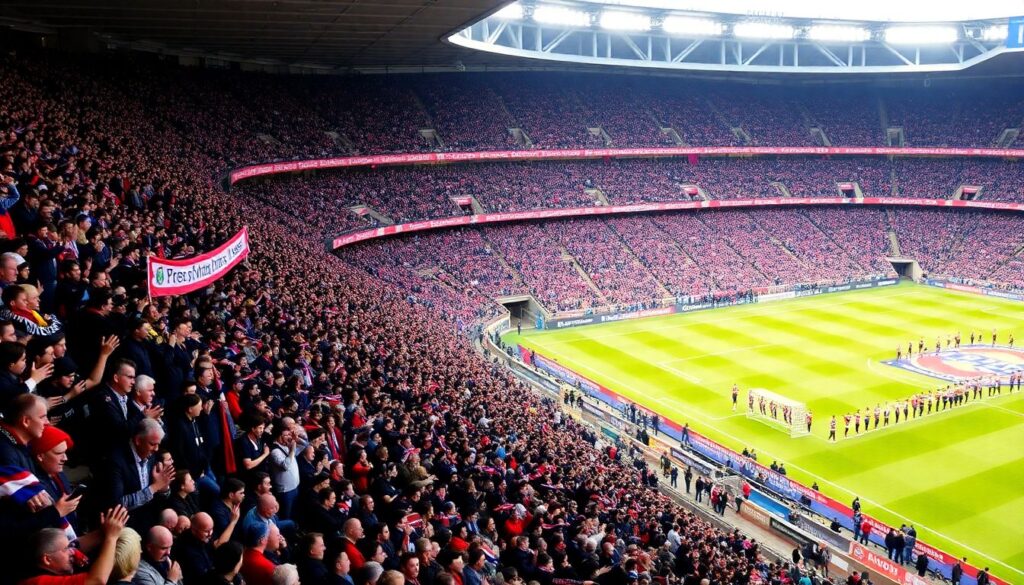
- Provides visible markers of belonging that are easily recognisable for cameras and other fans.
- Enables large-scale visual choreographies that intensify emotional impact.
- Creates tangible links to past events, heroes, and collective memories.
- Helps new supporters integrate quickly by adopting shared symbols (scarves, colours).
Limitations and tensions of material culture
- Commercialisation can reduce symbols to merchandise, diluting their collective meaning.
- Exclusive or expensive items may reinforce internal hierarchies among fans.
- Certain artefacts (political banners, provocative symbols) can trigger sanctions or conflict.
- Club control over official branding can clash with grassroots creativity.
- Identify which objects are mass-produced and which are handcrafted by fans.
- Follow the «biography» of a key artefact through photos and interviews.
- Analyse the balance between club-controlled and supporter-controlled symbols.
- Integrate material culture modules into antropología del deporte cursos online for practical observation exercises.
Boundary-Making: Inclusion, Exclusion, and Identity
Boundary-making is the continuous process of defining who belongs and who does not. In the stadium, this operates through language, space, clothing, and behaviour, producing layers of inclusion and exclusion among fans and between fans and others.
Markers such as colours, accents, ticket categories, and knowledge of chants classify people. Visiting fans, tourists, and casual spectators may be tolerated but rarely recognised as full insiders. Gender, class, and race also shape access and treatment, even when not openly discussed. Understanding these boundaries is essential for any diplomado en gestión de eventos deportivos y afición that aims at inclusive and safe environments.
Mini-scenario (misrecognised fan): A woman season-ticket holder in Bilbao, attending for years with her family, is repeatedly treated by stewards as a «guest» rather than a core supporter. Her story reveals how gendered expectations still mark the boundary between «real» hinchas and «accompanying» spectators.
Frequent analytical mistakes and persistent myths
- Assuming that all fans in the same stand share identical identities and political views.
- Romanticising ultras as purely authentic while overlooking their exclusionary practices.
- Interpreting violence only as «irrational» instead of situating it in boundary defence logics.
- Ignoring how ticket pricing and seat categories produce class-based segregation.
- Believing that anti-racist or inclusive club campaigns automatically transform everyday practices.
- Differentiate multiple insider categories: ultras, traditional season-ticket holders, casuals, tourists.
- Pay attention to how stewards and police treat different types of supporters.
- Collect narratives from those who feel marginal or displaced in the stands.
- Contrast club discourse on inclusivity with observed boundary practices.
Emotional Economies: Performance, Awe, and Catharsis
Emotional economies are patterned circuits of feeling that give value to certain experiences (euphoria, rage, pride) and distribute them across participants. The stadium organises peaks and valleys of affect that keep fans engaged and returning.
Goals, referee decisions, and rivalry moments concentrate emotional energy. Chants, gestures, and artefacts help process frustration or disappointment, turning potentially destabilising emotions into shared narratives («we were robbed», «we never give up»). The hincha learns to inhabit and reproduce these emotional codes, contributing to the stadion’s persistent attraction.
Mini-case (one match, three emotional peaks):
- Pre-match expectation: As line-ups appear, a youth stand in Sevilla organises a chant that builds tension; drums slow down, then accelerate, generating a collective sense of impending drama.
- Unexpected defeat: After conceding a late goal, silence dominates for several seconds. Then, a small group starts a song that reframes the loss as proof of loyalty («we are always here»). The chant spreads, softening anger.
- Post-match re-signification: Leaving the stadium, fans repeat fragments of the same chant in metro corridors, transporting emotion into urban space and reinforcing group cohesion despite defeat.
- Identify key emotional peaks in the match and the rituals associated with each.
- Observe how leaders transform negative emotions into narratives of pride or victimhood.
- Use audio recordings to capture shifts in volume, tempo, and tone across the game.
- Relate stadium emotional economies to everyday stress and relief in fans’ lives.
Applied Mini-Scenarios for Different Research Uses
This section suggests quick scenarios that link theory to practice in various professional and academic contexts in Spain.
- Designing an online course module: For antropología del deporte cursos online, assign students to map ritual sequences of a televised match (arrival, anthem, chants, tifos). They submit short fieldnotes focusing on transitions between everyday and ritual time.
- Preparing a market study for a club: In an experiencia del hincha en el estadio estudio de mercado, combine surveys with ethnographic observation of pre-game routes, entry gates, and post-match exits to detect friction points and ritual opportunities (family zones, memorial spaces).
- Evaluating educational programmes: When assessing a diplomado en gestión de eventos deportivos y afición, include practical visits where participants must identify inclusion/exclusion mechanisms and propose low-cost architectural or ritual tweaks to reduce tensions.
- Budgeting a specialised degree: Students considering a maestría en sociología del deporte precio in Spain can use this framework to design their thesis proposals, specifying which ritual dimension (space, objects, emotions) they will prioritise and why.
- Curating a reading list: Researchers deciding qué libros de antropología del fútbol comprar can focus on works that clearly connect empirical stadium ethnographies with theoretical debates on ritual, embodiment, and emotional economies.
Self-Check Checklist for Stadium Ritual Analysis
- Have you identified how stadium time differs from everyday time for fans?
- Have you mapped key ritual zones and access routes in and around the ground?
- Have you documented both collective behaviours (chants, gestures) and material culture (flags, jerseys)?
- Have you analysed mechanisms of inclusion and exclusion beyond official club discourse?
- Have you traced emotional peaks across the match and linked them to specific rituals?
Practical Clarifications for Researchers
How is a stadium ritual different from simple entertainment?
A stadium ritual includes repetition, symbolic meaning, and structured transitions that separate «inside» and «outside» time. Unlike pure entertainment, it reaffirms identities and social bonds through predictable sequences and shared emotions.
What basic methods work best for studying hincha experiences?
Participant observation, semi-structured interviews, and visual/audio recording are usually sufficient at intermediate level. Combining these with simple spatial mapping of stands and access routes already reveals core ritual patterns.
Can I rely only on TV broadcasts for my analysis?
Television helps with chants and visual displays, but it hides access routes, security controls, and marginal zones. For serious research, you need at least some in-situ observation to capture boundary-making and informal interactions.
How many matches should I observe to detect stable rituals?
Instead of a fixed number, focus on variation: attend league games, derbies, and low-stakes matches. When the same chants, gestures, and artefacts appear across these contexts, you can speak of stable ritual elements.
How do commercial interests affect stadium rituals?
Sponsorships, merchandising, and media rights shape architecture, scheduling, and object circulation. They do not eliminate rituals, but they influence which symbols are amplified, tolerated, or marginalised in the stands.
Is violence an inevitable part of football rituals?
Violence appears in some contexts, but it is not structurally necessary for rituals to function. Many intense stadium experiences rely on symbolic conflict and controlled transgression rather than physical aggression.
How can clubs use this knowledge to improve fan experience?
Clubs can respect and support organic rituals while reducing exclusionary or dangerous practices. This involves designing flexible spaces, negotiating with supporter groups, and integrating fan knowledge into event management training.