
Football can open real but extremely rare paths of social mobility, especially for young people from low‑income backgrounds, yet most dreams of «del potrero a la Champions» never become professional contracts. Understanding how academies, scouts, education, and labor markets actually work is essential to turn passion into safer, more realistic life opportunities.
Core arguments on football as a vehicle for social mobility
- Football creates highly visible success stories but statistically tiny chances of becoming an elite professional.
- movilidad social a través del fútbol happens mostly through structured systems: academies, education, and networks.
- Myths about pure talent hide structural barriers of class, race, geography, and migration policy.
- Protective strategies (education, guidance, savings) reduce risks of failure and exploitation.
- Clubs, federations, and public policy can spread benefits beyond the few stars via community programs and scholarships.
- Narratives from media and families strongly shape expectations, decisions, and identities of young players.
Historical trajectories: football’s evolution as a social ladder
The idea of «from the street pitch to global fame» emerged when early professionals came from working‑class neighborhoods and could suddenly earn more than local teachers, doctors, or factory owners. As broadcasting and sponsorship grew, individual success stories turned into a powerful collective myth.
Today, oportunidades económicas en el fútbol profesional exist, but they are concentrated in a tiny elite of leagues and clubs. The industry has professionalized: scouting databases, agents, training centers, and legal regulations have replaced informal trials in many contexts, especially in Europe and Spain.
For Latin America and Spain, football functions as a hybrid social ladder. It can provide upward mobility through salaries, scholarships, and later coaching or media jobs, but also reproduces inequality when only those who access quality training, nutrition, and networks can compete seriously. The phrase «del potrero a la Champions» describes more an exception than a rule.
To use football as a realistic tool for life improvement, families and practitioners must see it not as a magic escape from poverty but as one potential path among others, which works best when combined with schooling, vocational training, and financial literacy.
Debunking myths: the limits of the ‘from the pitch to glory’ narrative
- Myth: Talent alone is enough. Reality: Without structured training, exposure to scouts, and documentation (passports, visas, licenses), even outstanding talent rarely reaches professional levels.
- Myth: If you are good, they will find you. Reality: Scouts focus on specific regions, tournaments, and partner academies; many regions and barrios are barely watched.
- Myth: The professional contract solves everything forever. Reality: Careers are short, injuries common, and many contracts are low or unstable outside the top leagues.
- Myth: Quitting school is a necessary sacrifice. Reality: Education increases chances of scholarships, post‑career jobs, and understanding of contracts and finances.
- Myth: European clubs are always a guarantee of success. Reality: cómo llegar del potrero al fútbol europeo usually involves trials, adaptation, strong competition, and sometimes early terminations.
- Myth: Agents and intermediaries are always helpful. Reality: Good agents guide careers; bad or fake agents charge fees, abandon players, or put them in exploitative deals.
Narratives and identity: how stories shape opportunity and expectation
Below are concrete scenarios showing how narratives drive decisions and risks.
Scenario 1: The single‑path dreamer
A 14‑year‑old from a barrio in Buenos Aires hears only success stories of idols. Family repeats that football is the «only way out». He stops studying, joins an informal academy, ignores injuries to keep playing, and accepts a suspicious trial abroad because it fits the heroic story in his head.
Scenario 2: The «responsible dream» family
Parents in Sevilla support their daughter’s football dream but keep her enrolled in school and language classes. They research academias de fútbol для talentos de bajos recursos and seek local clubs that coordinate with schools. When a trial in another city appears, they negotiate education continuity and safe accommodation before accepting.
Scenario 3: The invisible talent
A talented boy in rural Colombia trains barefoot, with little transport money. Media stories convince him that «if you are good, you will be discovered», so he waits instead of actively searching for becas y visores de fútbol para jóvenes latinoamericanos. Years pass, and age limits close his window.
Scenario 4: The early migrant
A 17‑year‑old from Morocco moves to Spain after being promised trials with lower‑division clubs. Reality: he works unstable jobs, trains at night, and his documents are irregular. The original narrative of fast success prevents him from planning language learning or professional training that would expand his options.
Scenario 5: The role‑model mentor
A retired second‑division player in Madrid visits community centers, explaining that his modest career paid for university and a coaching diploma, but not luxury. His story adjusts expectations: football becomes one element of a diversified future instead of an all‑or‑nothing bet.
Mechanisms of mobility: academies, scouts, networks and informal routes

To move from potrero pitches to professional environments, young players typically pass through several mechanisms that filter, support, or exploit them. Understanding these mechanisms helps families and practitioners take concrete, low‑risk actions instead of relying on luck.
Formal mechanisms in practice
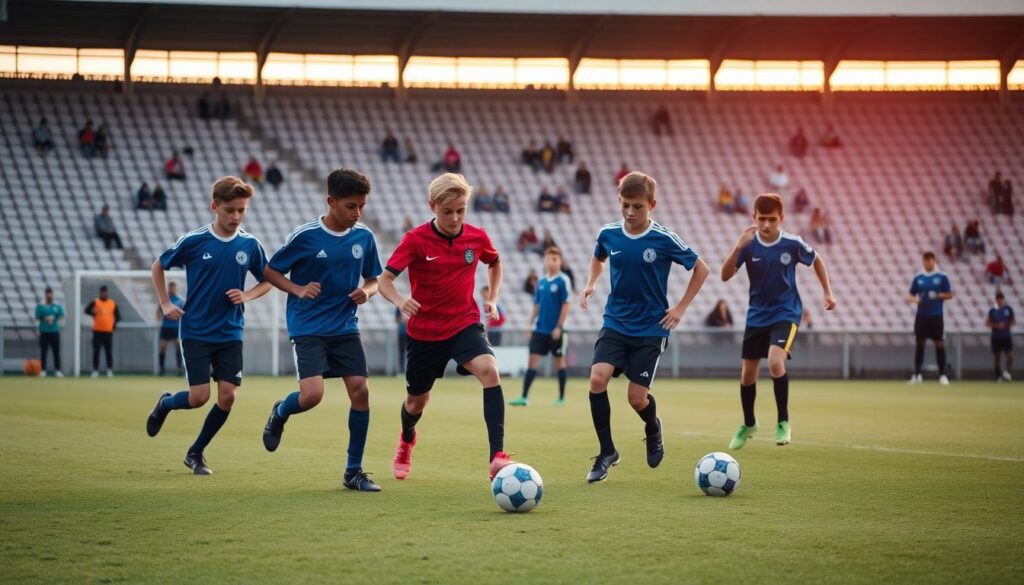
- Local clubs and federated competition: Registering in an official club puts players into structured leagues where scouts can objectively compare performance.
- Professional and semi‑professional academies: academias de fútbol para talentos de bajos recursos may offer subsidized places, boarding, nutrition, and schooling, often in partnership with bigger clubs.
- Regional and national selections: Participation in official tournaments increases visibility and often attracts visores from professional teams and agencies.
- Scholarships and exchange programs: Some players gain educational mobility via university scholarships, often in the US or private schools in Spain, using football as an entry door.
- Licensed agents and intermediaries: Legitimate agents connect players to clubes, negotiate contracts, and manage international moves, especially to European markets.
Informal and high‑risk mechanisms
- Unregulated «academies» that charge high fees, promise trials abroad, but have no official links to clubs or federations.
- Paid trials and showcase tournaments with unclear information about attending scouts and no follow‑up plans.
- Social media talent hunting where strangers offer contracts or visas without verifiable identity or track record.
- Migration through tourist visas with the hope of being discovered after arrival, often resulting in irregular status and vulnerability.
Practical mini‑scenarios of decision‑making
These short application cases show how to use the understanding of mechanisms in daily choices:
- Choosing between two academies: A family in Lima compares one expensive, informal academy promising contacts in Europe, and one cheaper club integrated into the official federation. They select the second because it guarantees federated competition, insurance, and documented exposure to scouts.
- Responding to a social‑media message: A teenager in Bogotá receives an Instagram message about a trial in Spain. Instead of sending money, he asks for the intermediary’s license number, club letter, and contract sample, and checks with the national federation before deciding.
- Planning educación + fútbol: A girl in Valencia uses football to apply for a scholarship in a private school with strong sports programs, improving both her training quality and academic support rather than choosing a pure football academy with no study options.
Benefits of football‑based mobility mechanisms
- Can provide structured routines, mentorship, and safe spaces compared to street environments.
- Offer access to better nutrition, medical care, and psychological support in well‑run academies.
- Create networks that later translate into coaching, scouting, or other football‑related jobs.
- In scholarship models, combine sport with formal education and language learning.
- For a small minority, open high‑earning professional careers, sometimes including international migration.
Limitations and risks to manage
- Extremely low probability of reaching top‑level opportunities económicas en el fútbol profesional.
- Concentration of visibility in certain cities, clubs, and tournaments, leaving many regions outside the radar.
- Financial pressure on families to pay fees, equipment, and travel without guaranteed returns.
- Exposure to scams, irregular migration, and contract exploitation, especially in transnational moves.
- Risk of identity collapse and mental‑health issues when the football dream ends without alternative plans.
Structural barriers: class, race, geography and the precarious labor market
- Thinking effort can cancel structural inequality: Discipline is essential, but it does not compensate for poor nutrition, lack of safe playing fields, or the absence of scouts in certain areas.
- Ignoring class and race bias in selection: Coaches and clubs may unconsciously favor players who fit certain physical, social, or linguistic norms, especially when moving into European contexts.
- Underestimating geographic isolation: Rural players or those far from football centers face transport costs and limited league access, which drastically reduce their visibility compared to urban peers.
- Romanticizing unstable jobs: Many contracts in lower divisions are short‑term or semi‑professional. Seeing any contract as a permanent escape neglects the precarity of this labor market.
- Overlooking migration rules: cómo llegar del potrero al fútbol europeo is not only about skill; work permits, age limits, and non‑EU player quotas create invisible ceilings.
- Assuming gender does not matter: Women’s football is growing but still offers fewer contracts, lower salaries, and limited media visibility compared to men’s game in most countries.
Practical interventions: club programs, education and policy levers
This section focuses on concrete, implementable actions for clubs, NGOs, schools, and local governments that want to turn football into a safer, more inclusive path of movilidad social a través del fútbol.
Mini‑case: Community club in a low‑income neighborhood
A neighborhood club in Barcelona decides to shift from «win at all costs» to «football as life project» for teenagers from low‑income families.
- Diagnosis: Many players skip school for training, parents do not understand the system, and unlicensed agents frequently visit games offering trials abroad.
- Actions implemented:
- Introduce a simple rule: players must be enrolled in school; repeated absences trigger a meeting with family.
- Create monthly workshops on contracts, migration, and realistic probabilities of professional careers.
- Invite verified agents, scouts, and ex‑players to explain how becas y visores de fútbol para jóvenes latinoamericanos actually work.
- Sign cooperation agreements with local schools to coordinate training times and share information about academic performance.
- Set up a transparent scholarship fund for equipment and transport, prioritizing the most vulnerable families.
- Results after several seasons: Very few players sign professional deals, but many use football to access vocational programs, stay in school longer, and avoid risky migration decisions based on false promises.
Simple action blueprint for practitioners
Adapt this minimal «pseudo‑plan» to your context:
- Map your ecosystem: List local clubs, academies, schools, public programs, and trusted agents; identify who already supports low‑income youth.
- Set guardrails: Establish clear criteria for accepting trials, paying fees, or traveling abroad (license checks, written invitations, school continuity).
- Educate families and players: Run short, repeated sessions on probabilities, career alternatives, and basic financial skills.
- Build dual pathways: Design programs where every football activity is linked to education, training, or employability services.
- Monitor and adapt: Track dropouts, school attendance, and well‑being, not only match results; adjust your approach each season.
Practical questions practitioners ask about sport-driven mobility
How can a community club realistically support mobility without selling false hopes?
Focus on dual careers: make schooling non‑negotiable, offer tutoring, and invite professionals to talk about non‑playing careers in sport. Present professional contracts as a bonus outcome, not the main goal, and celebrate educational and personal milestones as much as trophies.
What should families check before paying for an international trial or academy?
Verify the academy’s legal status, links with official clubs or federations, and references from former players. Ask for written conditions (costs, accommodation, schooling) and cross‑check the intermediary’s license with national or FIFA databases. Never send money to private accounts without contracts.
Are football scholarships a safer path than pure professional dreams?
Scholarships that combine football with secondary school or university usually provide better long‑term security. They reduce financial risk and open non‑sport careers while keeping the football dream alive. Evaluate the quality of both the academic program and the training environment, not only facilities.
How can coaches reduce the psychological damage when players do not «make it»?
Normalize failure as part of sport, share stories of players who built good lives outside professional football, and provide structured transitions when releasing players. Encourage diverse identities («student», «friend», «musician») so a rejected contract does not feel like a total identity collapse.
What role can schools in low‑income areas play in this process?
Schools can partner with clubs to align schedules, monitor attendance, and share information about student‑athletes. They can host talks on contracts, migration, and digital scams, and promote academic excellence as compatible with high‑level sport, not as a rival to it.
How do we handle unlicensed agents approaching very young players?
Create a clear club policy: all approaches must go through official channels, with parents present and written documentation. Publicly support families who refuse suspicious offers, and educate players on basic red flags such as requests for cash, lack of contracts, or pressure to travel alone.
Is it worth investing in girls’ and women’s football in poor communities?
Yes. Even where professional opportunities are fewer, women’s football brings health, confidence, leadership skills, and sometimes scholarships. Investing early also positions players for future growth of the women’s game, while signaling to the community that girls’ dreams are equally valuable.