
Football became a mass‑market consumer product when broadcasting, sponsorship and global branding started to matter as much as sporting success. From the late 20th century, leagues, clubs and players were packaged, priced and marketed like entertainment assets, driven by TV rights, merchandising and digital platforms rather than purely by local community logics.
Defining the Shift: Football as a Mass‑Market Commodity
- Football moved from local pastime to global entertainment once matches were sold as media content rather than only live events.
- Key inflection points: professionalisation, national leagues, all‑seater stadiums, pay‑TV and international tournaments.
- Modern fútbol moderno negocio del deporte relies on diversified revenues: broadcasting, sponsorship, ticketing, merchandising and data.
- Marketing reframed clubs as lifestyle brands, not just sports institutions.
- Digital distribution and social media turned fans into always‑on consumers of football content.
- Regulation, fan movements and public opinion still set limits to full marketization.
Early Commercial Roots: From Local Matches to National Spectacles
To understand when football became a mass‑market product, it helps to see it as a gradual layering of commercial logics onto a community game. Early professional clubs in Europe and Latin America already charged for tickets and pursued trophies, but the core remained local identity and physical attendance.
As national leagues were organised and stadiums improved, clubs realised they were selling more than a match: they were selling a weekly ritual. In Spain, England or Argentina, weekend fixtures turned into predictable spectacles, attracting advertisers, newspapers and later radio stations. Commercialisation here was still limited: the product was the live event, not yet a global entertainment franchise.
The decisive step toward mass‑market status came once football could reach millions who never set foot inside a stadium. Radio, then television, transformed matches into reproducible content. At that point, it made sense to talk about football as part of a wider entertainment economy, competing with cinema, music and, later, video games for attention and leisure spending.
A simplified timeline of this shift looks like this:
- Local pastime: informal games, community‑based clubs, minimal ticketing.
- Professional leagues: regular fixtures, paid players, stadium investments.
- National spectacle: radio and early TV, press coverage, basic sponsorship.
- Global entertainment: pay‑TV, branding, star players, international tours.
- Digital ecosystem: streaming, social media, data‑driven monetisation.
Common interpretative mistakes around this history usually come from nostalgia or simplification. Many people imagine a pure, non‑commercial past that never really existed, or they blame a single villain (TV, agents, the Bosman ruling) instead of seeing an accumulation of changes over decades.
- Distinguish clearly between local/professional, national spectacle and global entertainment phases.
- Avoid blaming one factor; treat TV, sponsorship, regulation and culture as interacting drivers.
- When you criticise fútbol moderno, specify whether you mean scheduling, pricing, governance or fan experience.
Broadcasting and Technology: How Media Turned Matches into Products
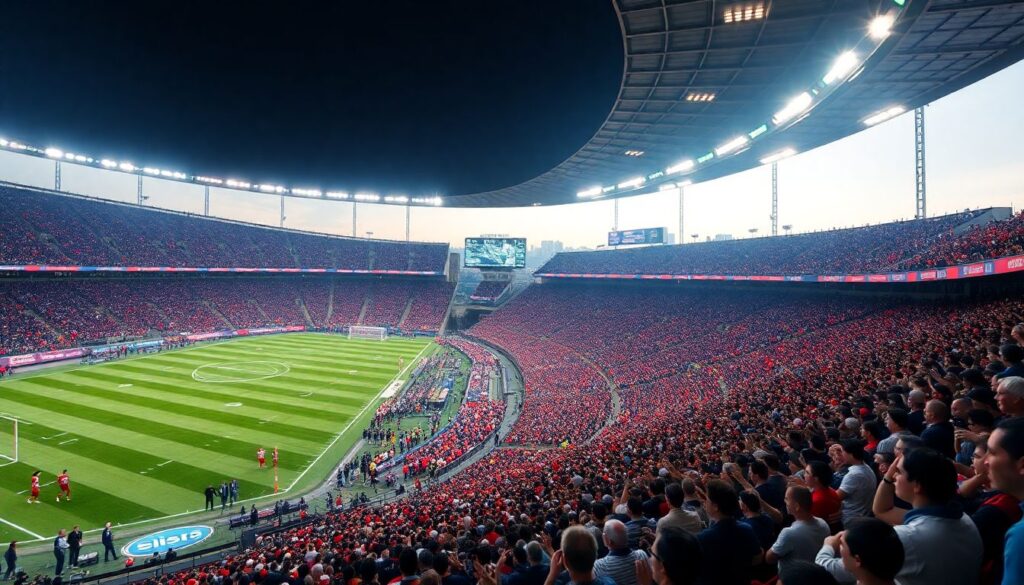
Broadcasting and technology are the main mechanisms that converted football into scalable, repeatable, tradable content. Instead of selling one stadium seat once a week, clubs and leagues could sell the same 90 minutes to millions of viewers, advertisers and now algorithms.
- Radio and free‑to‑air TV
Early broadcasts created national audiences and turned big derbies into shared cultural events. Clubs gained prestige and modest extra income, but football was still mostly a public service, not a premium commodity. - Pay‑TV and exclusive packages
With the rise of satellite and cable, leagues sold bundled derechos de televisión fútbol precios y contratos to broadcasters. Matches became paywalled content, scheduled to maximise subscriptions and advertising, not local convenience. - Globalisation of live rights
Top European leagues started selling rights abroad, making a LaLiga match in Madrid a must‑see product in Asia or North America. This globalisation created time‑zone‑friendly kick‑offs and pre‑season tours, optimised for TV audiences. - HD, VAR and production values
Technological upgrades (multiple cameras, graphics, VAR, surround sound) aligned football with high‑end entertainment. The match experience on screen became choreographed content, not just a raw broadcast of a game. - Streaming and platforms
The jump to consumo masivo de fútbol streaming y plataformas deportivas changed who controls the gate to audiences. Tech companies, OTT services and even clubs’ own platforms now compete with traditional broadcasters, fragmenting access and subscription models. - Data, second screens and social media
Clips, highlights, stats and memes circulate constantly. For younger fans, the product is not just live matches but endless snackable content around them.
Frequent analytical errors here include assuming that more cameras automatically mean a better sport, or that streaming is always more democratic. In practice, new technologies often shift power and revenue upstream, away from smaller clubs and grassroots structures.
- When evaluating a broadcast deal, look at scheduling, revenue distribution and accessibility, not just headline rights fees.
- Assess whether a new platform improves affordability and access for fans in Spain, not just global reach.
- Separate technological improvements that serve sporting justice from those mainly designed to increase monetisation.
Club Business Models: From Member Associations to Global Brands
Most early clubs were member‑run associations embedded in neighbourhoods or workplaces. Over time, as money and risk grew, many shifted towards corporate structures. Today, some clubs are listed on stock exchanges, others are owned by investment funds or states, and a few retain strong member control.
This transformation affects how clubs make decisions and whom they consider their primary customer. Is it the local season‑ticket holder, the global TV audience, commercial partners, or investors? Modern club strategies mix all of these, but the balance varies widely between contexts such as Spain, England and Latin America.
- Member‑owned clubs with commercial arms
Model common in Spain and parts of Germany, where socios retain formal power but professional executives run business operations. Here, tension appears when commercial decisions (kick‑off times, ticket prices) clash with members’ values. - Corporate ownership focused on profit
Private owners treat clubs as assets within a wider portfolio. Investment in players, academies or stadiums is evaluated in business terms. The risk is short‑termism, prioritising immediate financial performance over sporting or social goals. - State‑backed and soft‑power projects
Some clubs are tools of geopolitical influence. Commercial logic blends with political aims. This can inject huge resources and distort competitive balance, while raising ethical concerns for fans. - Multi‑club ownership networks
Groups owning several clubs share scouting, data and commercial deals. Talent becomes an asset that can be moved strategically within the network, affecting local identity and competitive integrity. - Latin America vs Europe
In parts of Latin America, clubs still depend heavily on transfer income and matchday cash, with weaker local TV markets and unstable governance. European giants, in contrast, lean on stable broadcasting money, global sponsorships and strong brands.
A recurring mistake is to treat all clubs as if they had the same freedom to choose their model. Legal frameworks, league rules and historical legacies constrain options; Spanish socio‑based institutions face different trade‑offs than privately owned Premier League sides.
- Identify clearly who controls your club (members, investors, state, group) before judging its decisions.
- When you hear about a new investor, ask how they plan to balance sport, community and business over 5-10 years.
- Compare your club’s revenue mix (tickets, TV, sponsorship, transfers) to its league peers, not to global super‑clubs.
Players, Agents and the Transfer Economy: Talent as Capital
One visible sign that football became a consumer product is how players are treated as assets within a transfer market. Contracts, image rights and agent commissions are central to club strategies and media narratives. Talent is bought, sold and amortised like capital, even though we are dealing with human beings.
The modern transfer system grew with the abolition of rigid restrictions on player movement, landmark legal cases and the globalisation of scouting. Agents emerged as key intermediaries, navigating contracts, image rights and off‑field deals that plug players into the broader entertainment economy.
Advantages of a market for talent
- Players can negotiate better conditions and move more freely to clubs that value them, increasing professional autonomy.
- Smaller clubs can fund themselves via player trading, developing talent to sell on to richer teams.
- A transparent transfer economy clarifies asset values on club balance sheets, attracting investors and lenders.
- Strong agents can protect players’ interests in complex negotiations, especially around image rights and personal branding.
Limitations and structural risks
- Inflation and speculation in fees can destabilise club finances and widen the gap between elites and the rest.
- Over‑reliance on transfer income makes clubs vulnerable to market shocks or regulatory changes.
- Younger players may be treated more as tradable assets than as people with long‑term development needs.
- Conflicts of interest can arise when intermediaries represent multiple parties or influence club strategies.
A common analytical error is to blame agents alone for all excesses. In reality, clubs, leagues, broadcasters and sponsors collectively build the money flows that make extreme deals possible.
- When judging a big transfer, distinguish between sporting logic, marketing value and financial engineering.
- Look beyond fees to contract length, salary structure and resale potential to understand real risk.
- Question narratives that demonise players or agents while ignoring club mismanagement and regulatory gaps.
Sponsorship, Merchandising and the Matchday Experience
Sponsorship and merchandising are the most visible faces of football as a consumer product. Logos on shirts, brands in stadium names, and club shops full of lifestyle products show how the industria del fútbol merchandising y patrocinios has evolved beyond simple advertising into long‑term partnerships and co‑branded experiences.
On matchdays, this logic extends to food, music, fan zones and hospitality packages. The stadium becomes a venue where every surface and moment can, in theory, be monetised. Done well, this can enhance the fan experience; done poorly, it can feel like pure extraction.
Typical misconceptions and how to avoid them
- "More sponsors always mean more money for the team"
Low‑quality or misaligned sponsors can damage the club’s image and alienate fans. Prevention: prioritise fewer, better‑aligned partners and be transparent about ethical criteria. - "Higher shirt prices have no real impact on loyalty"
Overpriced kits can push out younger or less affluent supporters. Prevention: maintain basic, affordable ranges and limit the number of compulsory kit changes per season. - "Turning stadiums into malls improves atmosphere"
Excessive commercialisation can dilute local culture and chants. Prevention: protect safe standing/active supporter areas, local bars and traditions inside and around the stadium. - "Hospitality is only about VIPs"
If handled badly, VIP expansion can create visible class divides. Prevention: balance premium products with initiatives that keep ordinary fans central to the matchday image. - "All sponsorship money is equal"
Some sponsors carry reputational, political or regulatory risks. Prevention: evaluate not just cash but long‑term brand impact and potential fan backlash.
Here the impacto del marketing en el fútbol profesional is obvious. The line between enhancing the show and exploiting supporter passion is thin, especially in traditional markets like Spain where community ties are strong.
- Audit the matchday from a fan’s perspective: how many interactions feel relational versus purely transactional?
- Support local and ethical sponsors that reinforce, rather than replace, the club’s identity.
- Push back against constant kit changes and ticket hikes that treat loyalty as an unlimited resource.
Governance, Regulation and the Limits of Marketization
Even if the economic logic pushes football towards full commodification, governance and regulation set hard and soft limits. Leagues, federations and public authorities intervene to preserve competitive balance, financial stability and social legitimacy.
Examples include financial controls, ownership tests, limits on betting sponsorship, or rules on youth development. Fan groups in Spain and elsewhere increasingly influence these debates, challenging purely profit‑driven decisions like closed competitions or extreme scheduling for overseas audiences.
A simplified pseudo‑decision tree for a controversial reform (for example, a new cross‑border competition) could look like this:
if (proposal.improves_revenue && !proposal.protects_competition) {
    reject();  // money without sporting integrity
} else if (proposal.burdens_fans || proposal.ignores_grassroots) {
    renegotiate();  // adjust kick-off times, revenue sharing, solidarity
} else {
    approve_with_review();  // monitor long-term effects
}
Regulation has been slower and weaker in some Latin American contexts, where economic instability and political turmoil complicate reforms. In contrast, European frameworks, while imperfect, have introduced more systematic financial and licensing rules. Still, global pressures, including the rise of fútbol moderno negocio del deporte, test these limits constantly.
- Before supporting a reform, check who gains power and money, and who loses access or voice.
- Demand clear mechanisms for fan consultation in league and club decision‑making.
- Support regulations that link elite revenues (TV, sponsorship) to grassroots and women’s football.
Self‑Check: Understanding Football as a Consumer Product
- Can you explain how broadcasting, especially derechos de televisión fútbol precios y contratos, changed your league’s schedule and finances?
- Do you distinguish between club ownership models when discussing spending, debt and ticket prices?
- Are you able to separate legitimate fan‑focused marketing from exploitative practices in merchandising and tickets?
- When a big reform is proposed, do you map its effects on players, fans, small clubs and grassroots, not just top teams?
- Have you considered how consumo masivo de fútbol streaming y plataformas deportivas affects who can afford to follow your team week to week?
Practical Questions about Football’s Transformation into a Consumer Product
When did football really become a mass‑market consumer product?
Football crossed that line when broadcasting and commercial revenues became more important than gate receipts. This happened progressively from the late 20th century with pay‑TV and global rights deals, turning matches into premium entertainment content sold worldwide.
Is commercialisation the same in Spain as in other European leagues?
Spain shares trends like pay‑TV and global branding but still has strong socio traditions and intense local identities. This creates more visible tension between business decisions and member or fan expectations than in some purely corporate leagues.
Does more money automatically improve sporting quality?
More money can improve training, facilities and player retention, but it can also create inequality and financial bubbles. Without smart governance and redistribution, commercial success at the top can weaken competitive balance and damage long‑term interest.
Are streaming platforms better for fans than traditional TV?
Streaming can increase flexibility and reach international audiences, but it also fragments rights and multiplies subscriptions. For many fans, overall cost and complexity rise, so the net benefit depends on pricing, availability and local regulation.
Why do clubs focus so much on global fans instead of locals?
Global audiences bring scalable revenue via TV, sponsorship and merchandise. However, over‑prioritising them risks diluting stadium atmosphere and historic culture. Sustainable strategies combine global growth with serious investment in local communities.
Can football stay a "sport" if it is so commercialised?
Yes, but only if sporting integrity, fair competition and supporter voice are actively protected. Rules, fan activism and ethical club leadership are necessary to prevent football from becoming just another entertainment product detached from its roots.
What is the role of fans in resisting excessive commodification?
Fans can organise, communicate clearly what lines cannot be crossed, and support constructive alternatives like community initiatives and ethical sponsors. Coordinated, informed pressure has already changed decisions about competition formats and ownership in several countries.