
Fútbol as a secular religion: why this metaphor works
Talk to any hardcore fan and you’ll see it instantly: football is not “just a sport”. It organizes weeks, gives people a sense of belonging, offers heroes and villains, and even a kind of moral code. In practice, it behaves a lot like a secular religion: no gods, but plenty of faith, rituals, and myths.
From a practical point of view, understanding football as a religión laica is not just an intellectual game. It’s a tool:
– for clubs and leagues that want deeper engagement without slipping into fanaticism,
– for brands and media that want to communicate without sounding fake,
– for educators and researchers looking at identity, migration, and social cohesion.
Below we’ll go through the rituals, idols, and modern mythologies of football, with recent numbers (roughly 2022–2024) and, most importantly, concrete methods, non‑obvious solutions and pro tips for working with this “faith” in a responsible way.
—
The scale of belief: recent numbers that look like religious statistics
Before talking rites and idols, look at the scale. The last three years made the “football = religion” metaphor extremely empirical:
– Qatar 2022 (Men’s World Cup)
FIFA’s official report (2023) states that the final between Argentina and France was watched by about 1.5 billion people across TV and digital platforms. The entire tournament reached around 5 billion viewers at least once. That’s not far from the estimated number of people who took part in some kind of religious celebration that year.
– Australia & New Zealand 2023 (Women’s World Cup)
FIFA reported in early 2024 that the women’s tournament reached over 1.4–1.5 billion viewers cumulatively. Stadium attendance broke records too: around 1.98 million spectators in total, filling or nearly filling arenas once reserved only for top men’s events.
– Club football and weekly “services”
UEFA and major leagues haven’t yet published a consolidated global figure for 2024–2025, but pre‑2024 trends were clear:
– The Premier League alone consistently averages around 39,000+ spectators per match in stadiums.
– In some markets (Spain, England, Brazil, Mexico), weekly TV audiences for big derbies still go to tens of millions.
If you compare these numbers with major religious pilgrimages like the Hajj (around 2–2.5 million pilgrims on site per year) or the Kumbh Mela (tens of millions on peak days but irregular), it’s clear: regular football rituals outperform most religious festivals in frequency and cumulative participation.
—
Rites: how matchday behaves like a secular liturgy
When we say “football is a secular religion”, we’re not only talking about passion. We’re talking about repeated, structured behavior that looks like liturgy.
Matchday as a weekly mass
Think about a typical Saturday:
– Fans choose “sacred clothing”: shirts, scarves, even “lucky” underwear.
– They follow strict pre‑game routines: same bar, same route, same seat, same chants.
– They arrive early for the “pre‑service” (chants, banners, tifos).
– They observe codified actions: standing for anthems, joining choreographed claps, minutes of silence, booing at “heretics” (the rival and sometimes the referee).
These aren’t random habits; they are ritual technologies that produce:
1. Emotional synchronization (everyone excited or tense together).
2. Identity reinforcement (“we” vs “they”).
3. A sense of meaningful time (“derby day” is different from a normal day).
In some ultra groups, the ritualization is even stricter than in many churches: marching routes, call‑and‑response chants, symbolic objects (drums, flags, flares), and highly planned visual displays.
Real cases: ritual innovation in the last 3 years
1. Argentina after Qatar 2022
The celebrations after Messi’s World Cup win were not just parties; they were mass rituals. Buenos Aires saw crowds exceeding 4–5 million people in the streets (local authorities’ estimates), with chants, images of Messi carried like religious icons, and people climbing on monuments as if they were altars. This wasn’t organized by a church, but the structure was recognizable.
2. Women’s football in 2023
During the Women’s World Cup, many fan bases created new rituals: inclusive chants, rainbow flags as part of the visual identity, and “family curves” where children lead songs. It shows that even within the same sport, you can design alternative liturgies that are less aggressive but equally intense.
—
Idols: players, coaches and even owners as saints and demons
How idols are manufactured
In classic religion, saints are intermediaries: closer to humans than God, but carrying some divine aura. In football:
– Players are the “saints” and sometimes “demi‑gods”.
– Coaches become prophets or heretics, depending on results.
– Owners and presidents are interpreted as benevolent patrons or corrupt tyrants.
The process is systematic:
– A narrative of origin (humble childhood, early talent).
– A story of sacrifice (injuries, rejections, training).
– A moment of revelation (defining goal, decisive match).
– Visual iconography: murals, memes, tattoos, statues, profile pictures.
Modern pantheon: real cases
– Messi vs. Maradona
In Argentina, the debate around “D10S” (a play on “Dios” + Maradona’s number 10) turned overtly theological. After 2022, many murals show Messi together with Maradona, like saints sharing the same altar. That’s a clear case of modern polytheism in a secular religion.
– Cristiano Ronaldo in Saudi Arabia
CR7’s move to Al‑Nassr in early 2023 triggered not only commercial changes but also a new mythical narrative: Western superstar joining a league tied symbolically to Islam and oil wealth. Social media in Saudi Arabia and across the Gulf framed him as a messianic figure who would “lift” the local game to global recognition.
– Women as new idols
Post‑2023 you see players like Aitana Bonmatí, Alexia Putellas, Sam Kerr become household names, especially among young fans. Their Instagram followings surged, and jersey sales of women’s teams in some European clubs started to close the gap with men’s teams. For many girls, they are first idols whose stories replace older, male‑dominated pantheons.
—
Modern mythologies: media, memes and global stories
How narratives spread today

In a digital environment, myths move faster than any sacred text ever did. Instead of scriptures, we get:
– Highlight reels as “miracle stories”: comebacks, last‑minute goals, impossible saves.
– Documentaries as canonical gospels: long‑form narratives that fix how we remember certain careers or tournaments.
– Memes as popular theology: jokes that define who is “GOAT”, who is “bottler”, who is “fraud”.
Streaming platforms and YouTube channels have multiplied documentales fútbol religión mitología moderna, from club histories to personal stories, making the quasi‑religious dimension explicit. Some productions literally compare fan devotion to pilgrimage, confessional practice, and shared rituals.
Statistics behind myth-making (rough, but revealing)
– YouTube and TikTok data (2022–2024) show that football‑related content is among the top sports categories globally, with individual highlight clips easily hitting 10–50 million views shortly after big matches.
– Search interest during Qatar 2022 and the 2023 Women’s World Cup regularly pushed terms like “Messi”, “World Cup final”, “Women’s World Cup highlights” to the top of Google Trends in multiple countries.
The effect: collective memory is now global and nearly instantaneous. There is almost no local myth that stays local for long if it has even minimal visual appeal.
—
The downside: when secular religion mutates into secular extremism
Calling football a religion is cute until it isn’t. Every ritual system can slip into fanaticism if there are no guardrails.
Concrete problems we’ve seen recently
1. Violence and radicalism
– Post‑match riots and clashes between ultras in various leagues (Latin America, Eastern Europe, parts of Western Europe) still cause injuries and occasional deaths each year. Precise global totals for 2023–2025 are fragmentary, but local police and media regularly report dozens of serious incidents per season in top leagues.
The pattern is religious: defence of sacred territory, punishment of blasphemers, martyr narratives for injured or banned fans.
2. Toxic tribalism online
Between 2022–2024, studies on online abuse (for instance, UEFA and FIFPRO reports) identified racial and sexist attacks on players that spike around high‑visibility events: missed penalties, controversial referee decisions, transfer sagas.
Digital tribes behave like sects: anyone who questions the idol – especially women or minority voices – is treated as heretic.
3. Economic capture of devotion
Clubs and brands sometimes monetize faith without ethical limits: endless kits, predatory betting partnerships, “mystical” NFTs. The relationship becomes less like shared faith and more like a pyramid scheme dressed in club colors.
—
Non‑obvious solutions: designing healthier “religion‑like” experiences
If you work in football (club, league, media, brand, education), your goal is not to remove this secular religiosity. That’s impossible – and it’s actually one of the sport’s strengths. The real job is to manage and redirect it.
Here are some non‑obvious, practice‑oriented strategies.
1. Turn myth‑making into co‑creation, not top‑down propaganda
Instead of only pushing official narratives (“our club is the greatest ever”), involve fans in story co‑creation:
1. Open “ritual labs” with fans
– Invite groups of supporters (including women, disabled fans, families, minority fans) to co‑design chants, pre‑game traditions, or tifo concepts.
– The trick: ask them explicitly, “What rituals would make this stadium feel more like home and less like a battlefield?”
2. Fan‑curated exhibits and digital archives
– Let fans upload and tag their own “sacred objects” (tickets, scarves, drawings) and micro‑stories.
– Museums of clubs like Barça or Liverpool already experiment with this, but it can be scaled to smaller teams and community clubs as a low‑cost, high‑engagement solution.
3. Myth diversity as a policy
– Make sure official communication highlights different kinds of heroes: star players, women’s teams, youth academy kids, long‑serving staff, local volunteers.
– This prevents the religion from centering on a single “messiah” whose fall (transfer, scandal, injury) can destabilize the whole emotional system.
2. Reframe rivalry as “sacred theatre”, not “holy war”

Rivalries are inevitable. The skill is to ritualize conflict so it produces energy, not hate.
Non‑obvious tactics:
– Joint rituals with rivals
Before derbies, organize visible joint actions: coordinated tifos on human rights, anti‑racism walks by captains, synchronized applause for a local cause. The key is not moralizing speeches, but shared, visual, emotional acts that re‑code rivalry as a game, not a war.
– Storytelling that honors the “enemy”
Club media can produce pieces that respectfully show the history of the rival’s stadium, fan culture, and legends. This seems counter‑intuitive commercially, but it often reduces violence by humanizing the other tribe without diluting competitive fire.
– Ritual sanctions, not only legal ones
When fans cross red lines (racism, physical attacks), don’t only use bans and fines. Use symbolic sanctions: public naming of banned fan groups in the stadium, “empty sector” ceremonies where seats are covered with messages from victims, etc. It reframes punishment as community defence of the sacred space.
3. Treat stadiums as temples of mixed use
In a religion, the temple is not used only for one type of worship. Applying that logic:
– Community rituals beyond matchday
Open stadiums for non‑match activities: language classes for migrants, school events, charity drives, even inter‑faith dialogues. This dilutes the purely tribal identity of the space and turns it into a civic sanctuary.
– Women’s and youth matches in prime slots
Scheduling women’s games and youth finals in the main stadium, in visible time slots, re‑codes who can be the protagonist of the “liturgy”. Data from several European clubs (2022–2024) show that when women’s matches are held in the primary stadium with strong promotion, attendance records jump, often into tens of thousands.
—
Alternative methods: using football’s secular faith in education and social work
You don’t have to be a club to work with this “religion”. Teachers, NGOs, social workers and even city planners can harness it.
Education: football as a lab for belief, ethics and identity
– Sociology and philosophy classes using match clips
Design a short module or even a curso online sociología del fútbol y religión that asks students to analyze chants, tifos and player worship as examples of ritual and myth. Young people who yawn at Durkheim will happily talk about ultras.
– Compare myths
Use documentales fútbol religión mitología moderna or carefully selected YouTube videos to compare Messi’s or Cristiano’s media narratives with classical heroes (Odysseus, Hercules) or religious figures.
The goal: show that myth is not “old stories” but a living structure that reappears in new clothing.
– Critical consumption of “sacred merchandise”
Let students calculate how much a family spends on kits, pay‑TV, streaming, and travel per year. Frame it as a case study in modern tithing: what are we paying for emotionally, and is it worth it?
Social cohesion: football as shared secular ritual
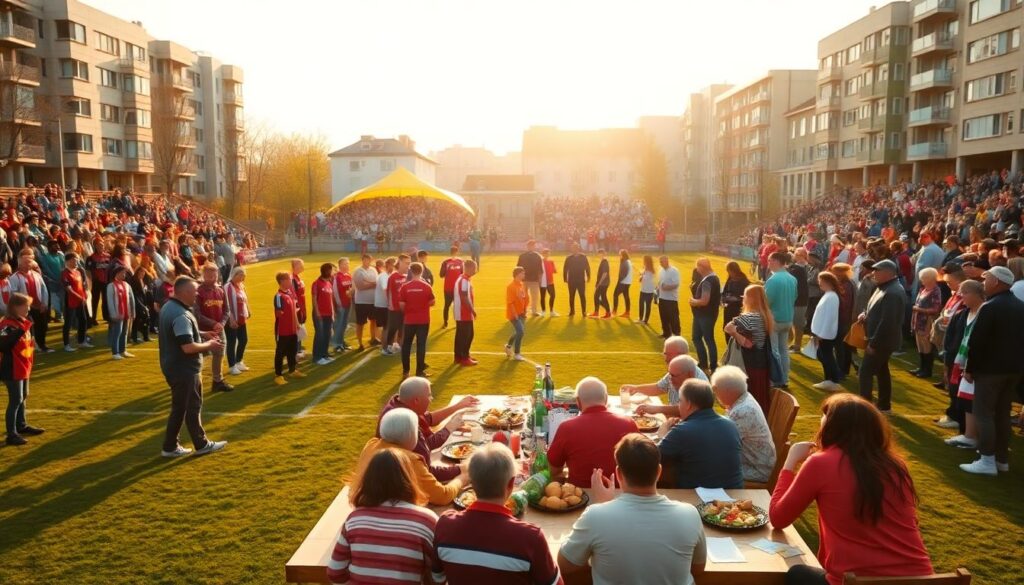
– Mixed‑fan community games
Organize tournaments where mixed teams represent neighborhoods, not clubs. Use simple, repeatable ceremonies: handshake circles, joint team photos, shared meals. It feels small, but these are micro‑rituals that prove rivalry doesn’t need hostility.
– Story circles with refugees and locals
Many social projects (e.g., in Germany, Italy, and the UK since the 2015 migration wave) used football as a “safe topic” for locals and new arrivals. Structured story circles where everyone shares their “first football memory” can create fast emotional bridges much faster than formal meetings.
—
Pro tips (lifhacks) for professionals working with football as a laic religion
If you’re a club official, marketer, media producer, researcher, or teacher, here are pragmatic “religion‑aware” lifhacks.
1. Think in terms of liturgical calendar, not just fixture list
Your season is not only matches; it’s a ritual year:
1. Identify your “holy days”: derbies, cups, anniversaries, memorial dates.
2. Design layered rituals for them: special scarf, unified visual theme, pre‑game narrative that connects past and present.
3. Communicate clearly so fans anticipate these as shared feasts, not random marketing stunts.
2. Build an ethical “doctrine” before the crisis comes
Most clubs improvise values only after a scandal. Better:
1. Draft a simple “secular creed”: 5–7 principles about respect, anti‑racism, gender equality, fair play, and non‑violence.
2. Integrate it visually: banners in the stadium, captain’s armband messages, junior academy codes of conduct.
3. When something goes wrong, refer back to this creed like a constitution, not a PR line.
3. Use data as your scripture
Religions use sacred texts; you can use metrics:
– Track not only ticket sales, but: incidents, online abuse spikes, diversity of attendance (gender, age), and participation in community events.
– After high‑risk matches, measure not just arrests, but positive rituals: number of tifos, songs created, joint initiatives.
Over two or three seasons, you’ll see whether your “religious engineering” is working.
4. Curate your canon: books, essays, and media
Don’t let the only “scriptures” be hot takes on social media. Introduce your staff, and even fans, to more reflective material:
– Recommend libros sobre fútbol como religión laica in club newsletters or fan forums; many exist in Spanish and English, mixing sociology and narrative journalism.
– For deeper theory, point advanced readers to ensayos académicos fútbol y religión compra online, where they can find peer‑reviewed work on ritual, identity, and globalization.
– Suggest a revistas especializadas fútbol cultura y religión suscripción for your media department or academic partners, to keep up with new analyses and case studies.
—
How to keep exploring: turning curiosity into structured learning
If this topic resonates with you, especially in 2026 when the lines between entertainment, belief, and identity keep blurring, treat it as more than a passing metaphor.
1. Create a personal or institutional reading list
Mix narrative books, academic essays, and long‑form journalism. Include at least one title that explicitly uses the “football as religion” frame.
2. Design a mini‑project
– If you’re a researcher: survey how your local fans describe their passion (religious language appears more often than you think).
– If you’re a teacher: run a short workshop where students map the “ritual chain” of matchday.
– If you’re in a club: do a small internal audit of your rituals, symbols, and values.
3. Use media strategically
Integrate selected documentales fútbol religión mitología moderna into training sessions, courses, or fan engagement events. Don’t just screen them; discuss them. Ask: “What beliefs is this film inviting us to share? Which of them are healthy, which are risky?”
—
Final thought
Football has become one of humanity’s most powerful religiones laicas: global, emotionally intense, and available every week. You can ignore this and let the rituals run wild, or you can study, design, and guide them.
If you treat stadia like temples, fans like believers, and media like scripture—without the illusions of infallibility—you can help shape a football culture that offers the best parts of religion (community, meaning, beauty, catharsis) while limiting the worst (fanaticism, exclusion, blind obedience). That is the real professional challenge for the next decade.