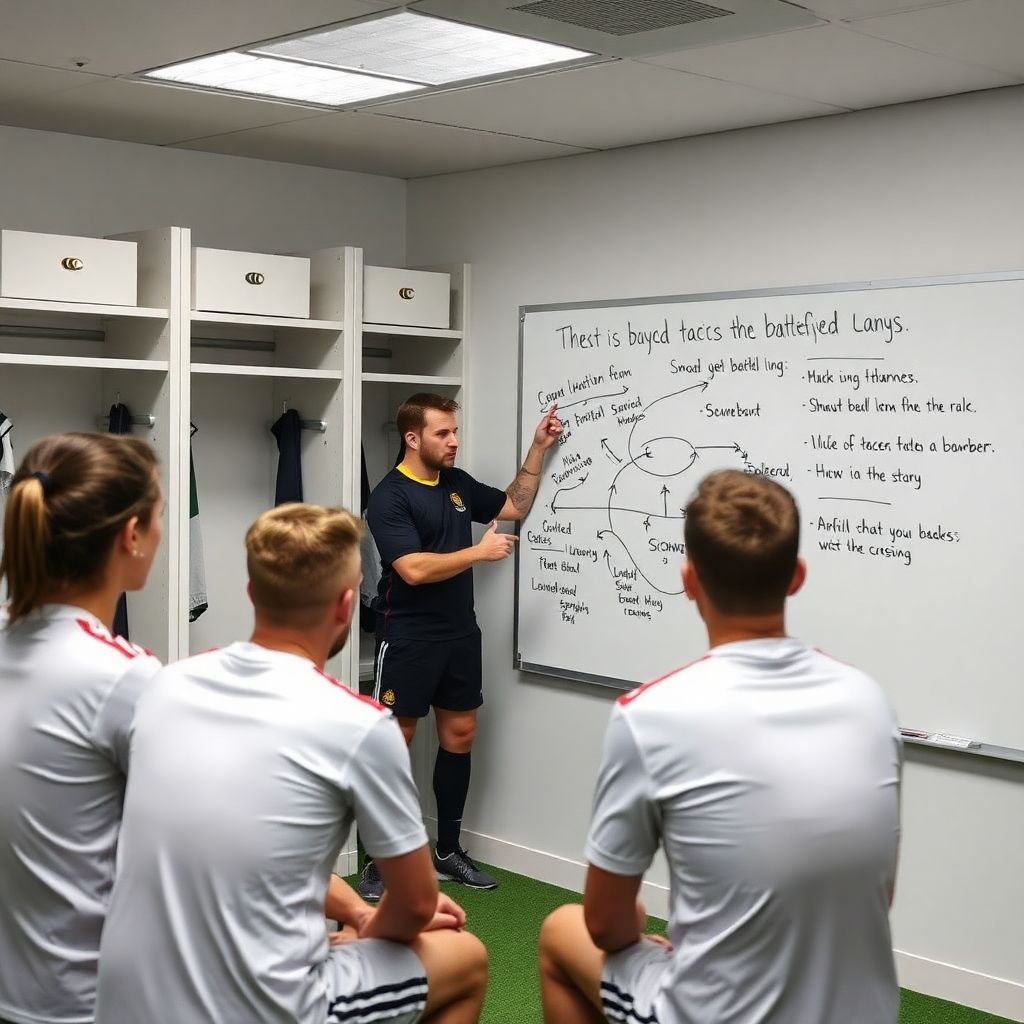
Tactical metaphors in coaching are intentional images or comparisons that frame how a team understands roles, space, and decisions. If you choose clear, concrete metaphors aligned with your game model, then players process tactics faster, stay mentally engaged under pressure, and share a common language that stabilises collective mindset.
Core propositions on tactical metaphors
- If your metaphors match your tactical principles, then players recall match plans more reliably under stress.
- If you use consistent images across training, video, and meetings, then your team develops a shared mental map of the game.
- If your language fits players’ culture and age, then metaphors feel natural and boost motivation instead of confusion.
- If you link metaphors to specific in-game cues, then players can self-correct faster without constant touchline instructions.
- If you review and refine metaphors regularly, then your communication evolves with the team’s level and ambitions.
Defining tactical metaphors in coaching
A tactical metaphor is a recurring image you use to describe game situations, roles, and decisions, so players can understand complex ideas quickly. Instead of explaining positional play with abstract jargon, you might talk about streets, squares, waves, or locks and keys to make concepts visible.
In football coaching, metaphors become part of the micro-language of the team. If you say «we close the house» when defending the box, then everyone knows the reference, the positioning, and the emotional tone you want: compact, urgent, collaborative. This is why many talleres de coaching para equipos deportivos include modules on metaphor design.
Metaphors have clear limits. They should support your game model, not replace tactical detail. If you rely only on poetic images without concrete behaviours (distance, timing, body shape), then players cannot translate language into actions. Good metaphors compress information; they never hide the work of clarification.
Section checklist: definition and boundaries
- If a phrase does not point to a specific behaviour on the pitch, then it is not yet a useful tactical metaphor.
- If players cannot draw your metaphor on a tactics board, then it is probably too vague.
- If your image contradicts your real principles (e.g., «war» metaphor for a possession game), then change the metaphor, not the model.
Cognitive mechanisms: how metaphors shape perception
Metaphors work because they transfer structure from a familiar domain to a complex, dynamic one like a match. In many curso coaching deportivo online programmes, this is explained as «borrowing a mental model» to reduce cognitive load for athletes during play.
- If you link tactics to a simple spatial metaphor (streets, lanes, floors), then players perceive space in stable chunks instead of chaos.
- If you frame transitions as waves or springs, then players anticipate rhythm changes rather than reacting late to turnovers.
- If you talk about the ball as a magnet or a hot object, then players intuit distances and support angles without constant measurements.
- If you use journey metaphors (doors, paths, checkpoints), then players sequence their decisions step by step instead of skipping phases.
- If your metaphors include emotional colour (calm sea vs. storm), then they quietly regulate arousal levels in high-pressure moments.
- If metaphors are repeated across training, then neural pathways strengthen and recall becomes automatic during matches.
Section checklist: cognitive effects

- If players repeat your images in their own words, then the metaphors are shaping their perception.
- If confusion rises every time you introduce new images, then simplify and stabilise your metaphor set.
- If you cannot link each metaphor to a cue, an action, and a feedback signal, then it is not cognitively useful.
Common metaphor families and their tactical implications
Different metaphor families push team mentality in specific directions. If you know what each family activates, then you can choose words that support your intended style of play instead of sabotaging it unintentionally.
- War and combat metaphors (battle, kill the game, destroy them). If you overuse these, then aggression and risk-taking increase, but so does indiscipline and emotional volatility.
- Journey and navigation metaphors (roads, maps, checkpoints). If you coach with these, then players tend to plan, pace themselves, and respect tactical routes through the pitch.
- Construction metaphors (build, foundations, scaffolding). If your language is about construction, then patience, structure, and collective responsibility grow.
- Nature and ecosystem metaphors (waves, trees, currents). If you prefer these, then players become more aware of rhythm, balance, and interdependence between lines.
- Business and project metaphors (investment, portfolio, risk management). If you use them in high-level squads, then decision-making becomes more rational and less emotional.
- Family and community metaphors (brothers, home, protect the house). If you emphasise these, then cohesion and sacrifice rise, but individual initiative may decline if not balanced.
Many libros sobre liderazgo y comunicación para entrenadores explore how these metaphor families influence not only tactics but identity and leadership style in the long term.
Section checklist: choosing metaphor families
- If your game model focuses on control and structure, then prioritise journey and construction metaphors over war language.
- If your team lacks intensity, then add short, controlled combat metaphors while keeping clear behavioural rules.
- If players misinterpret your images (too violent, too soft), then switch to a different family that fits their values.
Case studies: shifts in team mindset through metaphor use
Practical examples show how small shifts in language reshape mentality. In many Spanish clubs, coaches refine their wording after feedback from staff trained in máster en psicología del deporte y coaching, so metaphors support both performance and well-being.
- Case 1: From chaos to structure – If you replace «play freely» with «follow the rails» and map corridors as train lines, then full-backs and wingers coordinate width better, and build-up becomes more predictable.
- Case 2: From fear to curiosity – If you stop saying «do not lose the ball» and start using «open new doors» in the final third, then creative players attempt more progressive passes without panic.
- Case 3: From victim mindset to ownership – If you move from «they are killing us on crosses» to «we close the windows together», then defenders perceive aerial duels as shared, solvable tasks.
These shifts have clear upsides and downsides.
- If metaphors simplify decisions, then confidence and speed improve across the team.
- If language highlights collective responsibility, then blame culture decreases after defeats.
- If images are aligned with values, then motivation and buy-in to long-term projects grow.
- If metaphors are too strong (war, death), then anxiety or reckless behaviour may escalate.
- If you change images every week, then players stop trusting your messages.
- If staff members use conflicting metaphors, then the dressing room receives mixed mental models.
Section checklist: learning from cases
- If a language change does not alter behaviour within a few weeks, then the metaphor is weak or disconnected from practice tasks.
- If one metaphor spreads organically among players, then make it a central pillar of your communication.
- If a metaphor triggers jokes or resistance, then explore why before insisting on it.
Designing metaphors to elicit specific behaviors
Designing effective metaphors is closer to training design than to poetry. If you treat metaphors as tools with clear functions, then you can link them directly to desired behaviours in different phases of play and psychological states.
- If you want compactness, then use images of shrinking, closing, or tightening (net, blanket, house) instead of heroic solo actions.
- If you want calm build-up, then choose financial or construction images (invest, build step by step) rather than storm or battle language.
- If you want aggressive pressing, then pick predator or magnet images that emphasise collective hunting, not lone chasing.
- If you coach youth players in Spain, then design metaphors from school, city life, and local culture, so images feel close and concrete.
- If your staff attends formación para entrenadores de fútbol liderazgo y motivación, then integrate metaphor guidelines into your shared communication manual.
Common mistakes and myths often reduce the power of metaphor.
- If you believe «more emotional = better», then you may overload players; clarity beats drama in most match situations.
- If you think one brilliant metaphor will fix tactical confusion, then you ignore the need for repetition, drills, and feedback.
- If you assume metaphors are universal, then you will miss cultural, age, and position-based differences in how players interpret them.
- If you copy metaphors from famous coaches without adapting them, then your team may imitate language but not understand intent.
Section checklist: design principles
- If you cannot name the exact behaviour a metaphor should trigger, then do not use it yet.
- If a metaphor does not appear in your session plans and feedback, then it is only decoration.
- If players propose better images, then adopt them; ownership increases effectiveness.
Measuring impact: indicators and practical evaluation methods
To know whether your tactical metaphors work, you need simple indicators. If you combine observation, short player conversations, and basic stats from your analyst, then you can evaluate impact without complex research.
Mini-case of an evaluation cycle:
- If you introduce the metaphor «close the house» for low-block defending on Monday, then on Tuesday-Wednesday you design drills where players must recognise and shout the cue before compacting.
- If, during the weekend match, you see more coordinated movements and hear players using the phrase under pressure, then you log video clips and quotes.
- If, in Monday’s review, players can explain what «closing the house» means in terms of distances, triggers, and responsibilities, then you keep and refine the metaphor; if not, you adjust wording or replace it.
This «if-then» loop can be repeated with any key image. Coaches who attend talleres de coaching para equipos deportivos often build small tracking sheets to compare sessions before and after language changes.
Section checklist: evaluation habits
- If behaviour, language on the pitch, and understanding in meetings all move in the same direction, then your metaphor is effective.
- If only the slogans change but decisions do not, then the metaphor is superficial or poorly integrated into training design.
- If you cannot show two or three clear clips that illustrate the metaphor, then measurement will stay vague.
End-of-article self-audit for your coaching language
- If you listed your three main metaphors right now, then could you link each to one specific tactical behaviour?
- If you asked players to explain your favourite image, then would their answers match your intention?
- If a new assistant joined your staff, then would they find your metaphor use documented anywhere?
- If your current metaphors disappeared tomorrow, then which concrete decisions on the pitch would become harder?
- If your language contradicts the identity you want (e.g., risky metaphors for a cautious team), then what will you change this week?
Practical clarifications for coaches
How many tactical metaphors should I use with one team?
If players are intermediate level, then keep a small core set of recurring metaphors (for example, two for attack, two for defence, one for transitions). Too many images dilute attention and make communication noisy.
Should I change metaphors between age groups or categories?
If you work across academy and senior squads, then keep the same underlying concepts but adapt images to age and context. Younger players in Spain may respond better to school or game metaphors; senior professionals prefer business, project, or craft images.
How do tactical metaphors relate to team values and culture?
If your metaphors conflict with declared values (e.g., respect, collaboration), then they will create tension and cynicism. Align language with the identity you present in meetings, club documents, and any curso coaching deportivo online material you recommend to staff.
Can I overuse emotional or war-like metaphors?
If your team already shows high emotional intensity, then heavy combat language can push them into loss of control. Use such metaphors in short doses and balance them with images of structure, calm, and intelligence.
How can I train myself to use better metaphors?
If you want to improve, then study libros sobre liderazgo y comunicación para entrenadores, observe how top coaches talk in Spanish media, and practice rewriting your session plans with clearer images. Feedback from assistants and players is essential.
Do I need formal education in sport psychology to use metaphors well?
If you have access to a máster en psicología del deporte y coaching or similar, then your understanding will deepen, but it is not mandatory. Systematic reflection, simple evaluation, and alignment with your tactical model already take you far.
How do metaphors fit into leadership and motivation training for coaches?
If you attend formación para entrenadores de fútbol liderazgo y motivación, then treat every leadership tool as a chance to refine your language. Metaphors are not an extra; they are the medium through which most of your leadership is delivered.