
For most Spanish clubs, a pure club-empresa model suits high capital needs and investor control, while community-led clubs protect identity and fan influence. The best choice depends on your financing horizon, risk tolerance, and how much formal power you want to give supporters. Often, a mixed governance structure balances both.
Governance snapshot: core distinctions between club models
- Club-empresa maximises investor flexibility and speed; community clubs maximise legitimacy and long-term identity.
- Financial risk is concentrated in shareholders in empresas and diffused across members or community in social clubs.
- Fan voice is usually consultative in empresas and deliberative or deciding in community models.
- Exit options for investors are clearer in sociedades anónimas deportivas than in asociaciones or cooperatives.
- Regulatory oversight often differs, especially around transparency, related-party deals and financial fair play.
- Hybrid boards and golden-share mechanisms can soften the hardest trade-offs between capital and identity.
Ownership structures: empresa versus community-led clubs
When you approach clubes empresa vs clubes sociales análisis, ownership is the starting point. Use these criteria to frame your choice:
- Capital intensity of your sporting project
High ambitions (European competitions, large stadium projects, professional academies) tend to favour a club-empresa because equity injections and external debt are easier to structure and secure. - Time horizon of main backers
If core investors want a clear exit route (sale of shares, IPO, strategic buyer), a corporate structure is more suitable than a pure members association. - Local community attachment
In smaller cities or historic barrios, a community-led association or cooperative can align better with expectations that the club «belongs» to the town, not to distant shareholders. - Governance culture and capabilities
Where there is experience with professional boards, independent directors and clear reporting, club-empresa structures work smoothly. Where trust is based on assemblies and local leaders, member-owned formats are often more resilient. - Regulatory context in Spain
Spanish law distinguishes between sociedades anónimas deportivas and asociaciones deportivas. Before deciding, map how each form affects tax, disclosure, voting rights and compatibility with LaLiga or RFEF requirements. - Fan expectations about power
If hinchas expect to vote for presidents, approve key decisions or veto relocations, you need at least a community component, even inside a corporate shell. - Risk appetite of stakeholders
In a club-empresa, investors can lose their capital if the project fails. In a social club, members’ financial risk is usually limited, but sporting decline or loss of assets can still hurt the community. - Succession and continuity
Family-controlled empresas may face succession issues; member-based clubs can rotate leadership while preserving identity, but can also get stuck in factional politics.
Overall, any modelo de gestión clubes empresa fútbol ventajas y desventajas analysis should explicitly weigh: who puts in money, who decides, who can exit, and who absorbs financial and emotional losses.
Decision-making mechanisms and board composition
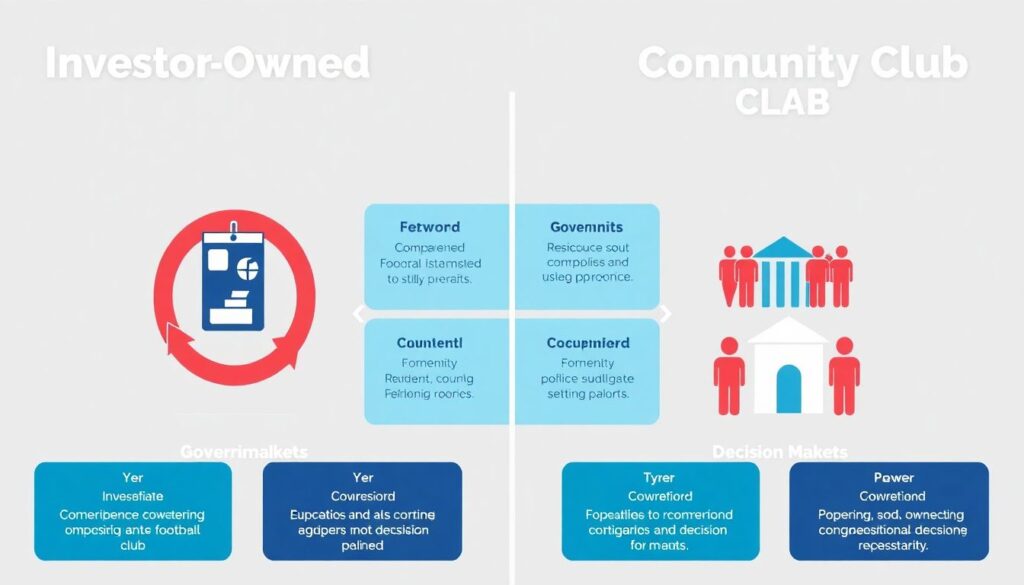
Below is a comparative view of how different governance setups distribute power. It can guide a comparativa clubes empresa y clubes de comunidad en el fútbol focused on who actually makes decisions.
| Variant | Best fit for | Strengths | Weaknesses | When to choose |
|---|---|---|---|---|
| Investor-dominated corporate board | Private investors funding rapid growth in professional divisions | Fast decisions, clear accountability, easy to align with investment strategy, simple for new investors to join or exit. | Low formal fan power, risk of decisions disconnected from local community, potential for short-termism. | When you need swift restructurings, major capital injections and are ready to manage fan relations via communication rather than co-decision. |
| Mixed board: investors plus member or community representatives | Traditional clubs opening to external capital while keeping a social base | Balances economic resources with legitimacy, channels fan concerns to the board, reduces risk of identity-breaking decisions. | Slower decision-making, potential tensions between financial and social goals, requires clear statutes and conflict-resolution rules. | When you want strong inversión but must show credible governance in clubes de fútbol empresa inversión to regulators and fans. |
| Member-elected board with investor advisory committee | Community-led clubs needing expertise but reluctant to cede control | Keeps voting power with members, brings in external know-how, can test investor relationships before equity deals. | Investors may feel underpowered, limited appetite for large, risky investments, slower turnarounds. | When identity protection is non-negotiable and the main goal is sustainable consolidation, not aggressive expansion. |
| Municipal-community partnership board | Clubs closely tied to city-owned stadiums or municipal funding | Stable political support, alignment with broader urban or regional goals, potential access to public infrastructure. | Exposure to political cycles, complex compliance, limited flexibility in transfers or relocation. | When the club is a strategic city asset and public authorities insist on governance involvement. |
| Supporter-trust majority board | Re-founded clubs, fan-owned projects or post-crisis restructurings | Maximum fan legitimacy, strong identity, long-term orientation, powerful narrative for sponsors and local partners. | Harder to attract big investors, risk of populist decisions, need for strong internal education on finance and governance. | When your priority is rebuilding credibility after mismanagement and giving hinchas direct control. |
Revenue streams, investment models and financial sustainability
Investment logic is where modelos empresa and community clubs diverge most clearly. Think in scenarios:
- If your main growth lever is external equity, then a club-empresa with clear shareholder agreements and exit options is the natural choice. It simplifies fundraising from funds, family offices or strategic partners.
- If you rely on organic growth from matchday, local sponsors and academy sales, a community-led or hybrid structure can work well, because you do not need to promise investors control or aggressive financial returns.
- If your short-term finances are fragile but brand and fan base are strong, consider a phased approach: start as a member club, then spin off a sociedad (for commercial rights or stadium operations) while keeping a golden share to protect identity.
- If your region offers public-private partnership opportunities (stadium redevelopment, training complexes), a joint venture between municipality and club-empresa can mobilise capital while anchoring the project locally.
- If your key sponsors demand professional governance standards, a more corporate board, independent audit committees and transparent reporting are easier to implement within a club-empresa framework, even if members still own a majority.
- If you anticipate volatile sporting performance, avoid heavy leverage tied to promotion. Instead, use variable investor returns (linked to TV revenues or player trading) and keep conservative wage-to-income policies regardless of ownership model.
In practice, the smartest clubes empresa vs clubes sociales análisis on the financial side maps not only revenue sources but also who carries cash flow risk when sporting results fluctuate.
Supporter rights, identity preservation and engagement mechanisms
The impacto del modelo club empresa en los hinchas depends less on legal form and more on how you encode supporter rights. Use this checklist to design your model:
- Define non-negotiables
Decide what must be protected regardless of investor interest: club name, colours, crest elements, home city, and matchday traditions. Write these into statutes or shareholder agreements. - Set minimum supporter voice
Choose at least one formal channel: elected supporter representatives on the board, a structured fan council, or binding consultation on major decisions such as stadium move or competition exit. - Clarify membership structures
In community clubs, define who can become a socio, voting rights, and fees. In empresas, decide whether to keep or create a parallel supporters association with recognised consultation rights. - Guarantee transparency rights
Publish annual reports, strategic plans and matchday policies in accessible language. Even in a tightly held club-empresa, regular open meetings with hinchas build trust. - Use contractual safeguards
Consider golden shares, veto rights for a supporters trust on identity issues, or supermajority requirements for key changes, especially if you expect future resale of the club. - Design engagement beyond crisis moments
Institutionalise fan input into everyday issues: ticket pricing, away travel, accessibility, and community projects. This reduces the risk of sudden, explosive conflicts. - Plan for conflict resolution
Define procedures for mediating disputes between investors and supporters (independent ombudsman, mediation panels). This is critical when shifting from community to empresa structures.
Regulation, compliance and jurisdictional effects
Legal form determines not just who owns the club, but also how scrutiny, taxes and sanctions apply. Typical mistakes when choosing:
- Underestimating how Spanish company law and sports regulations interact for sociedades anónimas deportivas, especially regarding capital requirements and reporting.
- Ignoring member-assembly rules in associations, which can block or delay urgent financial decisions if not designed with realistic quorums and timelines.
- Assuming that a club-empresa automatically convinces investors, without preparing a robust compliance framework and independent oversight to manage related-party transactions.
- Copying foreign governance models without adapting to Spanish labour, tax and municipal rules around stadium use and public subsidies.
- Failing to register and disclose real beneficial owners, creating reputational and banking risks that can affect player transfers and sponsorships.
- Overlooking competition and consumer-protection law when adjusting ticketing policies, membership benefits or broadcasting access after a governance change.
- Not stress-testing the model against negative scenarios (relegation, loss of a key sponsor, legal disputes), which can expose weaknesses in shareholder agreements or statutes.
- Leaving supporter rights in informal «gentlemen’s agreements» instead of binding documents, which become fragile if ownership changes.
A thoughtful comparativa clubes empresa y clubes de comunidad en el fútbol should always include legal advice focused on your specific autonomous community and competition level.
Stepwise decision path to your best-fit governance model
- If your project requires substantial upfront capital and investors demand clear control, start from a club-empresa baseline and add fan-protection mechanisms (supporter representatives, golden share).
- If identity and local legitimacy are your primary assets, start from a member-owned or supporter-trust model, then selectively open space for minority investors under strict statutes.
- If you are rebuilding after governance failure, prioritise a transition phase with strong supporter ownership and independent oversight, postponing heavy external inversión until credibility is restored.
- If municipal or regional authorities are central funders, design a partnership model that shares governance seats between public actors, community and, if needed, private investors.
- At each iteration, test: who can block key decisions, how hinchas are represented, and what happens in worst-case sporting and financial scenarios.
Performance metrics, risk trade-offs and scenario planning
For pure capital and speed, the best model for investors is a well-governed club-empresa with clear exit paths and professional boards. For long-term identity and democratic legitimacy, the best option for communities is a member-owned or supporter-trust structure. For mixed objectives, the best compromise is a hybrid board where investors, community and sometimes public authorities share power under transparent rules.
Common dilemmas and concise practical answers for club stakeholders
Can a club-empresa still be genuinely community-oriented?
Yes, if supporter rights are formalised: seats on the board, golden share on identity questions, and structured fan consultation. Without these, community orientation depends only on current owners and can change quickly with a sale.
Is it easier to attract serious investors to a community-owned club or to a club-empresa?
It is generally easier with a club-empresa because equity, governance and exits are clearer. Community-owned clubs can attract mission-aligned investors if they accept minority stakes and patient returns linked to sustainable growth.
Do member-owned clubs always protect fan interests better?
They often align structurally with fan interests, but not always. Poor internal democracy, low participation or local elites can distort decisions. Transparent rules, education and independent oversight are as important as formal ownership.
What is the main risk of converting a historic club into a club-empresa?
The biggest risk is losing legitimacy if fans feel excluded or fear identity changes. Managing the transición with clear communication, legal safeguards and visible supporter influence is critical to avoid permanent reputational damage.
Can a club move from club-empresa back to a community model?
It is possible but complex. It requires buying out shareholders, restructuring debts and drafting new statutes. Planning reversibility from the start, via call options or pre-agreed paths to fan ownership, makes this easier.
How should small Spanish clubs approach governance if they dream of moving up the divisions?
Many start as community clubs and professionalise step by step: independent directors, basic compliance, then selective investors. The key is to avoid overleveraging on promotion and to keep supporter engagement strong throughout growth.
Is a hybrid governance model just a temporary compromise?
Not necessarily. Stable hybrids exist where roles and rights are clear. They can be a long-term solution if investors accept shared power and supporters accept limits, all codified in binding documents.