
Del barrio a la Champions: everyday football as an identity engine
Football doesn’t just entertain; it produces identities. In technical terms, it’s an “identity technology”: a set of practices, symbols and routines that construct how people see themselves and how they are seen by others.
In plain language: football takes kids, families and whole barrios and gives them a shared story — sometimes one that literally goes from a dusty pitch to Champions League nights.
—
Key concepts: identity, territory and football
What do we mean by “identity” in football?
In social sciences, identity is the set of meanings a person or group uses to answer “who am I?” or “who are we?”.
Applied to football, we can separate three layers:
1. Individual identity futbolera
– “I’m a left back”,
– “I’m the fan who never misses away games”,
– “I’m the first from my block to get a trial”.
2. Collective identity
– Supporters (“we are Atleti”, “we are culés”).
– Neighborhoods (“we’re the team from the hill”, “we’re the port people”).
3. Hybrid identity
– Mix of both: “I’m María, captain of the girls’ team from Barrio Sur”.
These layers interact all the time: every training session, every match, every trip to the stadium.
—
“Del barrio a la Champions”: more than a cliché
Technically, this phrase describes an identity trajectory: a path where symbols, experiences and recognition scale up from ultra-local (the street) to global (the Champions League).
Diagram in words:
– Level 1: Street → you play in the alley or in the park.
– Level 2: Neighborhood club → you wear a real shirt, register, compete.
– Level 3: City/region → you travel, others know your club’s name.
– Level 4: Professional structures → academies, scouting, contracts.
– Level 5: Elite → Champions League, global broadcast, millions of strangers chanting your name.
Each step changes how you define yourself and how your barrio defines itself through you.
—
How football rewrites individual identities
From “kid from the block” to “athlete with a project”
When a child joins a structured team, their identity gains three technical components:
1. Role (position, playing style).
2. Competence profile (skills, weaknesses, potential).
3. Projection (what future seems possible if they keep going).
Instead of “I’m just hanging around”, they move towards “I’m a right winger, fast, and I want to make the regional squad”.
A very concrete, practical shift happens when they attend a campus de fútbol para niños en barrios humildes. These camps usually provide:
– Professional coaching sessions.
– Nutritional advice.
– First exposure to scouting logic: evaluation, feedback, progression.
This doesn’t magically create pros, but it injects structure into kids’ self-image: they learn to set goals, measure progress and understand effort as investment, not punishment.
—
Clothing and symbols: wearing your identity on your chest
Identity in football is highly symbolic-material: shirts, badges, colors.
When a team uses camisetas de fútbol personalizadas con nombre del barrio, it’s not just “cool merch”. Technically, it’s a portable narrative device:
– Front of the shirt: club crest → institutional identity.
– Back of the shirt: player name/number → individual identity.
– Extra text: name of the barrio → territorial identity.
Short diagram (verbal):
– No shirt → “anonymous kid playing”.
– Generic shirt → “football fan”.
– Personalized shirt → “representative of this specific community”.
Practically, if you run a neighborhood club, investing in these shirts:
– Increases kids’ sense of belonging.
– Reframes away matches as “we’re taking our barrio with us”.
– Helps families see football as something organized and serious, not just a pastime.
—
Collective identities: when a team becomes a mirror of a barrio
The team as a local “brand”
In technical language, a club can act as a symbolic proxy for its neighborhood. People who never touch a ball still say “we won” or “we got relegated”. This is vicarious belonging: living emotions through the team.
For barrios with social stigma (poverty, violence, marginalization), a football club can:
– Counter-stigmatize: “we’re not just what the news says; we produce talent, we travel, we compete”.
– Aggregate pride: kids, parents and elders share victories and defeats.
A semi-pro club making a national cup run can temporarily flip external perceptions: media coverage, interviews, local stories start focusing on effort and resilience instead of deficits.
—
From local pitch to European stands: fans’ journeys
It isn’t only players who go “from the barrio to the Champions”; fans do too.
Affordable viajes organizados para partidos de Champions League let entire supporter groups experience top-level football live. From an identity perspective, that does two important things:
– It connects their local fandom to the global football ecosystem: “our team doesn’t play there, but we’re part of that world”.
– It validates their passion: neighbours see that the weekend fan culture can justify international trips, planning, saving money — behaviors usually associated with “serious” tourism or professional activity.
And yes, many groups plan these trips around entradas Champions League baratas. Technically, cheaper tickets lower the “economic threshold” for turning an abstract dream (“one day I’ll see the Champions live”) into a real identity event (“I am someone who has been there”).
—
Structures that turn passion into trajectories
Youth academies and scholarships: ladders out of the barrio
Academias de fútbol base con becas deportivas are infrastructure for identity mobility. Formally, they:
– Select kids based on sporting potential.
– Provide training, education and often housing.
– Partially or fully subsidize costs for low-income families.
From a practical point of view, they:
1. Give concrete timelines (“if you progress in 2–3 years, you move up a group”).
2. Introduce kids to performance metrics (gps trackers, match videos, physical testing).
3. Expose them to mixed environments: they meet peers from very different backgrounds.
The identity effect: “I’m not trapped by my postcode; my skills are a valid passport to new social worlds”. That has carry-over value even if a player never turns pro: discipline, self-efficacy and networking usually remain.
—
Comparison: football versus other youth activities
If we compare football to other structured activities (music schools, dance, coding clubs), technically they all:
– Provide roles and goals.
– Build peer communities.
– Offer recognition.
But football has three specific advantages for identity formation, especially in working-class barrios:
1. Low entry cost
– A ball and a bit of space are enough to start.
– You don’t need instruments or expensive equipment.
2. High cultural visibility
– Elite role models are constantly on TV and social media.
– Pathways (local → regional → professional → Champions League) are widely understood.
3. Transnational meaning
– Football connects your barrio to a global language.
– Even if you migrate, football remains a ready-made social connector.
This doesn’t make football “better” than music or coding, but it explains why it’s such a powerful driver of both individual and collective identity in many neighborhoods.
—
Practical routes: how to leverage football to transform identities
For families and kids: concrete next steps
If you’re in a modest neighborhood and want football to be more than just passing time, you can think in terms of progressive layers:
1. Street and school
– Encourage mixed-gender, mixed-age games.
– Teach basic rules and fair play: this is your “civic training lab”.
2. Local club
– Register your child in an organized team if possible.
– Make sure the club communicates clearly: training schedules, expectations, code of conduct.
3. Development opportunities
– Look actively for a campus de fútbol para niños en barrios humildes in your city or nearby.
– Many are supported by foundations or clubs and are free / low cost.
4. Scholarships and academies
– Monitor local and regional academias de fútbol base con becas deportivas.
– Prepare simple highlight videos (even recorded by phone) and academic records; both matter.
5. Exposure to elite football
– Use TV, streaming and, whenever possible, stadium visits to show kids the full pyramid: grassroots to Champions League.
– Sometimes, combining entradas Champions League baratas with car-sharing between families makes a “once in a lifetime” trip viable.
The objective isn’t “everyone becomes a professional”. It’s building a strong, positive identity network around your child.
—
For community leaders and coaches: turning a club into an identity hub
If you run or support a neighborhood club, you can systematize its identity impact:
1. Visual identity
– Design camisetas de fútbol personalizadas con nombre del barrio and consistent colors.
– Use the same logo on social media, banners, and training gear.
2. Narrative strategy
– Keep a simple record of “from our barrio to…” success stories: scholarships, trials, tournaments.
– Tell these stories online and at club events; they function as reference myths for younger kids.
3. Educational integration
– Coordinate with local schools: attendance and grades as conditions for full participation in important matches or trips.
– Offer short workshops on nutrition, rest and mental health.
4. External alliances
– Connect with city councils, NGOs and pro clubs.
– Look for partnerships that can fund training material, camps or small viajes organizados para partidos de Champions League as motivational rewards.
You’re not just managing a team; you’re managing an identity ecosystem for the barrio.
—
Fans and trips: widening the identity map
Travel as identity “update”
When a group of friends from a humble neighborhood saves up to travel and see a major match, a few things happen:
– New social roles appear: trip organizer, budgeting expert, translator.
– The group’s story incorporates a new milestone: “we went from watching in the bar to singing in the away end”.
– Individuals internalize a new self-concept: “I can plan and execute complex things” — useful far beyond football.
Looking for viajes organizados para partidos de Champions League adds structure: packages usually include tickets, transport and hotel, reducing uncertainty and making the idea more realistic for first-time travelers.
Pair that with entradas Champions League baratas, and you convert a dream into a reachable project that families and youth groups can plan over months instead of years.
—
Measuring transformation: how do we know identities are changing?
Simple indicators you can actually track
You don’t need a research grant to detect identity shifts. At club or community level, track things like:
1. Retention
– Are kids staying longer in the team season after season?
– Drop-outs decrease when identity is strong.
2. Self-description
– Listen to how kids talk about themselves: “I’m bad at everything” vs. “I’m a defender, I’m working on my speed”.
3. Parental involvement
– Number of parents at games, meetings and trips.
– Stronger collective identity usually pulls parents in.
4. External recognition
– Mentions in local media, invitations to tournaments, partnerships formed.
– These are signs the barrio’s football identity is visible beyond its own borders.
Keep a simple yearly log. Over time, you’ll see whether your football project is just filling afternoons or genuinely transforming how people see themselves.
—
Putting it all together: from narrative to practice
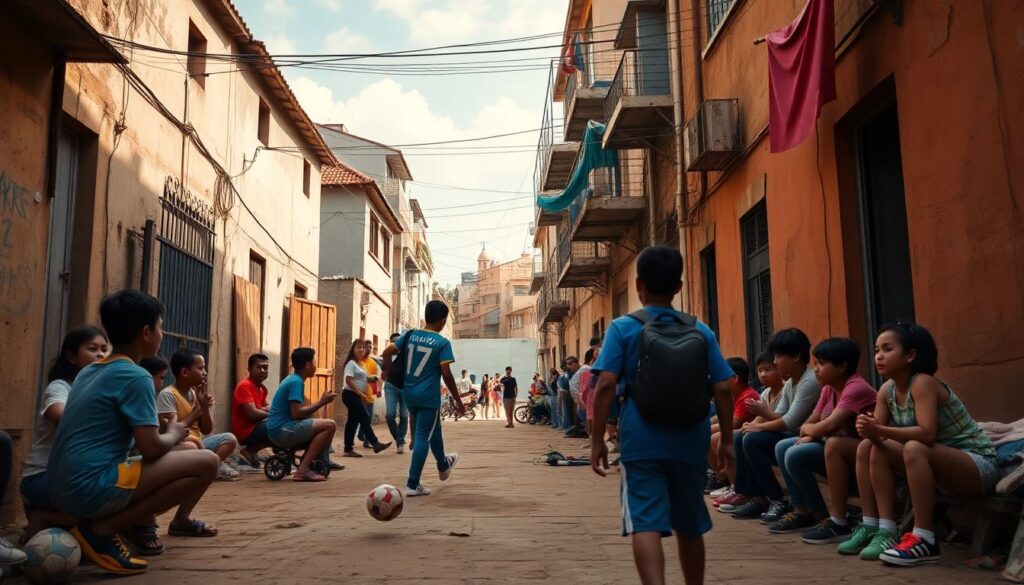
Football’s journey “del barrio a la Champions” is not only about extraordinary talents who end up on TV. It’s about thousands of small, cumulative steps where:
– A kid discovers they are good at something the world values.
– A neighborhood finds in its team a dignified, visible emblem.
– Families and friends open their geographic and mental maps through stadiums, camps and trips.
Whether you’re a parent, coach, community organizer or simply a fan, you can treat football as a practical identity tool:
1. Create clear, positive roles for kids on and off the pitch.
2. Use symbols (shirts, badges, colors) deliberately.
3. Connect your barrio to wider circuits: camps, academies, regional leagues, international matches.
4. Document and celebrate each “step up” — first away game, first scholarship, first major stadium visit.
That’s how you turn football from background noise on TV into a real engine of individual and collective transformation.