
El precio de la pasión: panorama rápido
Over the last few seasons, going to a big football game in Europe has quietly turned from a neighborhood ritual into something closer to a luxury city break. Clubs lean on tourism money, sponsors push hospitality products, and suddenly the classic season‑ticket holder finds themselves priced out by entradas VIP fútbol precios that would once have sounded like a joke. The passion in the stands is still marketed everywhere, but the people who created that atmosphere are often no longer the ones actually sitting in the stadium every weekend, especially in the biggest arenas in Spain, England and continental Europe.
At the same time, clubs argue that expensive seats pay for top players and modern stadiums. On paper that sounds logical; in practice, it raises a brutal question: how much “modern football” can a game take before it empties out its own soul and replaces local culture with one‑off tourist selfies?
Key concepts: putting names to what’s happening
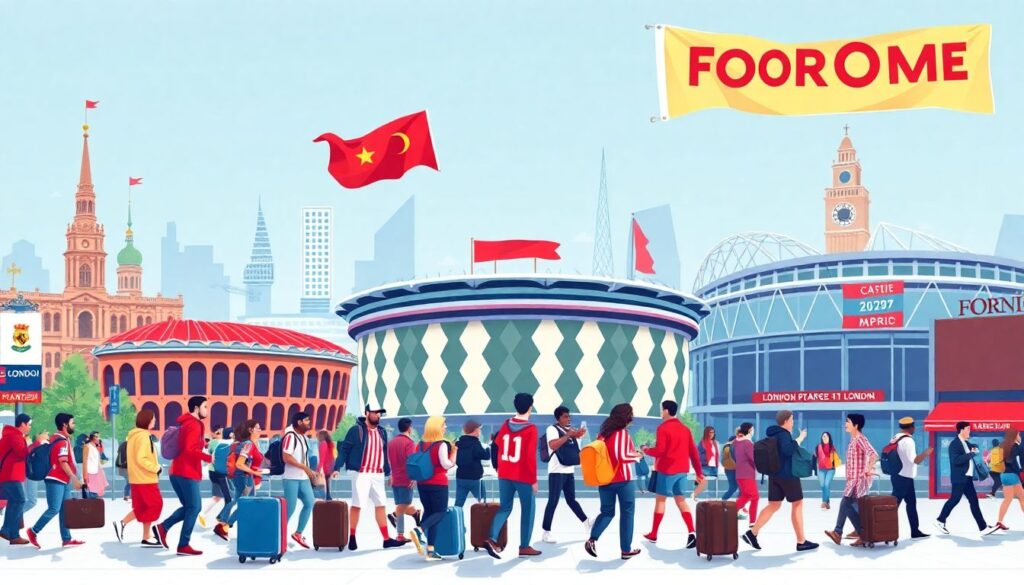
When we talk about “tourismo futbolero” we mean people who travel mainly to watch a match live, often combining it with a city break. In the last three seasons, tourism boards from Barcelona, Madrid and London all report rising demand for viajes turismo futbolero europa, especially around clásicos, derbies and big Champions League nights. “VIP tickets” are different again: they’re not just good seats, but full packages including catering, lounges, sometimes meet‑and‑greets and branded experiences. Clubs bundle these as hospitality futbol paquetes vip, sold to corporate clients and wealthy individuals at prices that can be ten, twenty or even fifty times a regular ticket.
Local fans, by contrast, are the ones living in or near the club’s city, usually buying season tickets or the cheapest single seats, often with long family histories in the same stand. The tension appears when the stadium capacity is finite but high‑margin visitors are almost infinite: every time a seat shifts from “normal” to “VIP” or from “local” to “tourist,” the economics tilt further away from the traditional supporter.
Text‑diagram: the three types of spectator
[Diagram: imagine three concentric circles. The small inner circle is “Hardcore local fans” — season tickets, singing, deep identity. The middle circle is “Regular locals and regional fans” — go several times a season, buy affordable seats. The large outer circle is “Tourists and VIP clients” — come once or twice, pay the highest prices. Arrows move from the inner circles to the outer one, showing how stadium policy and pricing slowly pushes people outward: fewer hardcore and regulars, more tourists/VIPs occupying central seats.]
In most top clubs, the outer circle used to be a bonus; now it’s becoming the main target. That quiet shift in who the game is “for” is at the heart of the problem.
Numbers: how prices and tourism have moved in three years
I don’t have access to 2025–26 internal club ledgers yet, but data up to the 2023–24 season already shows a clear pattern. According to UEFA’s 2024 European Club Benchmarking Report and studies by the CIES Football Observatory, average match‑day revenue per fan in the big five European leagues went up roughly 18–22 % between 2021–22 and 2023–24, even though average attendances were mostly stable. That gap only really makes sense if more people are paying premium prices: more VIP categories, more dynamic ticketing, more tourist demand. In La Liga, the Spanish Players’ Association noted that some clubs raised individual ticket prices for high‑profile games by over 30 % post‑pandemic, particularly Barcelona, Real Madrid and Atlético.
In terms of who’s actually inside the stadium, city tourism data is revealing. For FC Barcelona, pre‑remodel Camp Nou surveys suggested that around 15–20 % of home league crowds were foreign visitors in 2019. By 2023, after travel fully recovered, Barcelona’s tourism office estimated that up to 25–30 % of people in the ground for certain league games were tourists, with Champions League nights even higher. In London, a 2023 VisitBritain briefing suggested that about 1.5 million international visitors per year engaged in football‑related activities, up roughly 10–12 % over three seasons, with match attendance a major part. The stands haven’t grown; the composition has.
How VIP and hospitality reshape the stadium
One of the biggest changes isn’t just that prices are higher, but that the stadium map itself has been redrawn. Traditional “general admission” areas are being eaten away by hospitality zones and semi‑VIP products. New or renovated grounds in Madrid, Barcelona, London and Turin are all built around this logic: more boxes, more lounges, more “premium” seats, fewer cheap ones. The business model is simple: you make less money from a loud fan in a cheap seat than from a quiet tourist in a fancy one, so the architecture follows the money.
[Diagram: imagine the cross‑section of a stadium bowl. Originally, only a thin horizontal strip in the middle is colored “VIP/hospitality,” with huge areas above and below labeled “general fans.” In a modern version, the colored VIP strip has expanded vertically and horizontally, cutting into what used to be regular seating. A legend explains: each expansion of the VIP strip reduces the total capacity of low‑priced seats, even if total stadium capacity is similar or slightly higher.]
At the same time, clubs can sell hospitality futbol paquetes vip well in advance to sponsors and agencies, creating predictable revenue streams. That stability is wonderful for accountants, but it further locks in the idea that the stadium’s core customer is corporate, not local.
Price points: from cheap terraces to corporate lounges
To see how brutal the gap has become, look at rough price ranges. In the 2023–24 season, many top‑tier La Liga clubs offered standard seats for lower‑profile matches starting somewhere around 30–50 euros, while high‑demand games against giants could easily see face‑value prices in the 90–150 euro range for decent views. On the same night, entradas VIP fútbol precios for hospitality sections at those matches commonly ran from 300–500 euros and up, especially in the new Bernabéu and neo‑Camp Nou plans, where packages can exceed 1000 euros once you fold in dining and branding extras. In the Premier League, comparable “platinum” seats at big clubs often start at 400–600 pounds and scale to four figures against historic rivals.
Over three seasons, inflation alone doesn’t explain the hikes. Consumer price inflation in the eurozone between 2021 and 2024 was high by recent standards but still far behind the 20–40 % jumps seen in some match categories. Clubs justify this by pointing to transfer inflation and stadium investment; the reality is that only a fraction of fans can follow. For a local worker on an average salary in Madrid or Barcelona, a single big‑game ticket at dynamic‑pricing levels can easily swallow a quarter of their weekly net pay, while a mid‑tier VIP package may match or exceed their entire monthly rent. That’s not casual entertainment; that’s luxury retail.
Football tourism in Europe: a booming industry
Parallel to rising prices, viajes turismo futbolero europa has become one of the most visible forms of themed tourism. Before the pandemic, VisitBritain counted football as the number‑one live sports attraction for overseas visitors; by 2023, their data suggested recovery to, and in some cases beyond, 2018–19 levels of football‑related trips. Spanish and Italian tourism boards also target fans directly in campaigns that sell “weekend in Barcelona + match” or “Milan fashion and derby.” Football is no longer just part of the city; it’s a core product in the travel brochure.
[Diagram: a simple flow chart. Box 1: “Tourist decides city break.” Arrows to Box 2a: “Chooses city because of football match” and Box 2b: “Chooses city then adds match as premium experience.” Both flow into Box 3: “High‑spend booking: hotel + flights + tickets + merchandise.” A final arrow points to Box 4: “Club and city derive higher per‑visitor revenue than from locals.” The diagram highlights that tourists are designed to be high‑spend customers from the start.]
Because these visitors budget for flights and hotels, ticket prices feel relatively less painful for them than for locals. A 150‑euro seat may be just one component of a 900‑euro weekend; for a neighbourhood fan, it might be the only thing they’re trying to afford that month.
Champions League effect: peak prices, peak exclusion
The Champions League has its own special economy. For paquetes entradas partidos champions league, clubs and resellers know demand is global and spiky. Between 2021–22 and 2023–24, average official prices for knockout games at big clubs often started around 70–80 euros for the worst views, quickly rising above 120–150 for central stands, and that’s before the secondary market multiplied them. At the same time, VIP packages for those nights often include multi‑course meals, business networking, and branding opportunities, with prices per person that can climb into several thousand euros for semi‑finals and finals. The match is partly a backdrop for corporate hospitality.
UEFA’s own ticketing for finals shows the skew. In recent finals, only a minority of seats have gone at the most affordable category, with large chunks reserved for sponsors, hospitality and “neutral” packages. Clubs then mirror this logic at earlier stages. For the local ultras, who used to dream of “European nights,” the financial barrier is obvious. In some Spanish and English fan surveys between 2022 and 2024, more than half of respondents said they had stopped even trying to attend big European games in person, watching in bars or at home instead. The greatest nights become, effectively, television events for the core fanbase and in‑stadium spectacles for visitors and VIPs.
Buying tickets: locals vs global buyers
There’s also a subtle difference in how tickets are sold. When a local tries to comprar entradas partidos de fútbol liga española, they usually start from the club’s official portal, maybe limited by membership or season‑ticket priority. Many have to navigate windows that sell out in minutes, strict ID rules, and rotating kick‑off times that clash with work. Meanwhile, global fans rarely go through that maze. They buy through travel agencies, platforms bundling tickets with hotels, or official “international memberships” that include guaranteed access to certain games. The purchasing experience is almost two different products: a stressed lottery for locals, versus a premium, curated package for visitors who can pay more.
[Diagram: two parallel timelines. Line A is labeled “Local fan” with steps: Membership → Ticket window opens → Virtual queue → Sold out → Maybe secondary market at high markup. Line B is labeled “Tourist” with steps: Search “football weekend” → Agency page → Select package with guaranteed ticket → Pay higher but predictable price → Confirmation. Arrows highlight that Line B skips queue and uncertainty by paying a structural premium.]
Over time, it’s not just who can afford the ticket, but who has energy to fight the system. That extra friction quietly filters out many lower‑income or time‑poor locals.
Comparison: is it just football, or all major sports?
It’s tempting to think this is just a European thing, but similar dynamics exist in the NBA, NFL or major tennis tournaments. Courtside seats at an NBA playoff game or a Super Bowl hospitality box make even top‑tier European football look modest. The difference is that in many North American leagues, the sport has long been framed as an entertainment industry with a strong corporate flavor, while European football still sells itself as community identity first, business second. That gap between narrative and reality is part of why fans feel more betrayed.
If you compare matchday culture, you can see the contrast. In baseball or basketball, a big chunk of the crowd may treat the game as a backdrop to socializing, eating, and taking photos. Elite European football historically had a higher proportion of intensely engaged, singing, home‑grown support, especially in “ultra” sections. As hospitality zones expand into central stands, the sound and spontaneity of those sections risk being diluted. Some German clubs, with fan‑friendly policies, still preserve large cheap standing areas, showing that a different balance is possible. But even in the Bundesliga, pressure to monetize more aggressively is rising year by year.
Who loses what: beyond just money
For local fans, the loss isn’t purely financial. Being edged out of the stadium means losing a weekly social anchor, a place where generations mixed and rituals were passed down. Several sociological studies between 2021 and 2024, particularly in Spain and the UK, highlight how matchdays functioned as key intergenerational spaces: parents and grandparents bringing kids, friends meeting in the same bar, people from different jobs and backgrounds sharing one emotional language. When attendance turns into an occasional treat, or a TV‑only ritual, that dense web of relationships thins out.
[Diagram: a network map. In the “traditional” map, many small dots (fans) are densely connected to each other and to a central node (club/stadium), showing frequent matchday interaction. In the “touristified” map, local dots are fewer and more distant from the central node; instead, many transient dots (tourists) connect briefly to the stadium then disappear. The legend explains: the more transient the audience, the weaker the long‑term community ties built around the club.]
The club may still have millions of followers online, but digital likes don’t replace the feeling of belonging that comes from occupying the same seat every second Sunday for twenty years.
Can both worlds coexist? Possible counterbalances
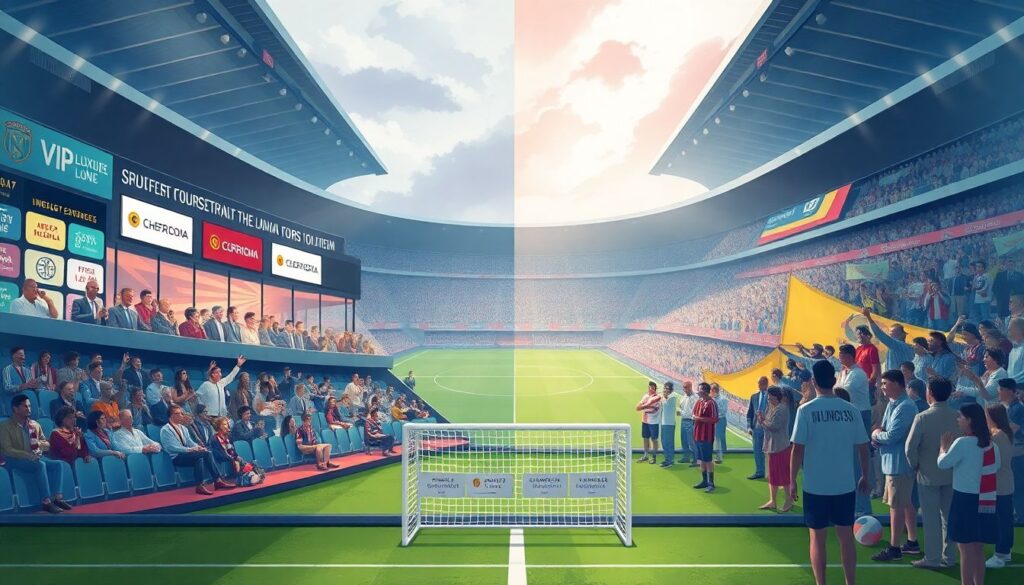
Is there a way to enjoy the financial stability that VIP money and football tourism bring without sacrificing the local heartbeat? Some clubs and leagues have started experimenting with partial shields. One approach is ring‑fencing a high percentage of tickets at controlled prices for local members or season‑ticket holders, particularly for key games. The German “50+1” ownership model, for all its flaws, has helped keep average ticket prices relatively lower than in England or Spain, and safe‑standing areas allow high capacity at low cost. A few Spanish clubs, under pressure from supporters, have frozen or limited price rises for certain stands even while adding premium tiers elsewhere.
There’s also room for smarter regulation. Cities and leagues could cap dynamic pricing multipliers, or require that any expansion of hospitality capacity be matched by protections for affordable sections. Transparency in how many seats go to sponsors, paquetes entradas partidos champions league, or agencies would allow public debate on whether the balance feels fair. Long‑term, there’s a deeper question: do clubs see themselves primarily as global entertainment brands or as civic institutions with responsibilities to their immediate community? Policies follow from how that question is answered.
What fans themselves can do
Supporters aren’t powerless, even if they often feel that way. Organized groups in England, Spain and Germany have shown that coordinated campaigns against excessive price hikes can work, especially when they attract media attention or threaten visible protests in‑stadium. Boycotting specific overpriced games, pressuring sponsors, and using membership structures to vote in more fan‑friendly boards are all tactics that have had partial success in the last three years. None of these fully reverse the tide of commercialization, but they can slow it and carve out protected spaces for locals.
[Diagram: a triangle labeled “Leverage.” One corner is “Collective action” (supporters’ groups, petitions, demonstrations). The second is “Economic pressure” (boycotts, public shaming of greedy sponsors). The third is “Institutional channels” (members’ votes, legal challenges, dialogue with leagues). Arrows move from each corner toward a central circle labeled “Negotiated balance: tourism + VIP money without expelling locals.” The idea is that only using all three sides gives fans real negotiating power.]
Even for global tourists who love the game, there’s a role: choosing agencies and clubs that clearly protect local fan bases, and avoiding grey‑market resale that fuels the worst pricing spirals.
Conclusion: who is football actually for?
Over the last three seasons, the direction of travel has been clear: more tourism, more VIP tiers, more revenue per seat – and a gradually shrinking place for the lifelong local supporter. Entradas VIP fútbol precios and sophisticated hospitality systems are not evil in themselves; clubs do need money, stadiums are expensive, and many visitors have a genuine, deep love for the sport. The problem is when the pursuit of high‑spending visitors stops being a complement and becomes the core business model, turning the historic fanbase into background noise or a marketing prop.
If that continues unchecked, the risk is obvious: stadiums full of cameras but short on soul, choreographed atmosphere replacing organic emotion, and a sport that still sells itself on passion while sidelining the people who generated that passion in the first place. The real challenge for the next decade is not technical or financial, but ethical and cultural: can football harness global demand and premium products without forgetting the neighbors who built it? The answer will decide whether matchday remains a living community ritual or just another expensive tourist attraction.