VAR in football increases factual accuracy on offsides, penalties and red cards, but risks damaging match flow, spontaneity and trust if implemented poorly. The best balance for La Liga and similar competitions is a minimalist, transparent VAR: clear error focus, rapid checks, strong communication, and limited, well-defined interventions.
Executive summary: VAR’s impact at a glance
- VAR fútbol: qué es y cómo funciona matters less than where you set the line between "clear error" and normal referee interpretation.
- Technology improves procedural fairness but adds decision load, stoppages and new polémicas del VAR en el fútbol, ejemplos recientes lo demuestran cada jornada.
- Coaches can exploit longer breaks tactically, while players must manage uncertainty around delayed flags and celebrations.
- Fans gain transparency through replays and explanations, yet risk emotional fatigue when celebrations are repeatedly interrupted.
- Leagues get more consistent season-level outcomes but must invest in training, communication and technology to avoid credibility crises.
- The most balanced model for most stakeholders is minimalist VAR plus clear communication, with strict time limits and a narrow set of reviewable incidents.
Referee perspective: procedural fairness versus decision load
From the referee’s angle, tecnología VAR ventajas y desventajas en el fútbol appear sharply: better tools to correct clear mistakes, but more complex cognitive demands. Instead of one real-time decision, the referee now navigates live judgement, VAR recommendation, monitor review and final confirmation under collective scrutiny.
Key criteria to judge whether VAR is helping or hurting referees:
- Clarity of protocol: How precise is the definition of "clear and obvious error" for handball, offside interference, and contact in the box?
- Decision time: Are most checks resolved within a short, predictable window, or does the referee frequently wait, creating visible hesitation?
- Autonomy balance: Does the on‑field referee retain authority, or do VAR suggestions feel like de facto orders?
- Communication tools: Is there a reliable line between VAR and referee, with concise standard phrases and no ambiguity?
- Mental load across 90+ minutes: Does the referee feel supported, or constantly second‑guessed and distracted by possible reviews?
- Public accountability: Are audio and explanations shared post‑match, so the referee’s reasoning is visible rather than assumed?
- Training and rehearsal: Has the team practised edge cases and pressure situations, especially in high‑stakes derbies and finals?
- Consistency across competitions: Do La Liga, Copa del Rey and European matches apply similar lines, or must referees switch mental models?
For referees themselves, the pragmatic recommendation is to support a narrow, clear-error VAR with strict time limits and post‑match transparency, which maximises help and reduces both decision load and public suspicion.
Coach and tactical consequences: stoppages, challenges, and adaptations
On the touchline, the impacto del VAR en el fútbol moderno opiniones among coaches is mixed: more justice but also more uncertainty. Time taken for checks becomes a tactical resource for instructions, emotional reset, and momentum management. Different VAR policy variants favour different coaching styles and risk appetites.
| Variant | Keeps balance for | Pros | Cons | When to choose it |
|---|---|---|---|---|
| Full VAR adoption (current FIFA-style model) | Big clubs, deep squads, detail-focused coaches | Maximises correction of errors; detailed offside lines; supports complex defensive systems. | More stoppages; frequent polémicas del VAR en el fútbol ejemplos recientes; higher frustration for fans and staff. | Use in top professional leagues with strong broadcast production and well-trained referee teams. |
| VAR with coach challenges | Coaches who like active game management, analysts with quick video access | Gives control to benches; limits total interventions; easier to accept when coach spent a challenge. | Risk of gamesmanship; coaches under pressure to "save" challenges; added sideline conflict. | Consider for tournaments and playoffs where each decision has extra weight and review slots can be rationed. |
| Minimalist VAR for clear errors only | Leagues prioritising flow and "spirit of the game", developmental competitions | Fewer interruptions; only obvious mistakes corrected; protects referee authority and match rhythm. | More grey-area incidents left uncorrected; fans may accept some "unfair" calls. | Best for domestic leagues seeking balance between justice and tradition, especially in Spain. |
| Broadcast-enhanced VAR for fans | Broadcasters, global audiences, entertainment-focused leagues | More camera angles; live explanations; reduces confusion at home; suits data-savvy fanbases. | In-stadium fans still lag; risk of "TV refereeing" overshadowing on-field action. | Adopt when rights value and global viewers are strategic priorities. |
| Data-driven VAR with semi-automated offsides | Analysts, high lines, pressing teams, league administrators | Faster lines; more consistent offside calls; less human drawing of frames. | Highly technical; can feel dehumanised; marginal offsides raise "spirit of the game" concerns. | Use in elite competitions where precision and speed justify the technological investment. |
Persona-focused comparison of VAR’s tactical and emotional impact:
| Persona | Primary benefit from VAR | Main concern with VAR |
|---|---|---|
| Referee | Support on game-changing errors, especially penalties and reds. | Loss of authority perception and extra cognitive load. |
| Coach | Fewer decisive errors against the team, extra time to adjust. | Uncertainty around when to celebrate goals or make subs. |
| Player | Protection from unseen fouls and off-the-ball incidents. | Delayed offside flags, confusion about allowable physicality. |
| Fan | Perception of fairness, access to replays and explanations. | Interrupted celebrations, feeling that technology runs the show. |
| Analyst | Richer data set for trends, tactical and refereeing analysis. | Over-focus on microscopic incidents instead of overall play. |
| League | Stronger competitive integrity and fewer headline scandals. | Implementation costs and backlash during controversial calls. |
For coaches, the actionable choice is to advocate for minimalist VAR or coach-challenge models, depending on whether your competitive edge lies more in tactical control or in keeping tempo and chaos on your side.
Player psychology and match rhythm: concentration, risk-taking, and flow
For players, the question is not just tecnología VAR ventajas y desventajas en el fútbol, but how it changes risk-taking and focus. Delayed flags, potential reviews and stoppages create micro-pauses that can either reset concentration or break flow, especially for forwards and defenders holding a line.
Practical scenario-based guidance:
- If you are a striker playing on the shoulder of the last defender, then keep running until the phase is clearly over; expect delayed flags and train your emotional reaction to goals being checked.
- If you are a central defender in a high line, then coordinate with your goalkeeper and full-backs using clear triggers, assuming semi-automated or line-drawn offsides will pick up tiny errors.
- If you are a midfielder who often makes recovery tackles, then adapt your technique to reduce slow-motion risk: fewer wild swings, more body positioning, knowing that VAR magnifies borderline contacts.
- If your team is under heavy pressure late in the game, then use VAR breaks as mental reset moments: re-organise, communicate marking assignments, and slow the opponent’s emotional momentum.
- If you are a goalkeeper, then stay fully engaged after conceding; many penalties, rebounds or close-range finishes will be checked and occasionally overturned.
- If you are captain, then be the filter with the referee: calm teammates during reviews and demand post-match clarity to keep trust in the process.
Players, especially in Spanish competitions, should train "VAR-resilient" routines: celebrate, but quickly reset; minimise reckless contact in the box; and treat VAR as another environmental factor like weather or crowd noise.
Spectator experience: transparency, trust, and emotional arc
For spectators in Spain, VAR can feel like both saviour and villain. The core tension is simple: more justice versus potential loss of spontaneity. A quick, structured approach helps leagues and broadcasters decide how to design communication and in-stadium experience so that fans stay engaged instead of exhausted.
- Define the emotional priority: decide whether your competition values uninterrupted celebrations or maximal factual accuracy in tight decisions.
- Audit current pain points: list the typical moments when fans in your stadium boo VAR – long waits, unclear handballs, or mismatched replays.
- Match review depth to competition level: for youth and lower leagues, prefer minimalist checks; reserve deep forensic review for top-tier matches.
- Increase transparency step by step: start with clear on-screen messages, then add short referee explanations over the PA system when culturally acceptable.
- Coordinate TV and in-stadium flows: ensure fans do not see long TV replays while the stadium screens show almost nothing.
- Educate with real, local examples: use neutral clips from La Liga to explain "var futbol qué es y cómo funciona" during broadcasts and pre-season content.
- Gather structured feedback: run periodic surveys on satisfaction with VAR decisions, separating perception of technology from referees themselves.
For fan-focused stakeholders, the recommendation is to invest more in communication design than in new cameras; many frustrations stem from silence and confusion rather than from any single decision.
Competitive integrity and measurable outcomes: penalties, offsides and season-level effects
When leagues adopt VAR, they usually seek cleaner tables and fewer season-defining mistakes. However, poorly tuned systems distort behaviour: defenders adjust contact, attackers adapt positioning, and referees recalibrate thresholds. Mistakes in how you "choose" your VAR philosophy can undermine exactly the integrity you want to protect.
Common strategic errors:
- Expanding review scope too quickly, moving from clear errors to re-refereeing all subjective contacts.
- Letting broadcast pressure dictate interventions, prioritising TV drama over consistent competition policy.
- Failing to separate "laws of the game" debates from VAR protocol debates, so every controversy becomes a referendum on the entire system.
- Ignoring lower-division impacts, where limited camera angles make elite-style VAR impossible but expectations have already changed.
- Underestimating adaptation: players, analysts and coaches will explore the edges of handball, blocking and offside rules under VAR.
- Communicating only in crisis mode, instead of publishing clear pre-season guidelines with examples and thresholds.
- Copy-pasting another league’s model without adjusting for your referee culture, media ecosystem and typical style of play.
- Not tracking how specific rule tweaks interact with VAR (for example, new handball clarifications or offside interpretation changes).
- Over-investing in technology while under-investing in referee coaching, fitness and communication skills.
For administrators, the reliable approach is incremental: fix scope, publish examples, adjust between seasons, and always test how changes affect match incentives, not just headline accuracy.
Governing bodies and rollout choices: consistency, costs and regulatory trade-offs
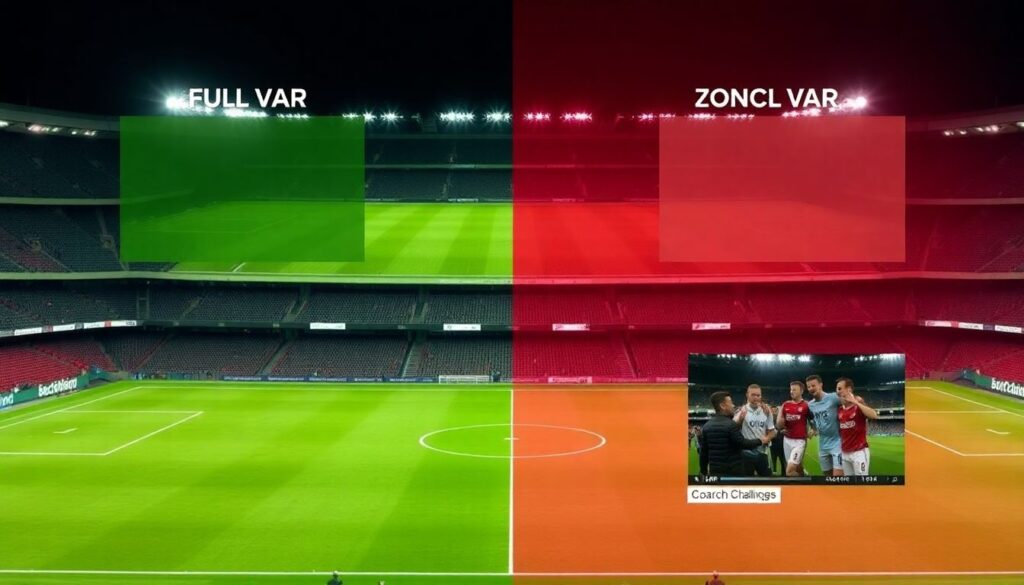
For federations and leagues, the decision is not "VAR yes or no" but which blend fits your identity. Full VAR adoption suits elite competitions with strong media pressure; minimalist VAR preserves flow for traditionalists; coach-challenge systems empower benches; broadcast-enhanced models serve global audiences; and semi-automated systems satisfy data-driven stakeholders. For referees and player unions, minimalist clear-error VAR plus strong training is usually best; for fans and broadcasters, transparent, well-explained reviews keep trust; for analysts and leagues, semi-automated offsides and rich data help narrative and planning. Given the futuro de la tecnología en el fútbol VAR y otras innovaciones, the most future-proof path is a narrow, clearly defined VAR today, designed to plug into more automation later without overwhelming the spirit of the game.
Stakeholder questions answered succinctly
Does VAR make football more just overall?
Yes, VAR reduces some clear mistakes on penalties, offsides and red cards, especially in top leagues with good camera coverage. However, justice also depends on consistent protocols; if thresholds move week to week, many fans will still feel outcomes are arbitrary.
Is the spirit of the game really damaged by VAR?
The spirit is challenged mainly when celebrations are repeatedly interrupted, and when tiny offsides decide goals. A minimalist clear-error focus and faster decisions protect spontaneity while still correcting the worst mistakes.
What VAR model is best for Spanish competitions?
For Spain, a clear-error, time-limited VAR with strong communication is usually the best compromise. It aligns with La Liga’s technical style while respecting the cultural value placed on rhythm, emotion and referee authority.
How should players and coaches adapt training to VAR?
Players should refine tackling and hand positioning, keep playing through delayed flags, and rehearse emotional resets after reviews. Coaches can plan mini-talks during stoppages and adjust pressing and offside traps knowing that technology closely tracks lines.
Why are there still big controversies even with VAR?
Many incidents remain subjective even with replays, especially in contact and handball situations. Additionally, communication gaps, inconsistent use of "clear and obvious error", and broadcast framing all fuel new polémicas around VAR decisions.
Will future technology fix all refereeing debates?
More automation will likely improve offside and goal-line decisions, but subjective fouls and handballs will still require human judgement. Debates will shift from "what happened" to "how strictly should we apply the laws".
Should lower leagues use VAR at all?
Only if they can guarantee enough camera angles, trained officials and communication tools. Otherwise, a simplified system or post-match review for disciplinary matters might protect fairness better than a partial, inconsistent VAR setup.