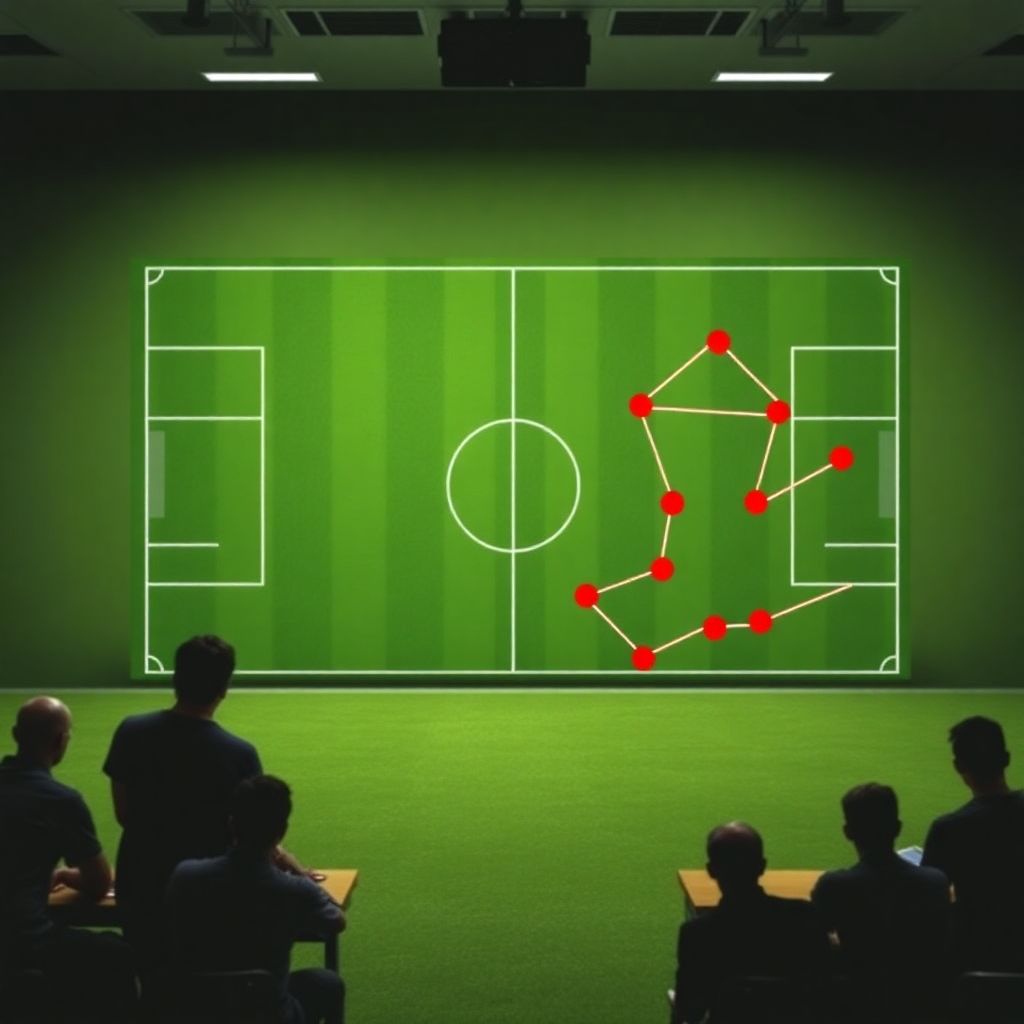
Catenaccio and positional play are not just tactics but worldviews about risk, control, and trust in the ball. Catenaccio starts from fear of space and protects it; juego de posición starts from love of the ball and manages space through circulation. Training choices quietly reveal which vision you follow.
Essence of tactical thinking in one view
- Catenaccio treats space as a threat to be closed; positional play treats space as an asset to be created and occupied.
- Defence-first systems embody distrust of chaos; possession models accept chaos and try to organise it with the ball.
- Your pressing, build-up and block height always expose your real risk tolerance, beyond slogans.
- Modern game models are usually hybrids, mixing containment (catenaccio roots) with proactive build-up (juego de posición).
- Clear decision rules in transitions are where your philosophy becomes visible: retreat, press, or keep attacking.
- Good analysis focuses on behaviours and spaces, not on romantic labels or myths about «attacking» and «defensive» coaches.
Origins and philosophy of the catenaccio
Catenaccio is a defence-first tactical system centred on protecting the box, closing central spaces, and counter-attacking quickly after regaining the ball. Its classic form uses a sweeper behind the defensive line, strict man-orientations, and deep compactness to minimise risk near the goal.
Historically, it emerged as a response to more open, man-to-man football. The core belief: if you control your own box and reduce high-value shots, you stay in the game and can win with few chances. The world-view behind it: safety through denial of space, emotional comfort in order and repetition.
This perspective extends beyond shape. Training prioritises defensive organisation, distances between lines, and rehearsed counter patterns. Creative freedom is mostly tolerated in transitions and set pieces, less in early build-up. The coach becomes a guardian of balance and discipline more than a designer of complex possession structures.
Core mechanics of positional play (juego de posición)
Positional play (juego de posición) is a ball-oriented model that organises players in relation to space, teammates, opponents, and the ball. Its world-view: if you control space through structured possession, you reduce risk and create better finishing situations. The actions are concrete and repeatable.
- Stable occupation of key zones: Keep at least one player between lines, one wide on each side, and a rest-defence structure behind the ball. Zones matter more than fixed positions.
- Superiorities as decision triggers: Progress only when you create numerical, positional, or qualitative superiority around the ball. If not, circulate instead of forcing.
- Use of the «third man»: Frequently play via a teammate who is neither passer nor receiver initially, to escape pressure and advance through compact blocks.
- Rondo logic scaled to the pitch: Training rondos teach angles, distances and timing; the same patterns appear in 7v7 and 11v11; the game model is essentially «big rondos».
- Immediate counter-pressing after loss: Losing the ball starts a new micro-phase: sprint to close the ball, nearest players press, others block passing lanes, back line squeezes up.
- Tempo control: Speed up when you disorganise the opponent, slow down to reset structure when your shape is broken. The ball is a tool for managing rhythm, not just for attacking.
- Shared reference language: Use simple verbal codes («fix», «third man», «switch») to align decisions quickly. This is where many libros sobre táctica fútbol juego de posición are useful: they give a vocabulary, not just diagrams.
Defence-first systems as expressions of risk perception
Defence-first tactics such as catenaccio are practical choices grounded in how staff and club perceive risk, not moral labels. In many contexts, they are the most rational answer to constraints like budget or squad profile.
- Underdog teams in top divisions: When your players are technically inferior, reducing game time in open field and concentrating actions near your box can be your only way to compete against elite positional play sides.
- Two-leg knockout ties: In continental competitions, a low block and counter-attacks can manage scorelines better than expansive football, especially away from home. Many análisis táctico fútbol moderno catenaccio vs juego de posición highlight this contrast.
- Relegation battles: Short-term survival often demands reducing goals conceded more than increasing goals scored. Coaches prioritise compactness, clearances, and set-piece focus instead of sophisticated build-up.
- Age groups or squads with low tactical maturity: When players struggle with complex structures, a simple, deep block with rigid roles is easier to execute reliably than fluid positional play.
- Clubs with strong «fighting» identity: Fans and management may value suffering, duels, and defensive heroics. In such cultures, catenaccio-style discipline feels emotionally coherent with the club’s story.
- Short, intense tournaments: National teams with little training time often choose safer, defence-first structures because high-level juego de posición requires more repetition and shared automatisms.
Spatial management, transitions and decision hierarchies
Tactics are sets of spatial rules and decision hierarchies under uncertainty. Whether you lean to catenaccio or positional play, you are teaching players how to manage space before, during, and after each action. Benefits and limitations come from these rules, not from labels.
Benefits of clear tactical worldviews
- Faster decisions because players know first priority: protect box, press forward, or keep the ball.
- Training sessions become focused, with exercises aligned to one main idea instead of random drills.
- Easier video analysis: you judge clips against a clear model, not vague «play better» expectations.
- Role clarity for players: defenders know how far to step out, midfielders where to receive, forwards when to press or hold shape.
- Recruitment aligned with style: you sign profiles that fit your space and risk philosophy, not just «good players».
Structural limitations to watch

- Rigidity: extreme catenaccio can leave you unable to chase games when you concede first.
- Complexity overload: over-detailed juego de posición can freeze players who need simple rules under pressure.
- Transition vulnerability: very deep blocks struggle to counter-press; very high blocks risk long balls behind.
- Mismatch with culture: a radical possession model in a direct-play club (or the opposite) can lose the dressing room quickly.
- Development ceiling: youth teams locked in pure low block or pure positional schemas may lack exposure to alternative problems.
Hybrid models: blending containment with proactive build-up
Modern coaches rarely use pure catenaccio or pure positional play. Hybrid models mix compactness without the ball and structured possession with it. The challenge is avoiding caricatures and misconceptions that confuse players. Many curso online de táctica fútbol del catenaccio al juego de posición focus on exactly this balance.
- Myth: «Defensive = cowardly, offensive = brave». Reality: pressing high aggressively is also risk-averse (you avoid defending deep). Parking the bus at 0-0 away can be strategically brave if it fits your resources.
- Myth: «More possession always means more attack». Slow, sterile possession often reduces shots; well-timed counters from a mid-block can create higher quality chances than endless circulation.
- Myth: «Positional play kills creativity». Clear structures free creative players from basic decisions (where to stand, who covers behind) so they can focus on timing, disguise, and 1v1s.
- Common mistake: copying shapes without principles. Using a 4-3-3 or 3-2-5 build-up does not make you positional if players do not understand superiorities and timing.
- Common mistake: mixing pressing cues. Combining a deep block mentality with occasional high pressing without clear triggers creates huge spaces between lines and confused roles.
- Misuse of references: Citing mejores entrenadores de fútbol especialistas en juego de posición without understanding the context of their squads or academies leads to unrealistic expectations in lower levels.
Evaluating tactics: metrics, outcomes and cultural alignment
Evaluation of tactics should connect behaviours, numbers, and club identity. Instead of asking «Is catenaccio modern?» or «Is juego de posición superior?», analyse what your team actually does and what risks it accepts. A simple mini-case shows how to turn worldviews into concrete checks.
Imagine a team in Spain’s third tier deciding between a conservative 4-4-2 mid/low block and a more ambitious 4-3-3 positional play model. Coaching staff design a short evaluation cycle over several matches, using observable behaviours and outcomes.
- Define behaviour indicators: line height in defence, number of passes before losing the ball, players ahead of the ball when losing it, counters conceded after loss.
- Connect to risk profile: if they accept defending big spaces behind the line, they push the block higher and commit full-backs forward; if not, they keep rest-defence stronger and wingers deeper.
- Relate to culture: if the club’s identity values proactive football, slightly worse short-term results may be acceptable while learning juego de posición; if survival is non-negotiable, catenaccio-influenced compactness might be prioritised.
- Iterate the model: adjust rules like «When in doubt, secure rest-defence, not extra player in the box» or «If outnumbered in first line of build-up, go long to a clear target rather than forcing through the press».
In this kind of análisis táctico fútbol moderno catenaccio vs juego de posición, metrics are tools to see if your decisions match your stated worldview. Advanced education, such as a máster en táctica y estrategia de fútbol juego de posición, can deepen this link between philosophy and practical game plans, but even basic tracking of behaviours already improves clarity.
Checklist for aligning tactics with your worldview
- Write one sentence that defines how your team wants to manage risk with and without the ball.
- List three non‑negotiable behaviours in defence, in possession, and in transitions for your game model.
- Verify that every weekly session design reinforces at least one of these behaviours, not isolated drills.
- When you watch top games or read libros sobre táctica fútbol juego de posición, translate ideas into simple rules your players can recall under pressure.
- Review video clips monthly to check if actions on the pitch really match your stated philosophy, and adjust the model if not.
Common tactical questions answered concisely
Is catenaccio still useful in modern football?
Yes, especially for underdog teams, tournaments with little preparation time, or clubs whose identity values defensive solidity. The key is to update details: pressing triggers, set-piece work, and fast transitions, not to copy historical versions blindly.
Can a team mix catenaccio and positional play effectively?
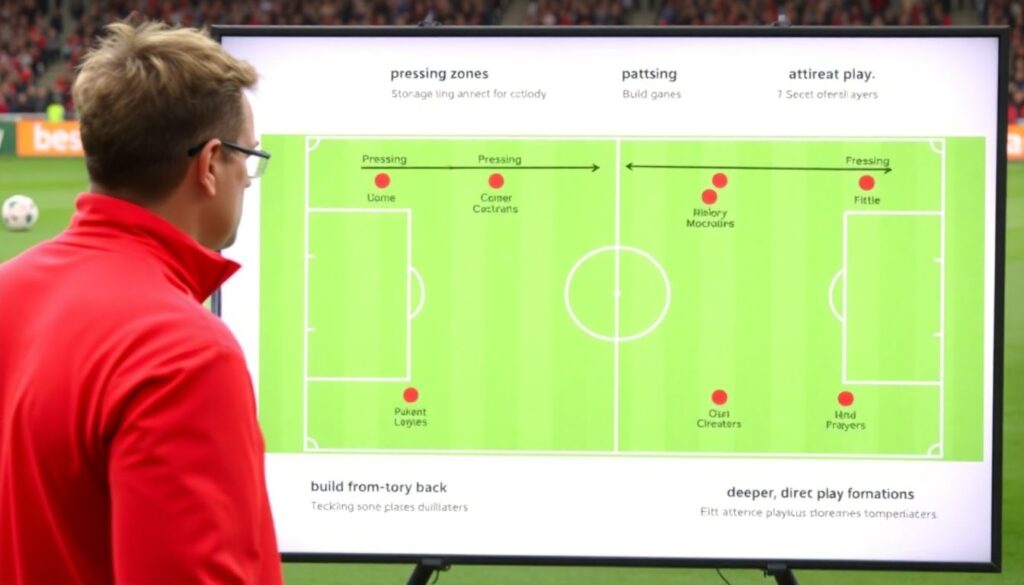
Yes, but only with clear rules about when to be compact and when to be expansive. Define zones and game states where you press high and build from the back, and others where you sit deeper and play more direct.
How do I start teaching positional play to amateur players?
Begin with simple rondos and positional games that train angles and distances, then connect them to 7v7 or 11v11 shapes. Use a small set of clear principles instead of a thick playbook, and repeat them consistently.
Are defence-first tactics bad for player development?
Not necessarily. They can teach concentration, compactness, and duels. Problems appear if players never experience pressing high, building under pressure, or combining in tight spaces. Rotate tasks across the season to expose them to varied problems.
Do possession teams always concede fewer counter-attacks?
No. Teams that attack with poor rest-defence structures may concede more counters than compact sides. Counter-pressing intensity, occupation of cover positions, and decision-making in risky zones matter more than raw possession percentage.
What should I look for in a course about tactics from catenaccio to positional play?
Look for clear links between theory and training exercises, real match examples, and context about squad level. A good curso online de táctica fútbol del catenaccio al juego de posición should show how to adapt principles to your players.
How can I study tactical worldviews more deeply?
Combine match analysis, coaching books, and structured education. Watching games of mejores entrenadores de fútbol especialistas en juego de posición, reading coaching literature, and, when possible, taking a máster en táctica y estrategia de fútbol juego de posición or similar programme can give both concepts and practical tools.