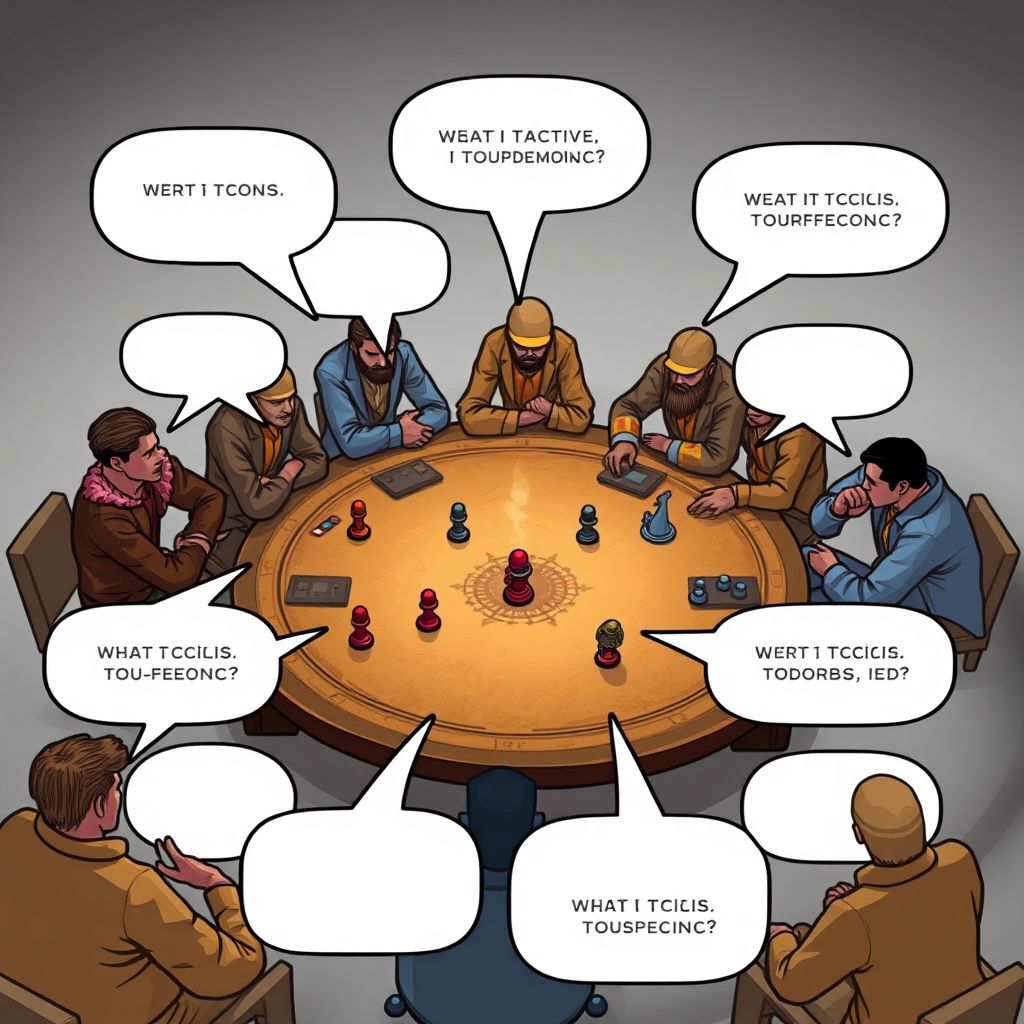
Tactics-as-language means that every system of rules and options in a game lets players «speak» certain worldviews while making decisions. If you design movement, economy, and conflict as a vocabulary of actions, then the viable tactics in your game will consistently express values like cooperation, hierarchy, risk‑seeking, or caution.
Essential Concepts That Define Tactics-as-Language

- If you treat tactics only as optimisation, then you miss how systems quietly teach players what matters in your world.
- If a mechanic is always the best choice, then your design is shouting a value, not whispering a nuance.
- If players repeat the same patterns across sessions, then your tactical «grammar» is strongly constraining their stories.
- If a rule appears rarely but changes stakes, then it functions like emphasis or punctuation in your design language.
- If different factions or builds reward distinct tactics, then you are offering dialects of the same systemic language.
- If your game world claims one thing in the lore and rewards another in play, then your tactical language will feel hypocritical.
Myths That Misread Tactical Expression
Many designers assume tactics are neutral tools sitting on top of a setting or story. In practice, tactics-as-language means your rules constantly comment on how the world works. A stealth system that almost never fails, or a diplomacy option that is always weaker than violence, expresses a clear vision of reality.
Myth 1: «Players invent the worldview; systems are just math.» If your combat, economy, and progression consistently favour specific behaviours, then players are pushed to «speak» that worldview to succeed. They can resist it creatively, but the baseline message is encoded in probabilities and payoffs, not in lore paragraphs.
Myth 2: «Balance solves everything.» If you balance only for win rates, then you risk erasing expressive differences between tactics. Two weapons that feel identical in risk, tempo, and narrative implication may be balanced, yet say nothing interesting about the fiction or about the values of the factions that wield them.
Myth 3: «Theme comes from art and text, not from tactics.» If your story praises cooperation yet solo rushing always wins, then the effective language of your game is individualistic. Intermediate designers in a curso diseño de sistemas de juego y narrativas emergentes often discover that most «ludonarrative dissonance» is really misaligned tactical messaging.
Grammar of Play: Mechanics as Syntax
Thinking of mechanics as syntax helps you see how players compose «sentences» of action over turns and sessions. Use conditional design rules to control how this grammar shapes meaning.
-
Turn structure as sentence order
If you enforce a strict order (move → act → resolve), then you foreground planning and commitment; actions feel deliberate and costly.
If you allow reordering or interrupts, then you create a language of negotiation and opportunism, where timing is part of tactical speech. -
Action economies as verbs
If certain verbs (heal, support, scout) cost relatively more actions, then players learn they are special or rare in your world.
If aggressive verbs are always action-efficient, then your system states that direct force is the most fluent form of communication. -
Resource flows as grammar rules
If resources regenerate quickly, then the language encourages bold «sentences» of big plays every turn.
If resources are scarce and persistent, then the language encourages cautious, minimalist statements, making each tactical choice feel like a long-term claim about values. -
Positioning as word order
If flanking, line of sight, and zones drastically change outcomes, then your language prioritises spatial literacy; maps become paragraphs to be parsed.
If positioning barely matters, then the game is saying that abstract numbers matter more than concrete geography. -
Information visibility as punctuation
If most information is open, then your language rewards explicit planning and shared reasoning among players.
If much is hidden or probabilistic, then your tactics speak in ellipses and question marks, emphasising trust, bluffing, and reading the table. -
Failure handling as grammar for disagreement
If failure hard-stops a plan, then your language is brittle and punitive; small mistakes become full stops.
If failure branches the story in interesting ways, then missed rolls act like commas, redirecting meaning rather than erasing it.
Lexicons of Challenge: Difficulty, Risk and Meaning
The «vocabulary» of your tactical language is made of challenge types, risk profiles, and payoffs. Different scenarios use different lexicons.
-
Competitive strategy games
If the dominant tactics revolve around tempo and territory, then your game speaks about expansionism and pressure.
If long-term tech or engine building wins more often, then the game’s lexicon values patience and compounding advantage. -
Cooperative tabletop campaigns
If encounter design mainly stresses attrition and resource drains, then your world feels hostile and grinding.
If scenarios emphasise coordination puzzles and combo timing, then the language celebrates trust and synchronised play between teammates. -
Action RPGs and character builds
If glass-cannon builds get the fastest progression, then the game glorifies risk and boldness.
If tanky, conservative builds are easier to play and progress, then the game supports stability and incrementalism as a safe dialect. -
Social deduction and negotiation games
If your rules reward loud table talk and public deals, then extroverted, confrontational speech becomes the dominant language.
If secret channels, written notes, or private whispers are more effective, then subterfuge and backchanneling define the system’s worldview. -
Sandbox digital worlds
If the economy heavily rewards grindy optimisation loops, then your world tells players that time invested equals moral desert.
If lateral, creative solutions (clever traversal, emergent combos) consistently outperform grinding, then ingenuity becomes the primary currency of meaning. -
Learning-focused serious games
If difficulty ramps by punishing exploration, then curiosity feels unsafe.
If experimentation is cheap and the game communicates clearly why something failed, then learners experience a lexicon where questioning and iteration are core verbs-an approach many libros sobre game design tácticas como lenguajes de juego now advocate.
Pragmatics in Sessions: Intent, Signals and Emergent Narrative
Pragmatics is about what tactics mean in context: what players intend, how others interpret signals, and how stories emerge across sessions.
- If you want players’ intent to matter, then design mechanics that let them declare goals («I protect», «I betray», «I negotiate») in rules terms, not only in fiction.
- If you want table talk to shape outcomes, then tie specific mechanical bonuses or unlocks to declared plans and shared commitments.
- If you want emergent narratives, then create systems where rare events, combos, or unlikely survivals trigger persistent consequences that players will retell later.
- If you want consistent reading of signals, then keep rule feedback clear: similar actions should have similar consequences so that groups can form shared expectations.
- If you want each campaign to develop its own «dialect», then provide modular rules knobs facilitators can tune between sessions based on how the group actually plays.
- If you over-specify narrative beats in scripted events, then you limit the space where tactics can generate surprising meaning.
- If your system hides too many modifiers and exceptions, then players cannot reliably read each other’s intent through choices; misinterpretation dominates.
- If only one or two tactics are viable at higher levels, then emergent narrative collapses into repetition; the language has too few words.
- If meta-currencies (fate points, ultimates) are too strong, then moment-to-moment tactics feel irrelevant compared with one-shot power spikes.
- If you never discuss group expectations between sessions, then unspoken social contracts may conflict with the incentives of your rules.
Cultural Encoding: How Systems Convey Values and Biases
Every rule is a tiny claim about how the world should work. Tactics-as-language helps you see which claims you are making intentionally and which are accidental.
- If your game always pays more for conquest than for alliance, then you are encoding a value that domination is superior to cooperation, whatever your lore says.
- If non-combat solutions are mechanically thin, then you are signalling that violence is the primary meaningful verb, even in otherwise rich settings.
- If randomness decides more than player skill at key moments, then your world implies that luck outweighs planning; this can be joyful or nihilistic, but it is never neutral.
- If certain body types, cultures, or social roles mechanically underperform, then stereotypes slip into your rules; players read these through tactics long before they read backstories.
- If authority figures in the fiction always have rules advantages, then your liberal or authoritarian biases appear in who is allowed to «win» systemic confrontations.
- If you work with consultoría en diseño de sistemas de juego y experiencia de jugador, then focus the conversation on how faction rules, difficulty curves, and rewards structure encode political or social assumptions-not just surface representation.
Designing Dialects: Building Systems to Guide Interpretation
Turning theory into practice is easier with conditional design recipes. Think of each «if…, then…» as a knob for creating a distinct tactical dialect and worldview.
Mini-case: tactics-as-language in a resistance strategy game
Imagine a small digital strategy game about a clandestine movement in a fictional city.
-
Position your core verbs
If you want the game to say «information is more powerful than force», then:
– Make the Gather Intel action cheap and safe.
– Make the Direct Assault action costly, loud, and escalating in risk each time it is used. -
Shape risk and reward curves
If you want cautious planning to be viable but not dull, then:
– Give compounding bonuses for chaining stealth and intel actions without being detected.
– Apply a soft cap so that over-turtling lets the regime tech and surveillance improve. -
Encode values in factions
If you create multiple resistance cells, then:
– Design a «Grassroots Network» faction with powerful coordination bonuses when many small cells act together.
– Contrast it with an «Elite Operatives» faction that excels at high-risk, high-reward solo missions. -
Align fiction with incentives
If your narrative claims that indiscriminate violence erodes public support, then:
– Add a Support meter that drops when players use collateral-damage tactics.
– Make low public support increase security budgets, so violent tactics literally make the game harder. -
Support emergent storytelling
If you want campaigns to feel unique, then:
– Let key operations create persistent tags on districts («Traumatised», «Inspired», «Militarised») that modify future missions.
– Let players read these tags as a memory of past tactical «sentences» written onto the city. -
Reflect on player learning
If you run this design inside a máster en diseño de juegos y teoría de sistemas lúdicos or a diplomado online en diseño de videojuegos centrado en sistemas y tácticas, then ask students:
– What behaviours did the rules praise or punish?
– What worldview do successful tactics imply about resistance, ethics, and power?
This conditional approach scales across genres, from board games to RPG campaigns. If you consistently tie each «good tactic» to a clear value or assumption about your world, then your whole design becomes a coherent language players can learn, critique, and ultimately rewrite through play.
Common Misunderstandings and Direct Clarifications
Is tactics-as-language only relevant for complex strategy games?
No. If your game has repeated decisions with consequences, then it already has a tactical language. Even simple mobile games or micro-RPGs teach players what «smart» play looks like and thereby encode a worldview.
Does thinking in tactics-as-language kill fun with over-analysis?

Not if used correctly. If you apply the lens during design and iteration, then you improve clarity and expressiveness. At the table, players can ignore the theory and simply enjoy how the game «feels», while still benefiting from your careful choices.
How is this different from balance and difficulty tuning?

Balance asks whether options are comparably strong; tactics-as-language asks what those options say about the world. If two builds are equally viable but one glamorises reckless risk while another promotes slow security, then your game is offering distinct ethical and emotional dialects.
Can players subvert the intended tactical language?
Yes. If players find creative strategies that contradict your intended message, then they effectively create slang. This is not a failure by default; it can reveal blind spots and inspire new official rules in later iterations.
How do I start using this approach in an ongoing project?
Pick one subsystem-combat, economy, or social conflict. If you list its most rewarding tactics, then ask what virtues or attitudes they promote. Adjust numbers, costs, or risks until the behaviour you want to celebrate is also the behaviour that wins consistently.
Should I always avoid dominant strategies?
Not always. If a dominant strategy clearly embodies the core value of your fiction, then it can be appropriate. The risk is when a dominant tactic contradicts the stated themes, making the game feel incoherent or cynical.
Where can I learn more about these ideas in a structured way?
Look for a curso diseño de sistemas de juego y narrativas emergentes or similar programmes that focus on systems literacy, not just content production. Target books and courses that treat mechanics, tactics, and player behaviour as a language that carries meaning, not just as optimisation puzzles.