Football mirrors contemporary society by exposing how we handle money, identity, migration, inequality, power, data and gender. On the pitch you see which values are rewarded: loyalty or consumption, merit or privilege, solidarity or hate. If you read matches sociologically, then every game becomes a live class on today’s social order.
What the Pitch Reveals at a Glance
- Commercialization shows how brands, media and platforms reshape fan identity and loyalty.
- Squad composition reflects real migration flows, multicultural coexistence and its tensions.
- Youth systems reveal who truly has access to social mobility through sport.
- Stadium rituals display political conflict, nationalism and soft power strategies.
- Data and VAR expose our current dilemmas about surveillance, fairness and trust in technology.
- Women’s football highlights structural gender inequalities and ongoing institutional reforms.
Commercialization and Identity: Sponsorship, Media Power and Fan Loyalty
Commercialization in football is the process by which clubs, leagues and players convert attention and emotion into revenue through sponsorships, broadcasting and digital platforms. It reshapes identity because fans increasingly relate to global brands and media narratives, not only to local community traditions.
Consider how a club like Paris Saint-Germain transformed from a local French team into a global entertainment brand through state-linked ownership, superstar signings and integrated marketing. In LaLiga, the packaging of El Clásico for worldwide audiences similarly turned a historical rivalry into a media product consumed in living rooms from Madrid to Seoul.
Media power is visible when kickoff times are set for television markets rather than stadium-goers, or when transfer sagas become episodic content. Fan loyalty shifts from neighbourhood-based belonging to platform-based engagement: you «follow» your team through streaming services, social media and fantasy games more than through the stadium turnstile.
For sociologists, commercialization is a lens to read broader consumer culture. The debates around airline or betting sponsors on shirts echo wider concerns about climate, labour rights and addiction. The spread of personalized content also reflects how digital capitalism fragments audiences into micro-communities of fans and «haters».
If you want to deepen this analysis, then look for libros sobre sociología del fútbol y sociedad contemporánea that trace how sponsorship and media have evolved alongside neoliberal reforms and the platform economy.
If you are a club or league decision-maker, then:
- If your sponsorship conflicts with local values, then expect identity resistance and consider participatory consultation with supporters.
- If you prioritise global TV over local fans, then invest in fan engagement projects that keep the stadium experience meaningful.
- If your communication treats fans only as consumers, then build programmes that recognise them as co-creators of club culture.
Migration and Multiculturalism: How Teams Reflect Population Flows
Migration and multiculturalism in football describe how player movements and diverse dressing rooms mirror global labour flows and everyday coexistence. Teams become compressed maps of colonial histories, economic gaps and new hybrid identities emerging in cities from Barcelona to London.
- Labour market dynamics: Clubs recruit globally, especially from regions with strong talent but weaker leagues. If wealthier leagues relax foreign player limits, then rosters begin to resemble global corporate offices more than local community teams.
- Colonial and linguistic ties: Historical connections shape routes: many South American players move to Spain or Portugal, while Francophone Africa is overrepresented in French leagues. If you analyse transfer routes, then you can reconstruct postcolonial influence in practice.
- Dual nationality and identity choice: Players with multiple passports choose national teams strategically and emotionally. If federations court diaspora talents, then international football becomes a negotiation of belonging rather than a simple birthright.
- Multicultural dressing rooms: Coaches manage religion, food, language and holidays. If clubs provide intercultural mediation and language support, then diversity can improve cohesion rather than create fractures.
- Fan reactions and xenophobia: Media narratives can celebrate diversity or stigmatise «foreign mercenaries». If political actors instrumentalise ethnicity, then the stadium may amplify wider social racism.
- Local youth displacement: Importing cheaper foreign players can block pathways for local youngsters. If regulations ignore this, then talent development becomes a global auction instead of a community investment.
Mini-scenarios: In some European cities, Moroccan-origin ultras support both the local club and the Moroccan national team, expressing layered identities. In others, tensions appear when migrant communities feel represented on the pitch but discriminated against in housing or jobs.
If you design integration policies, then:
- If your city uses football for social inclusion, then create mixed-origin grassroots teams that reflect actual neighbourhood diversity.
- If you run an academy, then provide language and legal support for migrant minors to avoid exploitative arrangements.
- If you work in education, then use documentales sobre fútbol y problemas sociales actuales to discuss racism, migration and belonging with students.
Inequality of Opportunity: Youth Academies, Infrastructure and Social Mobility
Inequality of opportunity in football refers to how access to facilities, coaching and scouting determines who can turn talent into a career. The sport is often sold as a meritocratic ladder, but structural factors strongly influence who even gets to step onto the first rung.
- Elite academies tied to big clubs: High-performance academies can offer education, nutrition and exposure. If entrance depends on early selection and informal networks, then children from poorer or rural areas are systematically underrepresented.
- Pay-to-play grassroots systems: In many contexts, families pay substantial fees for youth leagues. If access depends on parental income, then football reproduces class inequalities instead of challenging them.
- Urban vs rural infrastructure: Cities concentrate facilities and scouts. If regional federations neglect small towns, then local talents must migrate early or risk invisibility.
- Education-football balance programmes: Dual-career schemes mix school and training. If clubs treat schooling as secondary, then failed prospects face precarious futures once they are released.
- NGO and community projects: Some initiatives use football to open education or job pathways. If these are underfunded or short-term, then the impact on social mobility remains symbolic more than structural.
Typical scenarios include a promising teenager in a peripheral barrio who cannot afford travel to an elite academy, while a less talented peer from a wealthier family accumulates advantages through private coaching and contacts.
If you are a policymaker or club planner, then:
- If your youth system charges high fees, then create sliding-scale models and scholarships targeted at low-income areas.
- If you run a scouting network, then systematically map under-served regions and set quotas for visits and trials there.
- If you design coach education, then include modules from ensayos y análisis sobre fútbol como reflejo de la sociedad so staff can recognise and mitigate bias.
Stadiums as Political Arenas: Protest, Nationalism and Soft Power
Stadiums as political arenas means that matches become spaces where citizens express protest, nationalism, regional pride and international image-building. Chants, banners and even silences signal political positions that may be censored or ignored elsewhere.
For example, crowd responses to national anthems, flags and royal visits in Spanish stadiums reveal tensions around centre-periphery relations. Mega-events like World Cups or continental finals serve governments as displays of modernity and stability, even when domestic inequality or repression persists just outside the arena.
Post-2010 case studies include demonstrations during Brazilian World Cup matches about public spending, or debates around hosting rights in Qatar and Russia, where labour rights and geopolitical considerations overshadowed purely sporting discussions. If you read these events carefully, then each tifo and boycott movement becomes a data point in contemporary politics.
Political Potentials of Stadium Spaces
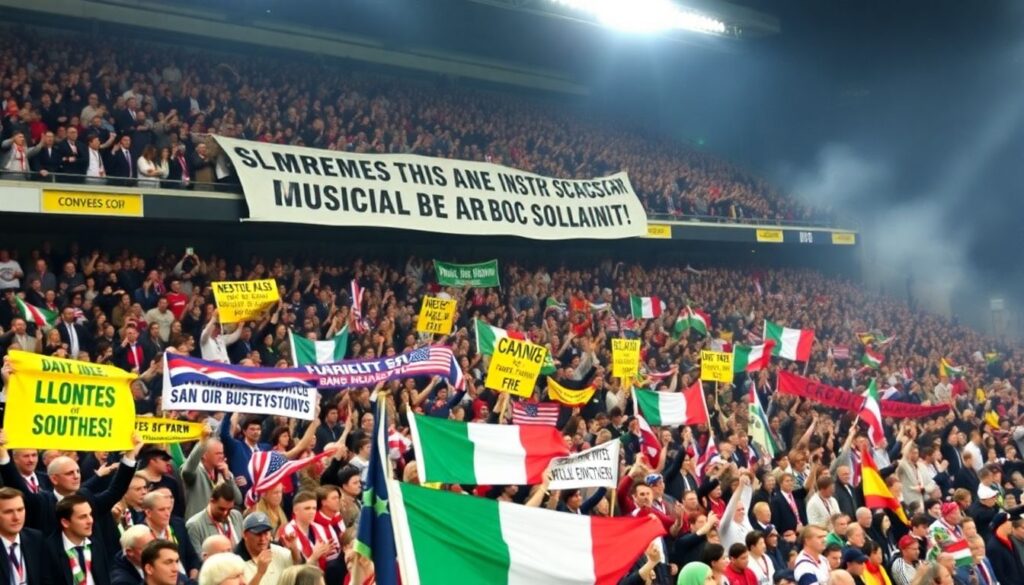
- Mass gatherings make it easier to send visible messages about injustices and demands.
- Televised games amplify local protests to global audiences.
- Shared rituals (anthems, scarves, colours) can reinforce solidarity across class lines.
- Supporter groups can organise mutual aid, from food drives to anti-racist campaigns.
Constraints and Risks in Stadium Politics
- Security regulations and federations can ban banners, slogans or symbols.
- Commercial interests may sanitise politics to avoid controversy with sponsors.
- Nationalist displays can slip into xenophobia or violence.
- Authoritarian regimes can use football success to distract from abuses.
Mini-scenarios: A club allows a minute of silence for victims of gender violence, turning the match into civic education; another bans a banner against corruption, causing fans to move their protest to social media where it reaches a different but smaller audience.
If you are involved in governance, then:
- If you regulate fan displays, then set clear, transparent criteria that protect anti-discrimination messages while restricting hate speech.
- If you host international tournaments, then pair events with human-rights monitoring instead of treating sport as an apolitical showcase.
- If you run civic education programmes, then integrate match-day campaigns and curated documentales sobre fútbol y problemas sociales actuales into school curricula.
Data, Surveillance and Fair Play: Technology’s Impact on Ethics and Performance
Data and surveillance in football refer to the extensive tracking of players and matches through GPS, video analytics and biometric devices. These tools promise performance gains and fairer refereeing, but they also raise questions about privacy, control and what we define as «justice» on the pitch.
- Myth 1: «Data is neutral and objective.» If you assume data is neutral, then you ignore who chooses variables, interprets models and benefits from decisions.
- Myth 2: «More surveillance always means more fairness.» If every contact is filmed and reviewed, then games risk losing spontaneity and players may self-censor celebrations or emotions.
- Myth 3: «Algorithms will replace scouts and coaches.» If you expect algorithms to fully replace human judgement, then you underplay context, dressing-room culture and psychological factors.
- Myth 4: «Players consent because they sign contracts.» If consent is bundled into non-negotiable contracts, then ethical standards around biometric data remain weak.
- Myth 5: «VAR eliminates controversy.» If fans believe VAR provides absolute truth, then any residual error undermines trust even more than before.
Recent seasons have shown how offside decisions decided by millimetres can spark debates about whether rules still reflect the spirit of the game. At the same time, player load monitoring has reduced injuries in some clubs but increased anxiety over constant measurement.
If you work in clubs or federations, then:
- If you introduce new tracking technologies, then develop clear data-governance policies and share them with players in understandable language.
- If you use analytics for recruitment, then combine quantitative indicators with qualitative scouting to avoid hidden biases.
- If you educate staff, then consider cursos online de sociología del deporte y fútbol that address surveillance, labour rights and digital ethics.
Gender Politics in Football: Visibility, Investment and Institutional Change
Gender politics in football examines how power, resources and recognition are distributed between men’s and women’s game, and how this distribution reflects wider gender norms. Visibility in media, prize money, facilities and leadership roles all reveal the depth of structural inequality.
Mini-case: Over the last decade, several women’s leagues in Europe turned partially professional, and some national teams negotiated better pay and conditions. Yet conflicts around celebrations, dress codes or leadership criticism showed how players were still expected to be grateful rather than assertive citizens within the sport.
In Spain and beyond, public interest in women’s tournaments proved that lack of audience was not an immutable fact but the result of decades of under-investment and media neglect. Institutional reforms, from federation statutes to club licensing, started to include gender equality clauses, but implementation remains uneven.
If you are shaping policy or club strategy, then:
- If you allocate budgets, then commit to multi-year investment in women’s football instead of one-off marketing campaigns.
- If you manage education or research, then promote a máster sociología del deporte y cultura del fútbol that treats women’s game as central, not as a side topic.
- If you work in media, then build editorial plans that normalise women’s football coverage across news, analysis and cultural content, including reviews of libros sobre sociología del fútbol y sociedad contemporánea written from feminist perspectives.
Practical Clarifications and Common Misconceptions
Is football really a good mirror of society, or is that an exaggeration?
Football does not reflect every aspect of society, but it condenses key dynamics around money, identity, power and inequality in a visible, emotionally charged space. If you combine match observation with social data, then football becomes a powerful entry point into understanding broader trends.
How can a fan start analysing football sociologically without academic training?
You can begin by asking who benefits from each decision: scheduling, pricing, transfers, marketing. If you complement this with introductory cursos online de sociología del deporte y fútbol, then you gain concepts and vocabulary to systematise what you already notice intuitively.
Are commercial sponsorships always negative for club identity?
Commercials are not automatically negative; their impact depends on alignment with community values and transparency of deals. If sponsors support grassroots projects and respect traditions, then commercialization can strengthen rather than dilute identity.
Does technology like VAR make football less emotional?
Technology reorganises emotions rather than removing them: frustration may shift from referees to screens and protocols. If leagues communicate clearly how systems work and preserve room for interpretation, then technology can support fair play without freezing passion.
Can football really promote social mobility for disadvantaged youth today?
Football can open mobility pathways but only for a tiny percentage of players. If policies focus on combining sport with education, health and civic skills, then football becomes a more reliable tool for improving life chances beyond professional contracts.
Is women’s football growing only because of market interest?
Growth results from a mix of player activism, feminist movements, institutional reforms and market opportunities. If governing bodies maintain structural support even when immediate profits are modest, then gender equality gains have a better chance to last.
How useful are books and documentaries about football for understanding society?
Quality libros sobre sociología del fútbol y sociedad contemporánea and documentales sobre fútbol y problemas sociales actuales provide context, historical depth and comparative cases. If you pair them with your own observations from local clubs and media debates, then you develop a more critical and nuanced perspective.