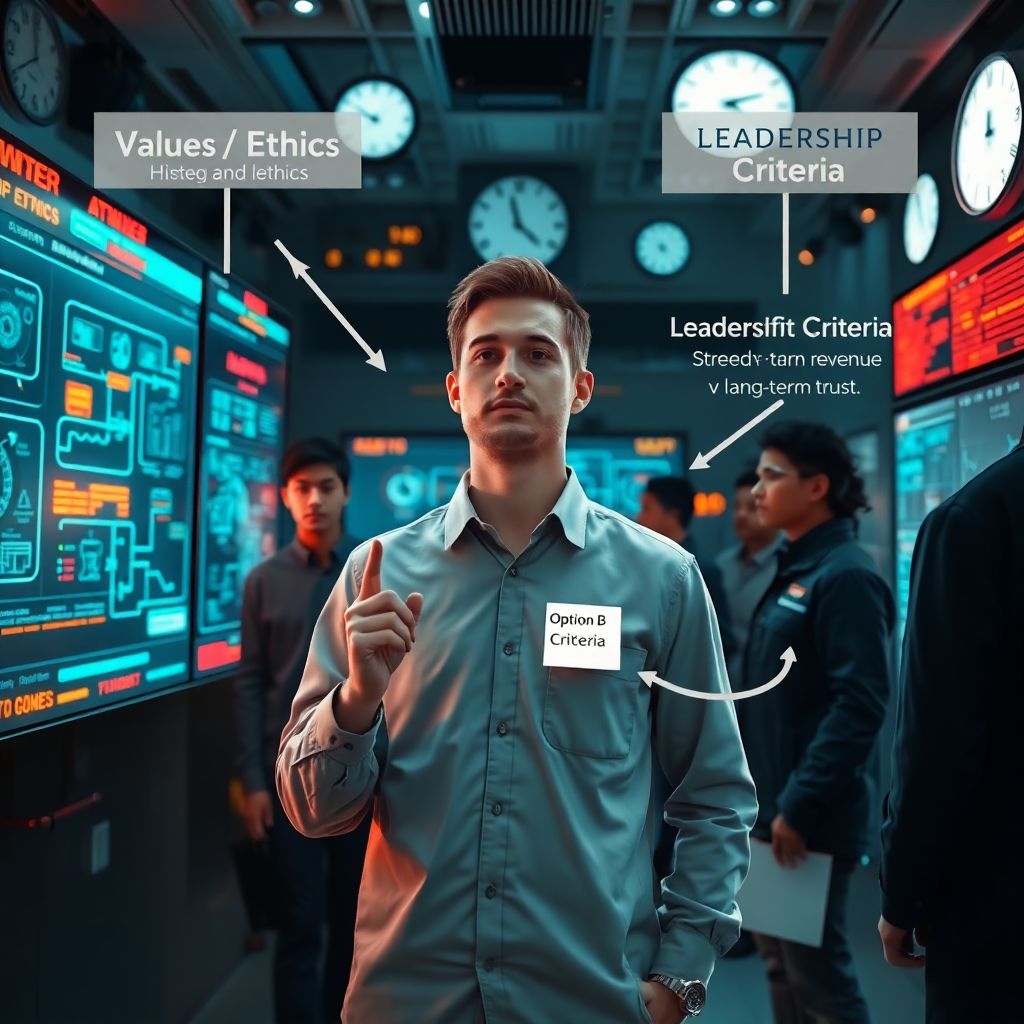
The technician as a practical philosopher
Being “el técnico como filósofo práctico” sounds poetic, but it’s actually very concrete: it’s about the person who solves real problems under pressure while thinking like a reflective, ethical leader. Not an academic philosopher, but someone who, in the middle of noise, deadlines and incidents, can ask: “What is the right thing to do here, and why? And how do I move this team there in the next 5 minutes?”
In modern organizations, technicians, engineers and mid-level managers are no longer just “hands” executing instructions. They decide priorities, accept or reject risks, manage conflicts, and often lead informal teams. That’s exactly where practical philosophy becomes a tool, not a luxury.
This mindset can be developed deliberately. Many companies already invest in curso liderazgo ético para técnicos, precisely because they’ve realized that a technically brilliant person without ethical and leadership criteria quickly becomes a strategic risk, not an asset.
—
Key concepts: leadership, ethics and decisions under pressure
Clear definitions (without academic fog)
Let’s ground the three pillars:
1. Leadership (for technicians)
Leadership here is not a job title; it’s influence plus responsibility.
– Influence: the real ability to change how others think or act (whether you have formal authority or not).
– Responsibility: accepting the consequences of that influence, even when nobody is explicitly blaming or praising you.
A “leader” technician is the one people look at in a critical moment and think: “If they say we go this way, we go.”
2. Ethics (professional and practical)
Ethics is not only about being “good” in a vague sense. In practice it’s:
> A system of principles that helps you decide what is acceptable, what is not, and what to do when everything seems gray.
In technical work, that means: safety, transparency, honesty with data, fair treatment of people, and courage to say “no” when something crosses the line.
3. Decision-making under pressure
Making decisions under pressure means choosing a course of action when:
– You don’t have all the information.
– Time is short.
– The cost of error can be high.
In other words, you rarely have the “perfect” option. You have to work with probabilities, trade‑offs, and risks.
—
Text-based diagram: how these three ideas connect
Imagine this simple mental diagram:
– Layer 1: Values (Ethics)
→ What is non‑negotiable for you and for the organization?
– Layer 2: Criteria (Leadership)
→ How do you translate those values into priorities and directions for people?
– Layer 3: Actions (Decisions under pressure)
→ What do you actually do in the field when time is tight?
As text:
> Values → shape → Criteria → guide → Actions
If any layer is missing, you have problems:
– Strong values but no criteria → paralysis (“I want to do the right thing but don’t know how”).
– Criteria without values → cold opportunism (“I optimize KPIs, who cares about the consequences”).
– Actions without either → chaos (reacting impulsively to the loudest voice or the most recent email).
—
The technician vs other roles: what’s special here?
Technician vs manager vs academic philosopher
Let’s compare the “practical philosopher technician” with two common figures:
1. Traditional manager
– Focus: budgets, reports, high‑level KPIs.
– Distance from the field: often high.
– Time horizon: quarters and years.
2. Academic philosopher
– Focus: concepts, theories, consistency.
– Environment: low pressure, lots of time to think.
– Output: texts, debates, analysis.
3. Practical philosopher technician
– Focus: concrete problems, systems, incidents.
– Environment: high pressure, limited data, conflicting demands.
– Output: quick and responsible decisions, communication, trade‑offs.
The technician usually has less power than a manager but more reality than anyone else. They see what actually happens in operations, in code, in machines, in customer systems. That position is perfect for leadership practical wisdom—if they’re trained for it.
That’s why targeted programs de desarrollo de liderazgo práctico para ingenieros have become so popular: they’re not trying to turn engineers into abstract thinkers but into field leaders who can reason clearly while under fire.
—
Short example: a technical decision that is also ethical
Imagine this:
– You find a potential security vulnerability in production.
– Exploiting it is not trivial, but not impossible.
– Fixing it now implies partial downtime and breaking a client deadline.
– Your manager suggests: “Let’s patch this in the next release, don’t raise alarms.”
This is not just a technical decision. It’s ethical and leadership‑related:
– Are you protecting users?
– Are you being transparent with the client?
– Are you balancing short‑term commercial pressure with long‑term trust?
A “practical philosopher” technician doesn’t just think “Can I fix it?” but “What is the right level of risk to accept, and who should know about it?”
—
Ethical leadership in technical environments
What ethical leadership looks like on the ground
Ethical leadership in a technical team is visible in small, stubborn habits:
– You don’t falsify data, even if the report looks “ugly.”
– You don’t hide near‑miss incidents; you analyze them.
– You push back against impossible deadlines that would force unsafe shortcuts.
– You document risks clearly, in language that non‑technical stakeholders can understand.
This is exactly the type of behavior that modern capacitación en ética profesional y liderazgo organizacional tries to institutionalize. Not just “ethics modules” with abstract codes, but case‑based work: “Here’s a real dilemma. What do you do, and why?”
—
Diagram: ethics as a filter before action
Visualize this simple flow in text:
1. Situation appears
↓
2. Technical analysis (what is happening, what options do we have)
↓
3. Ethical filter
– Does any option violate legal or safety norms?
– Is anyone being deceived?
– Who carries the risk vs. who gets the benefit?
↓
4. Decision (only among the options that pass the filter)
Without that filter, you risk optimizing for speed or cost at the expense of safety, trust or fairness. With it, you sometimes sacrifice speed—but you gain something harder to rebuild: credibility.
—
Decisions under pressure: how to stay sharp when the clock is loud
Understanding pressure as a variable, not as destiny

“Pressure” is not just having little time. It’s a combination of:
– Time limit
– Uncertainty
– Visibility (who’s watching you)
– Impact of error
Under pressure we all have predictable reactions: tunnel vision, overconfidence, or, on the contrary, paralysis. The practical philosopher technician expects those biases and designs routines to counter them, instead of trusting “gut feeling” blindly.
That’s why formación toma de decisiones bajo presión para empresas usually includes simulation, role‑play, and incident drills: you can’t learn to think under pressure just by reading about it.
—
Expert-backed micro‑framework for fast decisions
From crisis management and cognitive psychology research, a good practical framework is the 4C approach:
1. Clarify the problem (what is actually happening?)
2. Choose the main goal (what do we want to protect or achieve first?)
3. Create 2–3 realistic options (not 10 theoretical ones)
4. Commit and communicate (who does what, by when)
In text‑diagram form:
> Noise → (Clarify) → Clear problem
> → (Choose) → One priority
> → (Create) → Few options
> → (Commit) → Coordinated action
This doesn’t eliminate pressure, but it gives your mind a rail to run on.
—
From technician to “practical philosopher”: concrete practices
Five habits to cultivate (recommended by practitioners)
Here’s a numbered set of habits that repeatedly appear in expert interviews and research on high‑reliability teams:
1. Always write your reasoning, not just your decision
– Short note: “We chose option B because risk to safety is lower, even if cost is higher.”
– Benefit: later you can audit your thinking, not only the outcome.
2. Ask the “second‑order” question
– Not only “What happens if I do X?” but “What will this decision force others to do tomorrow?”
– This is where long‑term ethics usually enters the scene.
3. Name the trade‑off out loud
– “We’re trading speed for accuracy here,” or “We’re prioritizing client trust over short‑term revenue.”
– This helps align the team and reduces hidden resentment.
4. Slow down one minute before irreversible moves
– Even in fire‑drill moments, take 60 seconds to check: “What am I missing? What assumption could be false?”
– Many avoidable incidents disappear with this tiny pause.
5. Debrief after every relevant incident
– “What went well? What failed? What luck disguised as skill did we have?”
– Capture lessons, update procedures, adjust alerts.
These habits are simple, but not easy; they demand discipline. The good news: they fit into daily work without needing grand “transformation projects.”
—
Short comparison: intuitive vs structured decision-making
– Purely intuitive style
– Fast, based on experience.
– Works very well in familiar contexts.
– Fails silently in novel or complex situations.
– Purely analytical style
– Detailed, step‑by‑step.
– Can be too slow when time is critical.
– Sometimes creates the illusion of certainty.
– Hybrid “practical philosopher” style
– Uses intuition to generate options quickly.
– Uses simple structure (like 4C) to check and communicate them.
– Accepts uncertainty instead of hiding it with fake precision.
—
Learning paths: from courses to real-world labs
Formal training vs intentional self‑development
Organizations are finally recognizing that technicians need more than tools and manuals. They need frameworks for judgment. That’s why you’ll see offers like:
– curso liderazgo ético para técnicos
– formación toma de decisiones bajo presión para empresas
– programas de desarrollo de liderazgo práctico para ingenieros
– capacitación en ética profesional y liderazgo organizacional
– taller gestión de crisis y toma de decisiones rápidas para mandos intermedios
The honest truth: a single course will not turn anyone into a practical philosopher. But these programs can give common language, tested frameworks, and shared scenarios that teams can reuse in their own context.
In parallel, self‑development matters just as much:
– Reading incident reports from other industries (aviation, medicine, cybersecurity).
– Practicing scenario planning with colleagues: “If X happened tomorrow, what would we do?”
– Keeping a decision diary with 2–3 key choices per week and revisiting them monthly.
—
Expert recommendations: what seasoned leaders advise
From interviews with experienced technical leaders and crisis managers, three strong recommendations stand out:
1. Make your values operational, not decorative
– Instead of “safety is our priority,” define:
“We will always stop operations when…”,
“We will always inform the client when…”,
“We will never sign off if…”.
– Practical test: if a value doesn’t hurt sometimes (time, money, comfort), it’s probably just marketing.
2. Train your team before you “need” it
– High‑pressure thinking is a skill you build before the real crisis.
– Set up drills, tabletop exercises, or internal mini‑scenarios.
– Experts insist: “You don’t rise to the level of your goals; you fall to the level of your training.”
3. Protect truth‑telling, especially from the youngest or quietest
– The person with the key piece of information might be the intern or the night‑shift technician.
– Create rituals where everyone can flag concerns without being crushed.
– A culture where people can say “I’m not sure, but this doesn’t look right” is worth more than any tool.
—
Bringing it all together
The idea of “el técnico como filósofo práctico” is not mystical. It’s a very specific professional stance:
– You treat each technical decision as a small exercise in leadership and ethics.
– You accept that pressure is normal, and you prepare your mind for it.
– You use simple frameworks and habits to keep your thinking clear when others panic.
– You help your organization convert values into daily, operational decisions.
You don’t need a philosophy degree for this. You need curiosity, humility, and the discipline to reflect on what you’re doing, not just do it faster.
If you start with just two changes—writing down your reasoning for key decisions and running brief debriefs after incidents—you’ll already be practicing practical philosophy in its most useful form: helping real people make better choices in the moments that matter.