Money doesn’t score goals, but it decides who can afford the players who do. When we talk about “Desigualdad económica entre clubes: ¿competencia justa o oligarquía deportiva?”, we’re really asking whether modern football is still a sporting contest or already a closed shop run by a small financial elite. To sort that out, we need to look at numbers, business models, and a few very concrete stories from England, Spain, Germany and beyond, without hiding behind romantic talk about “the magic of the cup”.
From balanced leagues to financial gaps the size of a derby rivalry
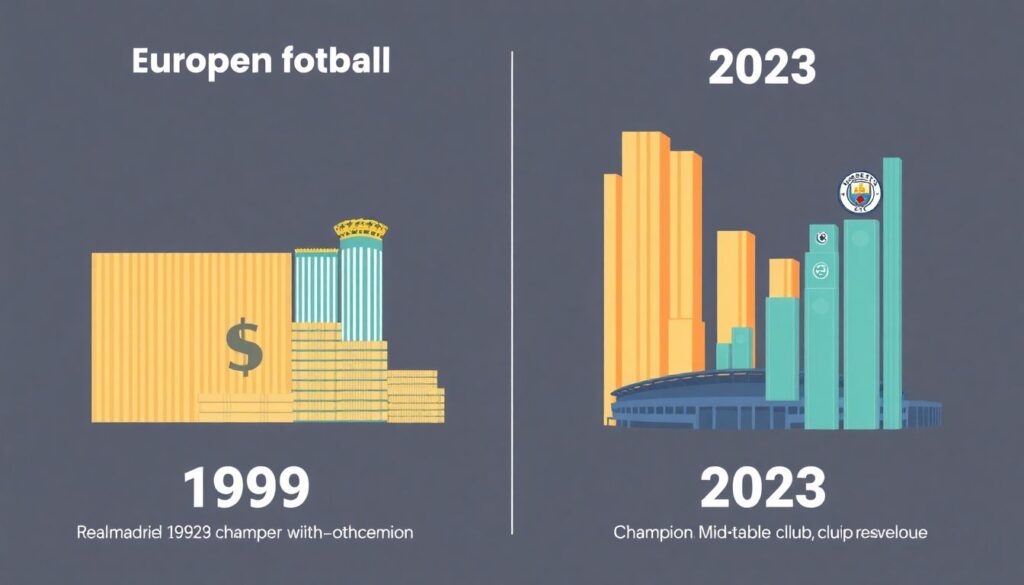
In the early 1990s, the difference in budget between a champion and a mid‑table club in Europe’s top leagues was big but not absurd. Today it’s a chasm. According to Deloitte, in 2023 Real Madrid and Manchester City both passed €800 million in revenue, while many clubs in the same domestic leagues operate with less than €80–100 million per season. In the Premier League, the ratio between the highest and lowest wage bills is regularly 6:1 or more; in LaLiga it can exceed 10:1 when you compare Barcelona or Madrid with recently promoted teams. That’s the kind of asymmetry you normally see between multinational companies and local shops, not supposed competitors in the same sporting competition. This is the starting point for any serious desigualdad económica entre clubes de fútbol análisis: before the first ball is kicked, the financial gap already decides which squads can realistically fight for trophies, which can maybe dream of a cup run, and which are just trying not to go bankrupt by Christmas.
TV money, global audiences and why some clubs sell shirts in Jakarta
The explosion of broadcasting deals is one of the main engines of inequality, even though it has also made leagues richer overall. The ingresos tv y derechos de retransmisión fútbol europeo in the “big five” leagues now reach tens of billions over a broadcasting cycle: the Premier League alone has domestic and international contracts worth well over £10 billion for just a few seasons. The paradox is that while leagues sometimes distribute a part of this in a more equal way, global popularity tilts the scales back toward the giants. A fan in Mexico might only watch Real Madrid, Barcelona, Liverpool and PSG, but his subscription money is mixed into league‑wide pools and commercial negotiations dominated by those very names. Some concrete patterns show up again and again: top clubs attract more prime‑time slots, more appearance fees in pre‑season tours to Asia or the US, and better individual sponsorship deals tied directly to their TV exposure. Meanwhile, a mid‑table club may depend almost entirely on domestic broadcasting and ticket revenue, with very limited upside abroad, even if they play in the same competition. The market logic rewards whoever already has the biggest audience, so the economic ladder becomes very hard to climb if you start on the lower rungs.
How different business models lock in advantage
If we look closely at the modelo de negocio clubes de fútbol grandes y pequeños, we see two almost separate ecosystems. Big clubs operate like entertainment conglomerates: they monetise not just tickets and TV, but also global merchandising, regional sponsors, social media, stadium tours and sometimes even real‑estate projects around their arenas. Smaller clubs survive on a narrow base: domestic TV share, local sponsors, player trading and matchday income. To visualise the contrast, think of two real cases from Spain. Real Madrid under Florentino Pérez used “galáctico” signings not only to win trophies but to sign bigger global partners: Emirates, Adidas and a long list of regional sponsors in Asia and the Middle East. Each new star increased shirt sales in markets thousands of kilometres away, creating a feedback loop between success and cash. At the same time, a club like Getafe or Rayo Vallecano mostly depends on local support and a comparatively tiny slice of central TV money. They can develop and sell players, yes, but every time they produce a gem, one of the giants comes in, pays a premium, and resets the deck. The smaller club gets a one‑off financial injection, while the big club strengthens both its sporting advantage and its brand appeal, widening the long‑term gap yet again.
Regulation, “financial fair play” and the illusion of a level playing field
Into this landscape walks UEFA’s regulatory framework, often summed up in one confusing phrase: fair play financiero uefa explicación. In theory, Financial Fair Play (FFP) was designed to stop clubs from spending wildly beyond their means and to encourage sustainability. In practice, critics argue it has often frozen the existing hierarchy instead of breaking it. Established giants usually have massive, stable revenue streams, which lets them spend more while technically “living within their means”. New challengers backed by ambitious owners, like Manchester City and Paris Saint‑Germain in their early takeover years, have faced investigations, sanctions, and complicated negotiations over what counts as “fair value” sponsorship. Meanwhile, historical brands with deep pockets of accumulated prestige can sign huge sponsorship deals precisely because they are already giants. The rulebook tends to treat this as purely market‑driven, despite the obvious circular logic: you’re big, so you can sign big contracts, so you can stay big. Important details matter: recent reforms have moved from pure “break‑even” rules toward squad‑cost ratios (limiting spending on wages and transfers as a percentage of revenue), but the same asymmetry remains. If Club A makes €800 million and Club B makes €80 million, both capped at, say, 70% of income, Club A can still outspend Club B 10:1 while proudly claiming compliance.
Real‑world case studies: from Leicester to PSG and the Spanish duopoly
Theory becomes much clearer when we look at specific clubs. Take Leicester City winning the Premier League in 2015–16. On paper, it was the ultimate underdog story: a club that had narrowly avoided relegation the previous season dethroned multi‑billion‑euro giants with a fraction of their wage bill. But the aftermath shows why economic gravity is so brutal. Within a couple of seasons, Leicester’s stars—Kanté, Mahrez and others—were poached by richer clubs. Leicester did grow its revenue and brand, but not enough to secure a place among the permanent elite. The fairy tale ended not with a dynasty, but with a respectable mid‑table status and eventually relegation again, a reminder that one exceptional season doesn’t rewrite structural rules. Contrast that with PSG after the Qatari takeover. Huge inflows of capital, controversial sponsorship valuations and aggressive transfer strategies quickly turned a traditional club into a domestic monopolist and a regular Champions League contender, despite heated FFP debates. On the sporting side, Ligue 1 became more predictable; on the economic side, PSG’s profile boosted the entire league’s TV deals but also concentrated attention and commercial power in one brand. In Spain, the long‑running dominance of Real Madrid and Barcelona shows yet another pattern. For years, they negotiated individual TV contracts, earning several times more than other LaLiga teams. Only after pressure from the rest of the league and the government was a more collective system introduced. Even then, the historical advantage in global fanbase and sponsorship means the financial duopoly remains, with Atlético de Madrid occasionally punching above its financial weight through exceptional sporting management.
The European Super League: symptom, not anomaly

The controversial project often summarised as superliga europea clubes ricos vs pobres wasn’t a random brainstorm; it was a logical extension of existing trends. The biggest clubs argued that they generate the majority of global interest and therefore deserve a bigger, more predictable slice of the pie through a semi‑closed competition. Critics replied that this would formalise what is already an informal oligarchy, turning European football into a franchise system more like the NBA, with limited sporting meritocracy. When fans across Europe protested in 2021, they weren’t just reacting against a new tournament format; they were pushing back against years of creeping inequality. The key fear was that a guaranteed place at the top would allow giant clubs to treat domestic leagues almost like secondary content, while smaller teams would permanently lose both money and visibility. Even though the initial version of the Super League collapsed under public pressure, court decisions and ongoing lobbying show the underlying tensions are far from resolved. The richest clubs still seek more control over broadcasting and commercial rights, while UEFA tries to keep a pan‑European pyramid intact, juggling its own financial interests in the Champions League.
Economic consequences for the wider football industry
The imbalance between rich and less rich clubs doesn’t stay confined to balance sheets; it shapes the entire football economy. Player salaries at the very top have exploded, driven by a bidding war among a few super‑clubs. This pulls the whole wage structure upwards, forcing mid‑level teams to overspend just to stay competitive, often accumulating dangerous debt levels. At the same time, agents and intermediaries thrive on frequent, high‑value transfers centered on that narrow elite, while grassroots investment often lags behind. For broadcasters, the situation is double‑edged. Big clubs drive subscription sales, but predictable results and repetitive match‑ups can erode long‑term interest. Leagues where the champion is known before Christmas may generate short‑term revenue yet risk fan disengagement over time. Sponsors face a similar trade‑off: backing the giant brings immediate exposure, but concentrating so many logos on the same few shirts leaves little room for brands wanting to connect with regional or niche fanbases.
– Winners in the current model:
– Global super‑clubs with historic brands
– Elite players and top agents
– Large broadcasters bundling premium content
– Losers in the current model:
– Smaller clubs with limited commercial reach
– Domestic leagues becoming too predictable
– Youth and grassroots projects that lack stable funding
Forecasts: where is the money and the power heading?
Looking ahead 5–10 years, several trends stand out if we try to project how economic inequality might evolve. First, international investors—from US funds to state‑linked entities—are likely to keep buying into clubs and multi‑club ownership structures, because football still offers unique global reach. This can mean more capital for infrastructure and analytics, but also a growing focus on financial returns, sometimes at the expense of local identity. Second, digital platforms and direct‑to‑consumer streaming may loosen the grip of traditional broadcasters, potentially allowing big clubs to negotiate more individually tailored deals. If that happens, current disparities could grow even sharper, as top brands monetise their own fan databases with targeted subscriptions, behind‑the‑scenes content and personalised merchandising. On the regulatory side, UEFA and domestic leagues will face pressure from both directions: big clubs pushing for more freedom and smaller clubs pushing for more revenue sharing and harder cost controls. It’s entirely possible to imagine stricter squad‑cost caps combined with luxury taxes or solidarity payments, borrowing ideas from US sports but adapting them to an open European pyramid. Yet without political will and unified enforcement, rules risk becoming window dressing while money keeps flowing upward.
– Possible corrective measures often discussed:
– More progressive distribution of TV and prize money
– Harder cost caps linked to league‑wide benchmarks, not just individual revenue
– Stronger solidarity mechanisms for academies and smaller clubs
– Possible drivers of even greater inequality:
– Independent streaming and content deals for the very top clubs
– Expansion of elite competitions reducing space for smaller teams
– Continued concentration of commercial sponsors around a tiny group
Is there still fair competition, or already a sporting oligarchy?
So, answering the core question—competencia justa o oligarquía deportiva—requires admitting an uncomfortable hybrid reality. On any given matchday, an underdog can still spring a surprise; knockout formats and injuries guarantee some unpredictability. But across a decade, titles, revenue growth and global brand power mostly accrue to the same small circle. The desigualdad económica entre clubes is not an abstract moral issue; it’s a structural feature of how modern football is financed, marketed and regulated. If stakeholders genuinely want something closer to fair competition, they’ll have to accept trade‑offs: maybe a little less income for the super‑clubs in exchange for more balanced leagues, or stricter spending rules that slow the arms race. If they don’t, the sport will continue drifting toward a de facto oligarchy in which a handful of brands monopolise trophies, attention and cash, while everyone else plays a different game under the same set of rules. Fans, ultimately, will decide how much predictability they’re willing to tolerate before the romance of football gives way to the feeling of watching a very expensive, very well‑produced rerun.