
The head coach as a practical philosopher is the person who turns ideas about football, people, and values into concrete daily decisions: who plays, how the team trains, how conflicts are managed, and how meaning is created around winning and losing. Philosophy becomes a tool for direction, not decoration.
Foundational Principles of the Coach-Philosopher
- Sees football decisions (line-ups, tactics, discipline) as ethical and educational choices, not only technical ones.
- Connects team values with small daily behaviours in training, matches, and meetings.
- Uses reflection and questioning to improve judgment, not to complicate it.
- Understands language, stories, and symbols as tools that build or destroy trust.
- Helps players think for themselves while staying fully committed to the collective idea.
- Evaluates success with a simple, repeatable review process after each micro-cycle or match.
Defining the coach as a practical philosopher
The coach as a practical philosopher is not an academic thinker, but a decision-maker who uses reflection, values, and clear concepts to guide everyday football work. Instead of separating «ideas» and «practice», this coach asks: what do we really believe about football and people, and how does that shape today’s plan?
In this sense, philosophy is a method for clarifying what matters most: what kind of football you want to play, what kind of people you want to develop, and what limits you will never cross in pursuit of results. This is as relevant to grassroots coaches as it is to a director técnico in La Liga.
The borders of this role are practical: it is not about giving long speeches or quoting classic libros de filosofía del fútbol para entrenadores. It is about making line-ups, rules, feedback, and tactical choices that are coherent with your declared identity. When there is a clash between short-term comfort and long-term values, the coach-philosopher chooses the long term.
Many coaches in a curso director técnico de fútbol online or a máster en dirección deportiva y liderazgo already touch these topics implicitly. Naming the coach as a practical philosopher simply makes explicit a responsibility they already carry: shaping the moral and mental climate in which football decisions happen.
Translating team values into daily practices
For the role to be real, values must appear concretely in how the team works. A coach-philosopher moves through a clear sequence:
- Clarify 3-5 non‑negotiable values. For example: respect, intensity, responsibility, continual learning, and courage with the ball.
- Define observable behaviours. For each value, write what it looks like in training, in a match, and in meetings. «Respect» might mean arriving on time, listening without interrupting, and no excuses when someone makes a mistake.
- Embed values into training design. If you say «intensity», your drills must reward quick transitions, repeated efforts, and mental alertness. A formación entrenador de fútbol enfoque táctico y mental is useful only if sessions reflect this dual demand.
- Connect values with selection and minutes. Players quickly see what is real. If a value never influences who starts, who is benched, or who is called up, it is just decoration.
- Use simple language and repetition. One short phrase per value («we press together, we rest together») repeated in training and video makes ideas stick more than complex motivational talks.
- Review behaviours weekly. In a short team meeting, ask: where did we live our values this week, and where did we fail? Two concrete examples are enough; avoid turning this into a lecture.
Designing an ethical framework for performance decisions
An ethical framework is a set of guiding questions you use to take difficult decisions under pressure. It protects the group from impulsive choices that damage trust. Typical scenarios where the coach must act as a philosopher include:
- Discipline versus performance. A key player breaks a rule before an important match. The framework asks: what message do we send if we ignore this? Is there a proportional consequence that protects both the rule and the team’s competitive level?
- Selection and meritocracy. When choosing the starting XI, do you prioritise current form, training effort, tactical fit, or hierarchy? An explicit order of criteria prevents accusations of favouritism and keeps decisions explainable.
- Injury risk and player protection. A player wants to play with discomfort. The coach-philosopher considers medical advice, the player’s long-term career, and the example this sets before deciding. Winning is important; sacrificing a career is not acceptable.
- Communication after defeat. Post-match comments can protect or destroy your own players. The ethical question: how can I tell the truth without humiliating anyone or shifting all blame away from myself?
- Use of psychological pressure. Motivational tools (public criticism, threats, rewards) must respect players as people. The framework asks: would I accept this treatment for my own child or for myself as a player?
- Relation with directors and staff. When management demands something that contradicts your principles (for example, fielding an unfit star for commercial reasons), your prior reflection on limits makes it easier to negotiate or say no with calm arguments.
In many posgrado coaching deportivo para directores técnicos programmes, these dilemmas are studied with case discussions. The practical philosopher-coach goes further: they anticipate their own red lines before such conflicts explode.
Applying philosophical tools to tactical and strategic choices
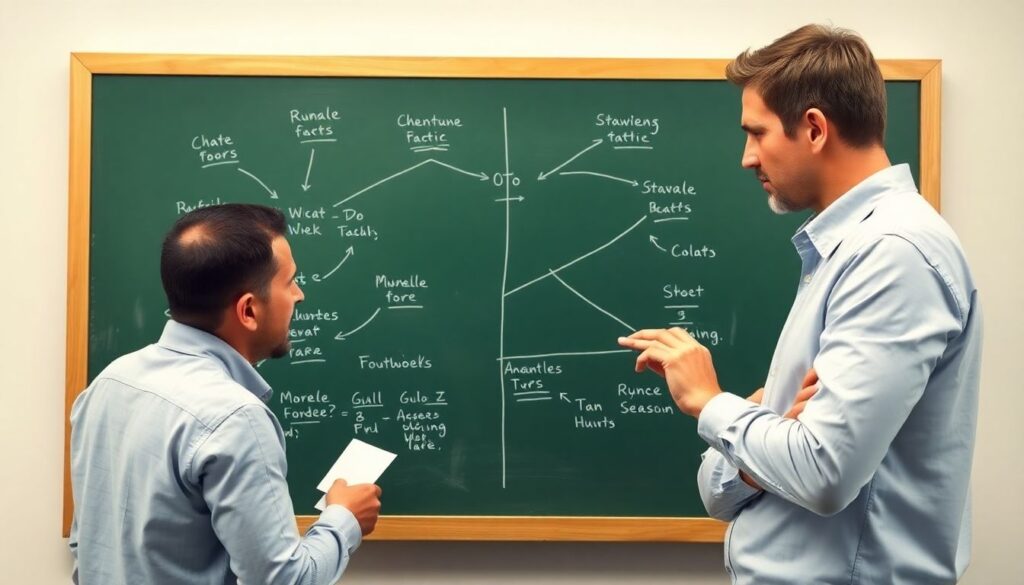
Philosophical tools are ways of thinking, not abstract theories. They help you simplify complex tactical situations, question assumptions, and align the long-term project with today’s game plan. Used well, they sharpen your football eye instead of replacing it.
Advantages of a philosophical approach to tactics
- Conceptual clarity. You define what «dominance», «control», or «aggression» mean in your model, so staff and players talk the same language.
- Consistent decision rules. For example, «we accept numerical inferiority wide, never central», or «we always protect the inside channel first». These are small, applied principles.
- Better video analysis. Instead of collecting random clips, you search for moments that confirm or challenge your key ideas about space, time, and risk.
- Learning from mistakes. After a tactical failure, you do not just change the system; you ask which underlying belief was wrong (about the opponent, your players, or the game itself).
- Coherent long-term planning. Recruitment, academy work, and first-team methodology align, because everyone shares the same basic concepts about how the game should be played.
Limitations and risks to keep under control
- Overcomplication. Too many abstract principles confuse players and slow decisions on the pitch. The more complex the idea, the fewer players can execute it under pressure.
- Paralysis by analysis. Endless discussion of possibilities can reduce the staff’s ability to choose and commit. The coach-philosopher must also be a coach-decision-maker.
- Ignoring emotions. Tactical thinking without attention to mood, fear, and confidence misses half the reality. Mental states change how players read and act on principles.
- Rigidity. A beautiful model of play can become a prison if the coach refuses to adapt to the squad’s real strengths or the specific context of a competition.
- Communication gap. Staff might enjoy conceptual debates, while players need simple cues and clear constraints. Bridging this gap is part of the philosophical job.
Shaping team narratives and the language of trust

The coach as philosopher pays special attention to words, metaphors, and stories. Language shapes how players interpret pressure, mistakes, and roles. Certain habits of speech systematically build trust, while others slowly erode it.
Common traps and myths around narratives
- Myth: «Strong teams don’t need explanations.» In reality, adults and professionals want to understand the logic behind decisions. You do not owe them agreement, but you do owe them clarity.
- Trap: motivational talk that contradicts reality. Promising equal opportunities when hierarchy is fixed destroys credibility. It is better to state honestly how selection works and then stay consistent.
- Myth: all criticism must be public to be effective. Public correction has its place, but constant exposure breeds fear. The wise coach chooses carefully what is said in front of the group and what is addressed privately.
- Trap: using war metaphors for everything. Aggressive language can energise short term, but long-term it normalises hostility and excuses disrespect. Football is competitive, not a literal battle.
- Myth: «Either you are positive, or you are realistic.» A philosophical approach combines realism about problems with faith in the team’s capacity to improve. Both messages can coexist in the same meeting.
- Trap: changing the story every week. Constantly switching between narratives («we are victims», «we are favourites», «we are rebuilding») confuses players. The core story of who we are should remain stable even when results fluctuate.
Cultivating player autonomy and collective judgment

The coach-philosopher wants players to understand the game deeply enough to make good decisions without constant instructions. Autonomy is not anarchy; it is educated freedom within a shared framework. This must be trained deliberately, not only demanded.
Short training-room example:
- Micro-scenario. Set a 7v7 game where wide players must decide when to stay wide and when to attack inside between lines.
- Guiding question. Pause play three times and ask only one question: «What did you read to make that run?» Let 2-3 players answer; do not give the solution immediately.
- Shared principle. Co-create a simple rule: «If the full-back jumps to press early, we attack inside; if he holds, we stretch him wide.» Write it on a board for reference.
- Repetition under pressure. Restart the game, adding time pressure or score constraints so players must apply the principle fast.
- Player-led review. In the last three minutes, ask one player to explain the rule to the group, using one clip or concrete example.
Simple pseudo-algorithm for post-match judgment (to avoid emotional overreaction):
After each match:
1. Separate facts from feelings (what actually happened vs. how we feel).
2. Identify 3 decisions that changed the game (ours or theirs).
3. Ask: which principle guided each decision?
4. Decide 1 thing to keep, 1 thing to adjust, 1 thing to stop.
5. Communicate this in <10 minutes to staff; in <5 key points to players.
Quick checklist for coach-philosophers
- Can I write my team’s 3-5 core values and 1 concrete behaviour for each?
- Do my selection, discipline, and communication choices clearly reflect those values?
- Do players know 3-4 simple principles that guide our tactical decisions?
- After each match, do we follow a short, repeatable review algorithm instead of reacting impulsively?
- Is my ongoing learning (courses, e.g. curso director técnico de fútbol online or máster en dirección deportiva y liderazgo) integrated into practice, not kept in theory?
Practical Questions from Coaches and Staff
Is the «coach as philosopher» idea only for elite levels?
No. The role is relevant at any level where you influence people, from youth to professional football. The complexity changes, but the core task-aligning values, decisions, and communication-remains the same.
How can I start if I have no formal background in philosophy?
Begin by clarifying your football and human values in simple language. Then connect them with concrete rules for training, selection, and feedback. If you read libros de filosofía del fútbol para entrenadores, use them to ask better questions, not to sound more sophisticated.
How do I balance tactical detail with the mental and ethical side?
Plan every micro-cycle with both dimensions: tactical objectives and mental/behavioural objectives. A good formación entrenador de fútbol enfoque táctico y mental shows how to embed both in the same drill, instead of adding psychology as a separate «talk».
Can a sport director or coordinator also act as a practical philosopher?
Yes. In fact, many contents of a posgrado coaching deportivo para directores técnicos aim at this: defining club-wide principles and ensuring that recruitment, academy work, and coaching decisions follow a coherent line.
How do I avoid overthinking and losing spontaneity on the bench?
Do the heavy reflection before the match: clarify 2-3 game principles and pre-decide some responses to typical situations. On the bench, trust these preparations and your intuition. The algorithm is: prepare deeply, decide simply, review honestly.
Are online courses enough to develop this role?
Online formats like a curso director técnico de fútbol online or a specialised máster en dirección deportiva y liderazgo can offer structure and examples. But without daily application in your team-testing ideas in training, matches, and meetings-knowledge will stay theoretical.
How do I know if my philosophical approach is helping the team?
Look for behavioural indicators: more consistent effort, clearer communication on the pitch, fewer repeated conflicts, and faster learning from mistakes. Combine this with a simple post-match review algorithm and regular feedback from staff and senior players.