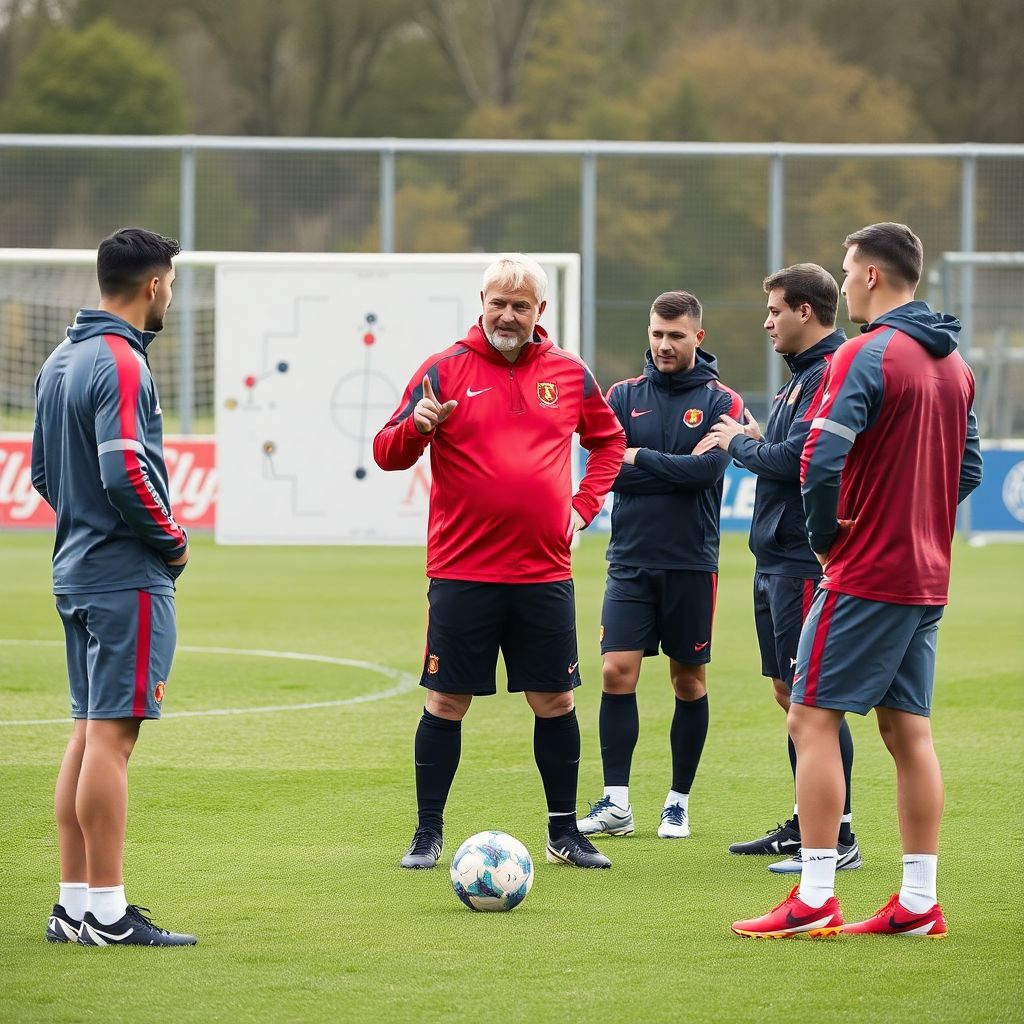
The coach-as-philosopher is not a guru speaking in slogans, but a trainer who links clear ideas about the game with daily training, selection and feedback. From Sacchi and Cruyff to Guardiola and Bielsa, the role means turning principles into repeatable behaviours, then checking if performance, learning and identity actually change.
Debunking myths about the coach-as-philosopher
- Myth: A philosophical coach only talks about ideas; reality: Sacchi, Cruyff, Guardiola and Bielsa obsess over concrete training tasks, distances and behaviours.
- Myth: Philosophy is incompatible with results; reality: clear ideas reduce randomness and help players make faster, more consistent decisions under pressure.
- Myth: This role is about motivational speeches; reality: it is mostly about designing sessions, structures and rules that teach the game implicitly.
- Myth: You need genius-level talent to apply these models; reality: even an amateur coach in Spain can adapt them through a good curso entrenador de fútbol metodología guardiolista or guided mentoring.
- Myth: Philosophy is fixed forever; reality: Cruyff, Guardiola and Bielsa constantly adjusted details while protecting a stable core of principles.
- Myth: Youth coaches should avoid strong ideas; reality: the clearest academies teach a defined style early, then add flexibility later.
Sacchi’s tactical manifesto: structure, pressure, and collective intelligence
Myth first: Sacchi is often reduced to defensive catenaccio. In reality, his manifesto was about compressing space to attack and defend together, transforming eleven individuals into a synchronised block. The coach-as-philosopher here is an architect of distances, timing and references more than a pure tactician.
Sacchi’s core definition of coaching centres on collective intelligence: every player reads the same cues and reacts in the same direction. Lines move together, pressure triggers are shared, and the team acts as a single organism. Philosophy, for him, is a clear model that dictates where, when and how the block behaves.
This approach sets boundaries: it is not a collection of set-plays, nor a list of inspirational quotes. It is a small number of non‑negotiable rules about height of the line, compactness, pressing direction and support angles. Everything the coach does in training and selection reinforces those rules.
For a coach following a formación online entrenador de fútbol posesión estilo sacchi y cruyff, applying this manifesto means turning abstract concepts into rigid constraints on the pitch: zones to occupy, maximum distances between players, and specific cues to start collective pressure.
- Practice idea 1: 7v7 in three horizontal zones, defending team must keep all players inside 25-30 metres from back to front; coach rewards line movements, not just ball recovery.
- Practice idea 2: 6v4 pressing waves, with clear triggers (back pass, lateral pass, bad first touch); defenders must jump together or all drop together.
- Practice idea 3: 8v8 with offside line coached actively; defenders are praised for stepping up on pass, not for last‑second tackles.
Cruyff’s legacy: philosophy embedded in youth, space and identity
Myth first: Cruyff’s legacy is often sold as «just total attacking football». In truth, his revolution was embedding a club identity from U8 to first team, teaching the language of space and daring on the ball long before players reached elite level.
-
Start with a non‑negotiable game model in the academy
- Same base structure (e.g., 4‑3‑3 or 3‑4‑3) across ages, adapted to pitch size.
- Fixed principles: building from the back, taking initiative, creating triangles and rhombuses.
-
Teach space, not only technique
- Rondos and positional games where the key is where you stand before the ball arrives.
- Coaches use the same positional vocabulary from U12 to senior.
-
Connect identity with recruitment
- Scouting favours players comfortable receiving under pressure and solving 1v1.
- Club understands some profiles may be weaker physically at 14 but more suitable at 20.
-
Use the same game ideas in training and matches
- Academy teams build up short even when behind, to consolidate habits.
- Coaches are evaluated on player development, not only weekend results.
-
Support the model with shared language and references
- Staff share libros de táctica fútbol cruijff bielsa guardiola to align concepts and vocabulary.
- Video libraries show «good examples» of the style from youth and senior teams.
-
Align parents and club environment
- Meetings explain why building from the back at U12 is more important than winning a local derby.
- Scoreboard pressure is redirected towards executing the model, not just the result.
- Practice idea 1: 4v2, 5v2, 6v3 rondos with strict positioning rules: players cannot close distance to the ball; they must create angles.
- Practice idea 2: 7v7 positional game in zones reflecting your game model, one player per zone maximum.
- Practice idea 3: Academy «identity day» where all teams train the same topic (e.g., breaking first line) with adapted difficulty.
Guardiola’s refinement: positional play, micro-decisions and patterns
Myth first: Guardiola is accused of «overcomplicating football». In practice, his positional play simplifies decisions by giving each player a clear role in each zone, plus a small set of if‑then patterns. The coach‑philosopher becomes a designer of decision trees, not a random improviser.
Guardiola’s work is most visible in specific scenarios where space and time are scarce. Each scenario has reference positions, preferred patterns and micro‑rules. A máster en coaching deportivo y filosofía del fútbol often uses his teams as case studies of how abstract ideas become concrete, repeatable actions.
-
Building from the back vs high press
- Goalkeeper and centre‑backs create a 3v2 or 4v3 base; six and fullbacks adjust to offer clear passing lanes.
- Pattern: attract press one side, find free man in half‑space on opposite side.
-
Attacking a mid‑block in 4‑4‑2
- Use width to stretch back line, then occupy both half‑spaces between lines.
- Pattern: inside fullback + inverted winger + eight in the pocket, rotating roles.
-
Possession in the final third
- Freeze at least five players in rest‑defence positions to control transitions.
- Pattern: third‑man combinations to break the last line instead of direct passes into traffic.
-
Controlled pressing after loss
- Immediate 5-6 second counter‑press around the loss zone with clear direction (inside or outside).
- Back line steps to squeeze, keeping team short and compact.
-
Managing a lead late in the game
- Use possession as defence: long passing sequences with low‑risk central lanes.
- Substitutions prioritise keeping structure, not only fresh legs.
-
Adapting positional play to different squads
- At Barça, false nine; at Bayern, wide wingers; at City, inverted fullbacks and box midfield.
- Same logic, different shapes according to player profiles.
- Practice idea 1: 6v4 build‑up game starting from goalkeeper, with fixed zones and bonus for third‑man runs.
- Practice idea 2: 8v8+3 neutral in two corridors and two half‑spaces, wingers locked wide, interiors locked in pockets.
- Practice idea 3: 7v7 transition game, goals allowed only within five seconds of ball recovery to train counter‑press and immediate attack.
Bielsa’s pedagogy: rehearsal, analysis and uncompromising principles
Myth first: Bielsa is pictured as a romantic who ignores results. In practice, he is one of the most demanding methodologists in modern football, using obsessive rehearsal and meticulous analysis to teach very clear principles: verticality, dynamic support, aggressive pressing and total commitment to the collective.
The strength of Bielsa’s approach is pedagogical consistency. Players know exactly what is expected in each phase and work at maximal intensity almost every day. However, that same intensity, plus his uncompromising ethics, can create emotional and physical strain if the environment is not carefully managed.
Benefits of Bielsa-style philosophical coaching
- Unshakeable clarity: everyone understands the non‑negotiable behaviours with and without the ball.
- High tactical literacy: players learn to read complex cues through constant video and repetition.
- Culture of effort: standards for work rate, weight control and attention to detail become part of the club’s identity.
- Accelerated development of young players who embrace responsibility and intensity early.
- Strong alignment between training and match style, reducing surprises under pressure.
Limitations and risks to manage
- Physical overload if session volume and intensity are not periodised carefully across the season.
- Mental fatigue from constant analysis and high emotional demand, especially for older players.
- Less flexibility for players who do not fit the required physical or psychological profile.
- Potential conflicts when club management prioritises short‑term results over long‑term culture.
- Difficulties in late‑season freshness if rotation and recovery are not protected.
- Practice idea 1: 11v0 rehearsals of pressing movements, then 11v11 with strict marking of distances and pressing direction.
- Practice idea 2: Small‑sided games with mandatory forward pass within three touches to push verticality.
- Practice idea 3: Weekly video micro‑sessions (10-15 minutes) on one principle only, with player discussion.
From idea to club DNA: culture, recruitment and daily training rituals
Myth first: writing a «philosophy document» automatically changes a club. Without alignment in culture, recruitment and daily routines, the document becomes decoration. Turning an idea into DNA means making it visible in how you sign players, how you speak, and how you structure every training day.
Typical errors and myths when clubs try to copy Sacchi, Cruyff, Guardiola or Bielsa are surprisingly similar, whether it’s an academy in Spain or a professional team joining a clinic de fútbol para entrenadores con metodología bielsista y guardiolista for a weekend.
-
Copying shapes instead of principles
- Error: adopting 4‑3‑3 or 3‑4‑3 while keeping old, contradictory behaviours (long balls, low block, no pressing triggers).
- Correction: first define what you want with and without the ball, then choose the shape that supports those aims.
-
Recruiting on name, not profile
- Error: signing «good» players who cannot receive under pressure or run the required distances.
- Correction: define 3-5 key traits per position according to your model and recruit only players who fit at least most of them.
-
Separating philosophy from physical and mental preparation
- Error: fitness coach plans isolated running, psychologist works on generic motivation, none linked to game model.
- Correction: integrate conditioning into game‑like exercises and tie mental work to specific match situations.
-
Changing ideas every season
- Error: each new head coach erases the previous model, forcing academy and first team into constant resets.
- Correction: club defines a stable framework; coaches bring nuances, not full revolutions every year.
-
Overloading players with theory
- Error: long classroom sessions, complex terminology, little time on the pitch.
- Correction: short explanations, then many small games and constraints that make the principle inevitable.
-
Ignoring coach education as a continuous process
- Error: staff attend one curso entrenador de fútbol metodología guardiolista and assume learning is complete.
- Correction: long‑term plan including internal workshops, external mentors and study of top teams across seasons.
- Practice idea 1: Monthly staff meeting where game model principles are reviewed against match clips from all age groups.
- Practice idea 2: Recruitment checklist per position aligned with on‑field behaviours, not just attributes like speed or height.
- Practice idea 3: Standardised daily routine (activation, main tactical block, finishing or transition game) shared by all teams.
Assessing success: metrics, player progression and long-term influence
Myth first: philosophical coaching cannot be measured. In reality, you can monitor whether your Sacchi‑Cruyff‑Guardiola‑Bielsa mix produces the intended behaviours, development and stability. The key is using simple, repeatable indicators linked directly to your principles, not only the league table.
In Spain, many coaches combine a máster en coaching deportivo y filosofía del fútbol with daily self‑assessment. They use match clips, data and player feedback to check if the model is alive. Even an amateur coach following formación online entrenador de fútbol posesión estilo sacchi y cruyff can apply a basic algorithm of evaluation.
Simple evaluation algorithm for a philosophical game model
- Define 3-5 core principles (e.g., compact pressing, building from the back, occupying half‑spaces, intense counter‑press).
- For each principle, create 2-3 observable behaviours (e.g., «back four inside 30 metres from nine when ball in mid‑third»).
- After each match, select 10-15 clips and tag them according to these behaviours: present, absent or inconsistent.
- Score each principle from 1-5 based on how often behaviours appear and their quality.
- Ask 3-5 players what the team tried to do in that match; compare their answers with your principles.
- Decide one training focus for the next microcycle to correct the weakest principle.
- Repeat this loop every 3-4 games to track trends, not just isolated performances.
Mini case: from chaos to coherent identity
Imagine a semi‑professional club in Spain. Results are inconsistent; styles change every week. The new coach designs a clear model blending Sacchi’s compactness, Cruyff’s positional structure, Guardiola’s patterns and Bielsa’s intensity. He uses the evaluation algorithm above for one season.
Over time, player answers in debriefs start matching the written principles, training focuses become clearer, and match clips show more frequent desired behaviours, even before the league position improves. The club invites staff to a clinic de fútbol para entrenadores con metodología bielsista y guardiolista to refine details. The role of coach‑as‑philosopher becomes visible: less noise, more coherence, and a shared identity that survives beyond a single coach.
- Practice idea 1: Monthly «identity report» summarising principle scores, typical clips and one priority for the next month.
- Practice idea 2: Player self‑ratings for understanding and executing each principle, compared with staff ratings.
- Practice idea 3: Seasonal review where clips from matchday 1 and the final match are compared side‑by‑side for each principle.
Concise practical clarifications on implementing a coaching philosophy
How many core principles should a coach-philosopher define?
Keep it small: usually three to five core principles are manageable for staff and players. More than that becomes hard to train consistently and to communicate clearly across all teams in the club.
Should youth teams copy the first-team system exactly?
Not necessarily the exact formation, but they should respect the same underlying ideas. Adjust shapes to age and pitch size, while keeping principles like building from the back, pressing intention or positional structure consistent.
How do I blend ideas from Sacchi, Cruyff, Guardiola and Bielsa without confusion?
Start by choosing one or two main references that match your context, then add small elements from others. If principles contradict each other, players will be lost; prioritise clarity over variety.
Is it possible to apply a philosophical model with very limited training time?
Yes, if you focus on one or two principles and design every exercise around them. Short sessions can still teach compactness, pressing or build‑up if games and constraints are well chosen.
What is the role of video analysis in this type of coaching?
Video connects abstract ideas with concrete images. Short, focused clips showing good and bad examples of your principles help players understand what you mean and how close they are to the target model.
How can a coach in regional or amateur leagues start this journey?
Begin with a written one‑page model, then choose two or three training games that express it. Complement with selected libros de táctica fútbol cruijff bielsa guardiola or affordable online courses instead of trying to copy full professional programmes.
When should a club reconsider or evolve its philosophy?

When long‑term evaluation shows players understand the ideas but the model still fails to suit the league context or player profiles. Evolution should be gradual, protecting the most important identity traits.