
El fútbol como religión secular: setting the stage
Let’s start with the simple question people usually ask half‑jokingly: *“Is football a religion now or what?”*
When you look at packed stadiums, choreographed chants, club anthems, pilgrimages to away games, and the way fans talk about “sacred” colours, it’s hard not to see *el fútbol como religión secular* as more than a metaphor. But the interesting part isn’t the poetry of it; it’s what you can do with this idea in real life—whether you’re a fan, a coach, a marketer, a teacher or a community organizer.
This text is basically *el fútbol como religión ensayo*, but in a practical, down‑to‑earth, “how does this help me tomorrow?” tone.
Football as secular faith vs. pure entertainment
Two main lenses: belief vs. show
There are two dominant ways to look at this:
1. Football as secular faith (collective belief)
2. Football as mass entertainment (global show business)
In real life, both overlap, but they drive different decisions.
Football as secular faith treats clubs and national teams like identity anchors. The badge is not just a logo; it’s a flag. Matchday is not just a slot in the calendar; it’s a ritual. From this angle, *fútbol religión del siglo XXI* isn’t a joke—it’s a description of how millions structure their weekends, friendships and even moods.
Football as entertainment sees the same game as content: 90 minutes plus highlights, memes, fantasy stats and betting odds. Here the goal is maximizing engagement, views and revenue. Fans are “audiences,” not “believers.”
Both views are real; your job is to decide when to lean into which one.
– If you’re running a club, supporters’ group or academy, you gain more by treating football as belief + community.
– If you’re a broadcaster, streamer or brand, you’re usually optimizing for entertainment + attention.
Knowing which “mode” you’re in keeps you from sending mixed signals: you don’t preach sacred loyalty on Monday and push purely transactional offers on Tuesday without consequences.
Practical implications for everyday life
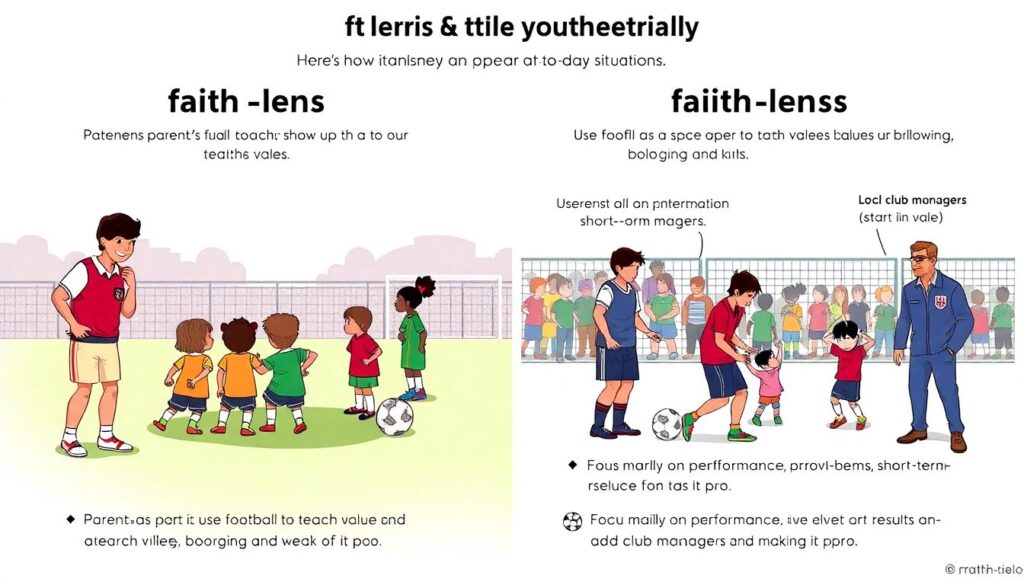
Here’s how those two lenses show up in day‑to‑day situations:
– Parents & youth coaches:
– Faith‑lens → Use football as a space to teach values, belonging and resilience.
– Entertainment‑lens → Focus mainly on performance, short‑term results and “making it pro”.
– Local club managers:
– Faith‑lens → Invest in traditions, rituals, symbols, fan participation.
– Entertainment‑lens → Push events, VIP zones, digital content, one‑off campaigns.
– Fans themselves:
– Faith‑lens → You’re part of something bigger, even when the team loses.
– Entertainment‑lens → If the show is bad, you switch channel or club.
Knowing your own lens helps you avoid burnout, frustration, or that “I take this too seriously” feeling.
What the “religion” metaphor actually gives you
Understanding the social meaning of football
The *significado social del fútbol moderno* is not only about who wins trophies. It’s about how football:
– Creates shared time (everyone watching the same final)
– Produces shared language (inside jokes, metaphors, chants)
– Builds micro‑tribes (ultras, supporters’ clubs, fantasy leagues)
This is why, for a city, losing a club or getting relegated can hurt like losing a piece of identity. From a practical standpoint:
– Teachers can use football to talk about identity, conflict, cooperation and globalization.
– Community projects can use local clubs as hubs to reach kids who ignore “official” programs.
– Therapists and social workers sometimes use club allegiance as an entry point to build trust, especially with teens.
Thinking of football as a secular religion isn’t about exaggerating; it’s about using what’s already emotionally charged to move real‑world projects forward.
Football and “religious” fan behaviour
Talk about *fútbol y fanatismo religioso análisis* gets dark quickly: violence, discrimination, conspiracy thinking (“the refs are against us”, “the league hates us”). But even here, there are skills and tools we can pull out of it.
Recognizing fanatic patterns helps you:
– As a fan: notice when the game is starting to control your mood, relationships or money.
– As a coach or club: design codes of conduct, steward training and messages that cool down tensions.
– As a policy‑maker: choose policing and crowd‑management methods that reduce confrontation rather than inflame it.
A simple practical rule:
Whenever language shifts from “we love our club” to “we’re better humans than those people”, you’re leaving the stadium and entering a quasi‑religious war mindset. That’s the moment to intervene—online or offline.
Technologies: how the new “temple” works
From stadiums to screens: what’s changed
Technology has turned the stadium into only one of many “holy places.”
Today, the real *impacto cultural del fútbol en la sociedad* flows through:
– 24/7 streaming and highlights
– Social media, fan channels and podcasts
– Video games and fantasy football
– Betting platforms and prediction apps
These tools are neutral in theory, but in the real world they shape how we believe and belong.
Think about it this way:
In the past, you went to the stadium or listened to the radio; now, you live inside a permanent, noisy, football‑flavoured internet.
Pros and cons of the new football technologies
What’s genuinely helpful
– Streaming & on‑demand video
– Lets diaspora fans stay connected to their “home” club.
– Makes small leagues and women’s football visible worldwide.
– Social media
– Fans co‑create club culture: tifos, chants, memes, grassroots campaigns.
– Easier to organize charity matches, protests, fundraisers.
– Data & analytics tools
– Coaches at amateur and youth level can use cheap GPS, apps, and simple dashboards.
– Parents and players get clearer feedback than “you played badly”.
– Gaming & fantasy football
– Teach tactics, probabilities and long‑term planning in a playful way.
What can go very wrong
– Over‑commercialization
– Fans start feeling like data points, not members of a community.
– Clubs chase “global engagement” and ignore the people who actually go to the stadium.
– Algorithm‑driven outrage
– Platforms reward hot takes and anger.
– Ref decisions become viral wars instead of rules discussions.
– Addictive design
– Betting and fantasy can quietly become compulsive.
– Kids and adults alike can lose money, sleep and focus over “the game”.
The key is not to reject technology, but to use it as an amplifier of the best parts of football rituals, not the worst.
How to use tech without killing the “soul” of the game
Whether you’re managing a kids’ team or a fan account, you can use a few practical guardrails:
– Limit “always on” modes:
– Set match windows and “offline hours” for groups and chats.
– Separate analysis from rage:
– Use tools (replays, stats, xG graphics) to understand the game, not just to blame people.
– Mix online and offline:
– Any big digital community should have real‑world meetups, charity actions or local projects at least a few times a year.
Comparing different “use cases” of football as secular religion
Three approaches in practice
You’ll usually see three real‑world strategies around football:
1. Football as identity infrastructure
– Used by cities, schools, community centers.
2. Football as commercial ecosystem
– Used by clubs, brands, broadcasters.
3. Football as personal growth tool
– Used by coaches, parents, educators, therapists.
They’re not mutually exclusive—but you should be clear which one is your priority, because the tone, tools and expectations are very different.
What each approach is good and bad at
– Identity infrastructure
– Strengths:
– Builds long‑term loyalty and resilience.
– Reduces loneliness; creates safe spaces for emotions.
– Weaknesses:
– Slow “ROI” in classic business terms.
– Can slide into “us vs. them” tribalism if not guided.
– Commercial ecosystem
– Strengths:
– Brings money, jobs, better facilities, more content.
– Attracts global attention and talent.
– Weaknesses:
– Temptation to treat fans like customers who can be replaced.
– Overload of games and competitions dilutes meaning.
– Personal growth tool
– Strengths:
– Clear impact on character, discipline, mental health.
– Works even if a kid never becomes a pro.
– Weaknesses:
– Hard to measure in spreadsheets.
– Often underfunded, overshadowed by trophy‑chasing.
If you’re designing a project—an academy, a fan club, a local league—decide which of these is your core mission. You can borrow elements from the others, but one of them should clearly lead.
Practical recommendations: how to “use” football’s religious side
For fans: enjoy the faith, keep your balance
You don’t need to be a sociologist to use this stuff. A few simple habits help you stay a passionate fan without losing perspective:
– Set a time budget for football: matches, debates, scrolling. If it eats into sleep or important relationships, dial it back.
– Learn a bit about sports psychology: understanding bias and emotional swings makes losing easier to handle.
– Use matchdays as a chance to connect intentionally: invite someone lonely to watch, bring your kids, mix generations.
In other words, let football be a ritual—but a chosen one, not a compulsion.
For coaches and academies: design rituals on purpose
Treat your team like a small secular congregation—in a good way:
– Create positive rituals: specific warm‑ups, handshakes, songs after games, clear pre‑match routines.
– Tell club stories: heroes, difficult seasons, comebacks. Kids learn values through narratives, not lectures.
– Use technology in simple, human ways:
– Short video clips for learning, not hours of tactical wallpaper.
– Shared group channels with rules: no insults, no blame storms.
Your goal is to make the team feel like a second home, not a factory for future contracts.
For clubs and fan organizations: protect the “temple”

If you work for a club or a supporters’ group, remember that you’re not just handling customers; you’re managing something closer to a shared myth.
Very practical moves:
– Involve fans in visible decisions: banners, local causes, charity partners, sometimes even kit elements.
– Maintain affordable access for at least part of the stadium; if only corporate clients can attend, the ritual breaks.
– Train stewards and moderators not just in security, but in de‑escalation and inclusion.
Your brand is not only your logo; it’s the way people feel in and around your “temple.”
For educators and community workers: turn games into gateways
Use football as a gateway to topics that are otherwise “boring” or “too heavy”:
– History and geography through clubs and rivalries.
– Math and statistics through scores, probabilities and fantasy leagues.
– Ethics and citizenship using fair play, racism, sexism and corruption cases.
Here, the *significado social del fútbol moderno* is your friend: you piggyback on attention that already exists instead of fighting for it.
Trends and predictions toward 2026
What’s shaping the “religion of football” now
Looking at current developments, a few 2026‑oriented trends are already visible:
– Hyper‑personalized fandom
– Algorithms build unique highlight feeds: your “liturgies” are custom‑made.
– Fans support multiple clubs across leagues and even e‑sports, like having several “saints”.
– Growing role of women’s football
– Women’s leagues are becoming central, not secondary.
– New fan cultures emerge with different ritual styles and narratives.
– Hybrid stadiums
– AR/VR layers on top of live games: stats on glasses, multi‑angle streams, mixed reality activations.
– For some, the main “church” will be a headset, not a physical terrace.
– Ethical pressure on clubs and federations
– Human rights, environmental impact, and financial transparency matter more to younger fans.
– A club that behaves badly off the pitch risks “moral relegation” in the eyes of its own supporters.
All this reinforces the idea of *fútbol religión del siglo XXI*: not because people pray to football, but because they use it to think about meaning, community, and justice, the same way traditional religions used to structure those conversations.
How to adapt your own practice by 2026
No matter where you are in the football ecosystem, you can start adjusting now:
– Make values explicit. State clearly what your club, group or project stands for—and live by it.
– Design for depth, not just reach. A smaller but engaged community is more “religious” (in the good sense) than a huge but indifferent audience.
– Blend tradition with innovation. Keep the core rituals (colours, songs, local customs) while testing new, meaningful uses of tech: storytelling, education, inclusion.
If you treat football as both stage and sanctuary, you’ll be better prepared for the next waves of change.
Final thoughts: more than a game, less than a god
Football doesn’t need actual miracles or dogmas to behave a bit like a religion. It already offers:
– Shared myths and heroes
– Weekly rituals and emotional highs
– A sense of belonging to something larger
What you do with that is the real question.
Handled carelessly, it turns into fanaticism, addiction, and empty spectacle. Handled with intention, it becomes one of the most powerful tools for social connection, education and personal growth that we have today.
The ball will keep rolling. The trick is to decide whether you’re only watching the show—or also using this “secular faith” to build something worthwhile in your corner of the world.