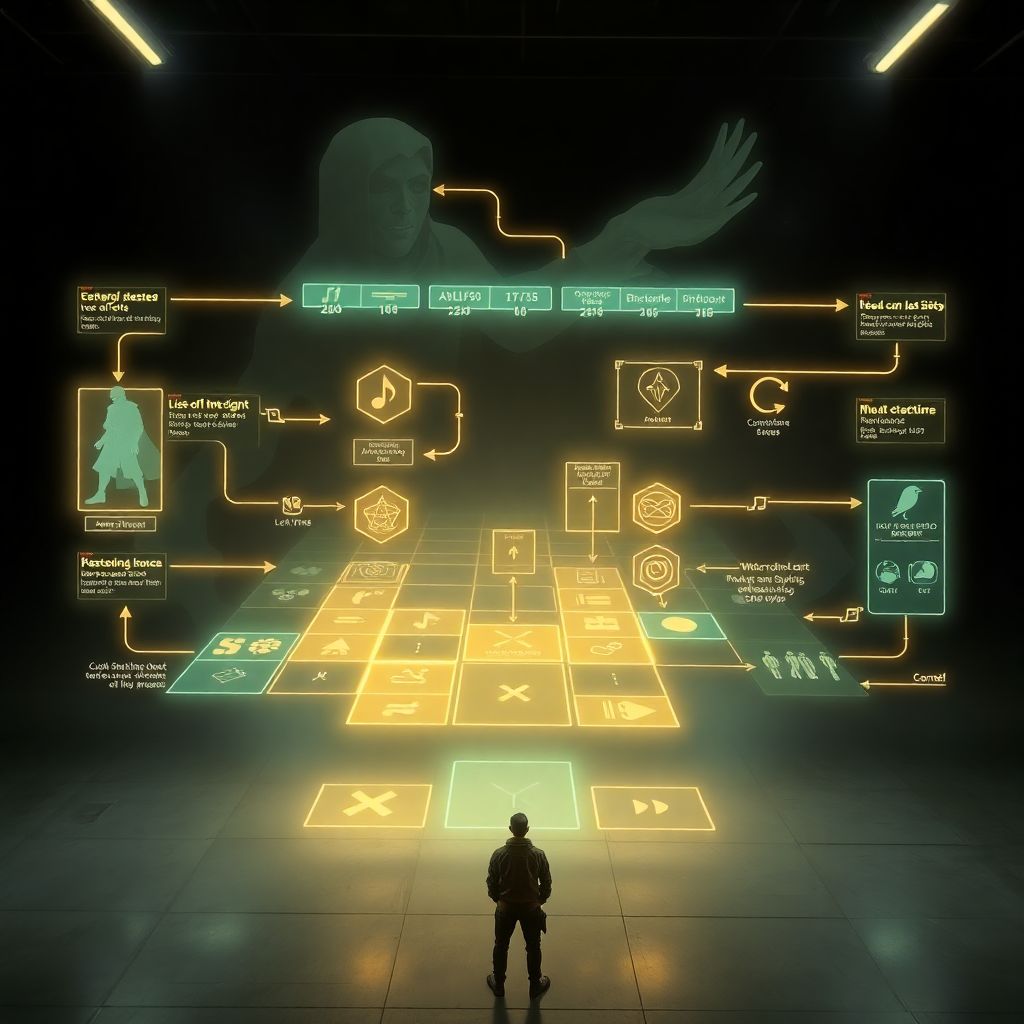
Tactics as language: reading the hidden sentences of play

Tactics aren’t just “how to win”; they’re the way a game whispers its worldview to the player. Every cooldown, line of sight, damage curve and scoring rule is a little grammatical rule in a secret language. A stealth game where patience beats aggression is literally telling you that slowness and observation are rewarded. A roguelike where you lose everything on death is arguing that learning matters more than possessions. When you treat tactics as language, you stop asking only “is this balanced?” and start asking “what is this system saying about risk, trust, cooperation, power?” — and whether that message is the one you actually want to send.
Sometimes the loudest sentence in a game is the one you never wrote in the dialogue box. It’s the rule that forces players to betray, grind, or rush — and suddenly your “cozy” game is teaching ruthless optimization.
Inspiring examples: when systems speak louder than story
Think about how Portal teaches respect for curiosity with almost no explicit preaching. The level design nudges you into trying the “impossible”; the reward is that satisfying whoosh through space. The tactical layer — experimenting, observing, re-framing the room — becomes a manifesto about lateral thinking. Or take Journey: there’s no chat, no lobby, no usernames. The only “tactics” of interaction are staying close, chirping, and helping. That tiny tactical palette says more about anonymous kindness than a dozen cutscenes. Even competitive games do this: in Overwatch, roles and cooldowns form a sentence about interdependence — lone wolves hit a ceiling, while layered abilities create emergent support stories. Systems become essays, written not in paragraphs but in cooldown timers and synergies.
If you want to design like that, stop copying “meta builds” from other games and start asking: what kind of person does my rule set reward becoming?
Unusual design moves that change the message
One unconventional trick: deliberately make a “suboptimal but meaningful” tactic powerful enough to be viable. Imagine a shooter where shouting warnings to teammates literally tags enemies and grants tiny armor buffs; suddenly, talking is a tactic, not background noise. Or a farming sim where giving away crops multiplies soil fertility next season; generosity becomes a win condition, not a sacrifice. Another wild move: invert default controls to highlight values. What if “reload” was mapped to a slightly awkward combo to make players feel the weight of firing? Or permadeath that only triggers if you ignored certain non-violent solutions. These choices encode ethics in button presses, not just in lore.
Strange mechanics are risky, but they force players to think, “Why is the game making this easy and that hard?” That question is pure gold if you want to communicate values.
Growing your tactical vocabulary as a designer
Treat yourself like someone learning a foreign language: you’re not just collecting words, you’re absorbing grammar. Play genres you normally avoid and intentionally break them. Speedrun a slow strategy game. Role‑play a pacifist in a battle royale. Each time you feel the system push back — a grind wall, a forced duel, a matchmaking penalty — write down what value that pushback seems to enforce. Is it saying “be efficient, or be excluded”? Once you start cataloguing those moments, you build a mental lexicon of tactical “phrases”: soft pressure, hard gating, social leverage, resource scarcity, information asymmetry. That lexicon is the foundation for designing your own, more intentional messages.
A very practical twist: mod existing games with tiny rule changes and watch how player behavior mutates. A one‑line script can reveal a whole hidden paragraph of system meaning.
Nerdy but effective training hacks
If you learn better with structure, take a diseño de videojuegos curso online and use every assignment to ask, “What are these mechanics secretly teaching?” Don’t just aim for a certificate; treat each prototype as a philosophical statement. If you want to go deeper, look for a máster en game design y narrativa where systems and story are taught together, so you’re never allowed to separate “how it plays” from “what it says.” Parallel to that, build a tiny personal “lab” of tools: any software for diseño de mecánicas de juego that lets you quickly prototype (from spreadsheets and Twine to Unity or Godot) is enough, as long as you iterate brutally fast. Ten ugly experiments that explore a value are better than one polished game that accidentally preaches the opposite of what you believe.
Also, get used to writing postmortems for yourself, even on tiny jams. They’re your grammar notebooks — where you decode what your own systems just said.
Case studies: systems that quietly change real-world behavior
Look at how some fitness apps turned boring repetition into tactical play. When steps become resources and streaks become fragile combos, people literally reorganize their day to “play better” at moving. The system is telling them that consistency is a high‑value move, and they respond. In education, well‑designed language‑learning apps use spaced repetition as a stealth tutor in humility: you can brute‑force a long session, but the optimal tactic is gentle daily effort. Values — patience, routine, resilience — are encoded in when the app lets you succeed. Some studios even partner with an agencia de gamificación para empresas to redesign onboarding or safety training so that cooperation unlocks options faster than solo heroics, sending a clear message about collective responsibility without a single motivational poster on the wall.
Notice how none of these examples rely on inspirational slogans; the “lecture” lives inside cooldowns, streaks, unlock trees, and cooperative triggers.
Weird but successful twists
One indie co‑op game gave players asymmetrical information: only Player A could see traps, only Player B could see optimal paths. Voice chat wasn’t a convenience; it was the core tactic. The message: “good communication is literally how we survive.” Another student project limited text chat to words pre‑unlocked by in‑game actions, so your “vocabulary of trust” grew as you supported others. These aren’t marketing gimmicks. They’re mechanical poems about interdependence. When you start from “what human behavior or value do I want to make tactically smart?” and only then choose mechanics, you step into a very different design space than when you start from genre tropes.
That mindset also protects you from copying the same extractive loops that made other games money but left players feeling hollow.
Resources: feeding your system-design brain
If you want to systematically study this “language of tactics,” surround yourself with people and materials that treat games as systems of meaning, not just content pipelines. Good libros de diseño de juegos y narrativa don’t just list best practices; they break down how reward schedules, failure states, and information flow shape the player’s sense of agency and morality. Read them with a pen in hand and constantly ask, “What is this mechanic encouraging someone to believe about themselves or the world?” Pair that with talks from systems designers, research papers on behavioral psychology, and postmortems from games that changed how players collaborate or compete. Over time, you’ll start to see recurring design “verbs” — reward, nudge, gate, tempt, forgive — and you’ll use them more deliberately.
Combine theory with tiny weekly prototypes where you choose one value (trust, curiosity, patience) and ask: “How can I make this the strongest tactic in the game?”
Next steps: make your next game argue for something
For your next project, don’t start with “It’s a roguelite with cozy vibes.” Start with a sentence: “I want players to feel that sharing knowledge is the sharpest weapon,” or “I want failure to feel like exploration, not shame.” Then design every tactical layer to make that statement materially true. Reward players with information, not just loot. Make cooperation unlock strategies that solo play cannot reach. Use penalties sparingly, like punctuation marks, to emphasize what really matters. Whether you learn through a structured program, a chaotic jam schedule, or by remixing classics, remember: every rule is a word, every tactic is a phrase. If you choose them consciously, your games won’t just entertain — they’ll teach players a new way to think, without ever sounding like a lecture.